Frequency Separation Retouching: The Complete Guide to Professional Skin Retouching in Photoshop
Frequency separation is one of the most powerful and widely adopted retouching techniques in professional portrait and beauty photography. The method works by splitting an image into two distinct layers — a low-frequency layer that contains colour and tonal information (broad gradients, colour casts, and overall luminance) and a high-frequency layer that contains texture and fine detail (pores, hair, fabric weave, and skin texture). By separating these two components, a retoucher can independently smooth skin tones, correct colour irregularities, and remove blemishes on the low-frequency layer without destroying texture, while cleaning up texture defects on the high-frequency layer without affecting underlying colour or tone. This separation of concerns is what makes frequency separation so effective: you can address skin problems at the level where they actually exist, rather than smearing everything together with a crude blur or clone.
The technique has its roots in signal processing theory, where the concept of decomposing a signal into frequency bands has been standard practice in audio engineering, telecommunications, and image processing for decades. In the context of digital photography, the "frequency" refers to how rapidly pixel values change across the image: areas of smooth, gradual tonal transition (like the broad colour of a cheek) represent low frequencies, while areas of rapid, fine-detail change (like individual pores, eyelashes, or fabric texture) represent high frequencies. By mathematically splitting an image into these two bands, frequency separation gives the retoucher surgical control over each domain independently — a level of precision impossible with older, cruder tools.
Understanding Frequency Domains in Photography
The concept of spatial frequency in images is analogous to audio frequency in sound. In audio, low frequencies are the bass — deep, slow vibrations that carry the "weight" of the sound — while high frequencies are the treble — fast vibrations that carry detail, crispness, and transients. In an image, low spatial frequencies carry the smooth, broad tonal and colour information — the overall shape of light falling across a face, the basic colour of skin, the large-scale shadows and highlights. High spatial frequencies carry fine detail — the texture of every pore, the edge of every eyelash, the weave of fabric, the grain or noise of the capture. Mid-frequencies sit between these extremes and carry information like larger blemishes, wrinkles, and the transitions between tonal zones.
When you look at a portrait, your eye perceives both domains simultaneously but responds to them differently. Smooth, even skin tones (low frequency) make skin look healthy and luminous, while clear, detailed texture (high frequency) makes skin look real and three-dimensional. Common skin problems often exist primarily in one frequency domain: redness, blotchiness, uneven colour, dark circles under eyes, and hyperpigmentation are all low-frequency problems — they affect the broad colour and tone without changing the texture. Acne scars, enlarged pores, dry flaking skin, and peach-fuzz hair are high-frequency problems — they affect texture without necessarily changing the underlying colour. Frequency separation lets you treat each problem where it lives, achieving much more natural results than any single-tool approach.
Setting Up Frequency Separation in Photoshop: 8-Bit Method
The basic setup requires creating two copies of the background layer, then mathematically separating the colour/tone information from the texture information. Begin by duplicating the background layer twice. Name the bottom duplicate "Low Frequency" and the top duplicate "High Frequency." Select the Low Frequency layer and apply a Gaussian Blur (Filter > Blur > Gaussian Blur). The blur radius determines the cutoff point between what counts as "low frequency" and what counts as "high frequency." For a standard portrait captured on a modern high-resolution camera, a blur radius of approximately 4 to 10 pixels usually works well — enough to smooth out the fine skin texture but not so much that it eliminates larger features. The goal is to blur away the texture while preserving the broad colour and tonal shapes. Zoom in to 100% and adjust the radius until the skin texture is just completely smoothed out.
Next, select the High Frequency layer and apply Image > Apply Image. In the Apply Image dialog, set the Layer to "Low Frequency" (the blurred layer), set the Blending mode to Subtract, set Scale to 2 and Offset to 128. Click OK. This mathematically subtracts the low-frequency information from the full image, leaving only the high-frequency texture information. The High Frequency layer will now look like a flat grey layer with visible texture detail — skin pores, hair, fabric weave, and edges will all be visible as subtle variations from neutral grey. Set the blend mode of the High Frequency layer to Linear Light. When you view the composite, the image should look exactly like the original — the low-frequency colour/tone plus the high-frequency texture recombines perfectly to reproduce the original image. If the composite doesn't match the original exactly, something went wrong in the setup — re-check your Apply Image settings.
Setting Up Frequency Separation: 16-Bit Method
When working in 16-bit mode (which you should be, for professional retouching), the Apply Image settings differ slightly. Create the same two duplicate layers, blur the Low Frequency layer identically, then select the High Frequency layer and open Image > Apply Image. Set the Layer to "Low Frequency," set the Blending mode to Add, check the Invert checkbox, set Scale to 2, and set Offset to 0. Click OK and set the High Frequency layer blend mode to Linear Light. The mathematical result is identical, but the different dialog settings are necessary because Photoshop handles the Subtract blend mode differently in 16-bit mode. Many professional retouchers exclusively use the 16-bit method because it preserves more tonal precision, particularly important when working with RAW files and high-dynamic-range captures.
To streamline the setup, most professionals create a Photoshop action that automates the entire process: duplicate the background twice, name the layers, apply the Gaussian Blur (with a stop-and-prompt so you can adjust the radius per image), run Apply Image with the correct settings, and set the blend mode. The entire setup then becomes a single click (or keyboard shortcut), saving significant time on high-volume retouching jobs. You can record separate actions for 8-bit and 16-bit workflows, or create a single action that uses conditional steps based on bit depth.
Working on the Low-Frequency Layer
The low-frequency layer is where you address all colour and tonal issues. Because the texture has been removed, you can paint, clone, heal, and blend freely without affecting skin texture. The most common tools for low-frequency work are the Brush tool (sampled from nearby skin colour, with low opacity and flow — typically 10–30% opacity), the Clone Stamp tool (set to Current Layer, soft brush, 20–40% opacity), and the Mixer Brush (excellent for blending transitions between tonal zones). Use these tools to smooth out blotchy redness, even out sunburn, reduce dark circles under eyes, blend uneven foundation or concealer, and correct colour casts in specific areas. The critical advantage is that every adjustment you make to colour and tone leaves the overlying texture completely untouched — the pores, fine lines, and natural skin texture remain perfectly intact because they live on the separate high-frequency layer.
When smoothing skin tones on the low-frequency layer, use very gentle, gradual strokes. The most common beginner mistake is being too aggressive — painting large areas of uniform colour onto the low-frequency layer, which creates an unnaturally smooth, plastic result even though the texture is preserved. Real skin has subtle colour variations: the cheeks are slightly warmer (more red) than the forehead, the area around the nose has different undertones, the temples may be slightly cooler, and there are natural gradients between all these zones. Preserve these variations; only smooth out the unnatural irregularities (blotches, spots, dark circles, sunburn lines). Build up your corrections in thin layers — multiple passes at 10% opacity give far more natural results than a single heavy pass.
Working on the High-Frequency Layer
The high-frequency layer contains the texture detail, and here you address all texture-level defects: acne scars, enlarged pores, dry or flaky skin patches, stray hairs, wrinkles (when you want to reduce them without removing them), and any sharp blemishes that affect texture. The primary tools are the Clone Stamp (set to Current Layer, with a small, hard-edged brush at 70–100% opacity) and the Healing Brush (also set to Current Layer). When cloning on the high-frequency layer, you are copying texture from one area to another without bringing any colour or tone with it — because colour and tone live on the low-frequency layer. This means you can clone clean skin texture from a cheek to cover an acne scar, and the colour underneath will remain unaffected. The result is seamless: the underlying colour stays exactly the same, but the texture is now smooth and clean.
When working on the high-frequency layer, always clone from areas with similar texture character. The texture of the forehead differs from the texture of the cheeks, which differs from the chin, which differs from the nose. Pore size, density, and direction all vary across the face, and mixing textures from different facial zones creates an unnatural patchwork look that viewers detect immediately. Clone from nearby areas with matching texture character, and rotate your sample point frequently to avoid creating visible repetitive patterns. For particularly challenging texture repairs, consider sampling from the opposite side of the face (left cheek to right cheek), where the texture character is usually very similar.
Choosing the Correct Gaussian Blur Radius
The Gaussian Blur radius applied to the low-frequency layer is the most critical decision in the entire frequency separation workflow, and getting it wrong is the most common cause of poor results. If the radius is too small, some texture information will remain on the low-frequency layer, and when you smooth or paint on that layer, you will inadvertently smear texture, creating visible artifacts. If the radius is too large, some colour and tonal information will be pushed onto the high-frequency layer, limiting your ability to smooth colour transitions effectively and potentially creating colour artifacts when you clone texture.
The ideal radius depends on the image resolution, the subject distance, and the character of the skin. For a full-frame camera capturing a typical half-length portrait at standard distances, a radius of 6–10 pixels is usually appropriate. For tightly cropped beauty headshots at high resolution, a radius of 3–6 pixels may be better. For full-length portraits where the face occupies a smaller portion of the frame, a radius of 8–15 pixels might be needed. The visual test is: look at the low-frequency (blurred) layer — can you see any trace of skin texture, pores, or fine lines? If yes, increase the radius. Does the blur eliminate features you want to preserve as low-frequency (like the edge between the nostril and cheek, or the gradient inside a shadow)? If yes, decrease the radius. The blur should remove texture but preserve all broad colour and tonal shapes.
Frequency Separation for Skin Smoothing Without Plastic Effect
The "plastic skin" effect is the single most common frequency separation failure, and it occurs when retouchers over-smooth the low-frequency layer. Even though the high-frequency texture is preserved, excessively uniform colour and tone underneath that texture creates an uncanny-valley result — the skin looks like a mannequin or a wax figure, technically textured but tonally dead. Real skin has an intricate web of colour variation: visible blood vessels create subtle warm patterns, melanin distribution causes micro-gradients of warmth and coolness, and the interplay of subsurface scattering creates soft transitions between light and shadow that are deeply complex. Obliterating this variation by over-smoothing the low-frequency layer is the retouching equivalent of playing a song with all the dynamics compressed out — technically complete, but lifeless.
The antidote is restraint. Work at low opacity (10–20%), use small brush sizes, preserve natural colour gradients, and constantly toggle visibility of the Low Frequency layer to compare before and after. A good practice is to complete your low-frequency smoothing, then reduce the entire Low Frequency layer's opacity to 70–80% to let some of the original variation show through. Better yet, perform your smoothing on a separate blank layer clipped to the Low Frequency layer, so you can independently control the intensity of the smoothing without affecting the base low-frequency data. The goal is improvement, not perfection — the skin should look better, healthier, and more even, but it should still look like skin, not plastic.
Using the Mixer Brush on Low Frequency
The Mixer Brush is arguably the most effective tool for low-frequency skin work because it simulates the behaviour of a real paintbrush mixing wet paint on a canvas — it picks up colour from the area where you start your stroke and gradually blends it into the areas you paint over. This is exactly the operation you want on the low-frequency layer: gently blending adjacent colour and tonal regions to reduce harsh transitions and blotchiness. Set the Mixer Brush to "Clean Brush" mode with Wet at approximately 20–30%, Load at 20–30%, Mix at 70–80%, and Flow at 20–30%. These numbers create a gentle blending action that requires multiple passes for significant change, which is exactly what you want for controlled retouching.
With these settings, the Mixer Brush excels at evening out transitions between sun-exposed and shaded areas, smoothing foundation edges, reducing the visibility of rosacea or eczema without eliminating it entirely, and creating smooth gradients across cheeks, forehead, and chin. The key technique is to paint with short, smooth strokes that follow the natural contours of the face, picking up clean colour and gently carrying it across problem areas. Change your sample point frequently by pressing Alt to pick up fresh colour, rather than dragging one colour across large areas. The Mixer Brush can also be effective for reducing the appearance of prominent veins, broken capillaries, and hyperpigmentation spots — paint over them with nearby clean skin colour at low opacity for gradual, natural correction.
Multi-Band Frequency Separation
Standard frequency separation splits the image into two bands: low and high. Advanced retouchers sometimes use multi-band (three-band or more) separation for even finer control. In a three-band setup, the image is split into low frequency (broad colour and tone), mid frequency (larger texture features like pores, wrinkles, and small blemishes), and high frequency (the finest texture detail like microstructure and noise). This allows you to, for example, soften the appearance of wrinkles (mid-frequency) without affecting either the broad skin tone or the finest texture detail — something impossible with standard two-band separation.
To set up a three-band separation, create three copies of the background. Blur the bottom copy with a large radius (perhaps 20–30 pixels) — this becomes the Low band. Blur the middle copy with a smaller radius (perhaps 4–6 pixels) — this becomes the Mid band. The top copy remains unblurred — this is the High band. Apply Image on the Mid band to subtract the Low band, set to Linear Light. Apply Image on the High band to subtract the Mid band (the blurred version), set to Linear Light. You now have three independent frequency bands. While more complex to set up and manage, three-band separation provides exceptional control for high-end beauty and fashion retouching where the quality standard demands invisible, flawless results.
Frequency Separation for Body Retouching
Frequency separation is not limited to facial retouching — it is equally valuable for body retouching, where uneven skin tones, tan lines, bruises, razor bumps, and stretch marks are common issues. When retouching body skin, the same principles apply: correct colour and tone issues on the low-frequency layer, fix texture issues on the high-frequency layer. Tan lines are a classic low-frequency problem — the colour difference between tanned and untanned skin can be reduced by painting with colour sampled from the adjacent area on the low-frequency layer. Razor bumps and ingrown hairs are primarily high-frequency problems — they can be cloned out on the high-frequency layer without altering the surrounding skin colour. Stretch marks typically span both frequencies — they have both a colour component (often lighter or redder than surrounding skin) and a texture component (the marks have a different surface quality).
For body retouching, the Gaussian Blur radius typically needs to be slightly larger than for facial work because body skin viewed at full frame is generally smoother and has less pronounced fine texture than facial skin. A radius of 8–15 pixels is common for body work. Be especially careful when retouching near the edges of the body against backgrounds — frequency separation does not respect edge boundaries, so blurring near edges can pull background colour into skin or vice versa. Use selections or masks to protect edges when working near body outlines, clothing lines, or any other sharp boundary.
Common Frequency Separation Mistakes to Avoid
The most prevalent mistake is the already-discussed over-smoothing of the low-frequency layer, producing plastic-looking skin. The second most common mistake is using the wrong Gaussian Blur radius — too small leaves texture on the low-frequency layer (causing smearing when painted), too large pushes colour information onto the high-frequency layer (creating unexpected colour shifts when cloning texture). The third common mistake is using the Healing Brush on the high-frequency layer — while the Healing Brush works excellently for many retouching tasks, on the high-frequency layer it can introduce subtle colour artifacts because it attempts to blend the luminance of the surrounding area into the healed region. The Clone Stamp set to 100% is usually more predictable on the high-frequency layer because it produces a pure texture replacement without any blending calculation.
Another frequent error is performing frequency separation too early in the retouching workflow. Frequency separation should generally come after basic cleanup (removing obvious spots, stray hairs, and blemishes with the Healing Brush on the original image) and after any dodging and burning or colour correction. If you perform frequency separation first and then try to dodge and burn, the burn tool interacts differently with the separated layers than with a flat image, producing unpredictable results. The recommended workflow is: (1) basic cleanup, (2) dodge and burn for contouring, (3) frequency separation for skin smoothing and final refinement, (4) final colour and tonal adjustments. This order ensures that frequency separation operates on an image that is already close to final, requiring only subtle refinement.
Frequency Separation vs Dodge and Burn: When to Use Each
Frequency separation and dodge-and-burn are complementary techniques, not alternatives. Dodging and burning excels at reshaping light and shadow, contouring the face, enhancing cheekbone structure, defining jawlines, and adding depth to eyes. It works by modifying luminance values — making areas lighter or darker — and is the preferred technique for all large-scale contrast and light-shaping work. Frequency separation excels at correcting colour irregularities and smoothing transitions without altering the overall light structure. It works by modifying colour and texture independently. The ideal retouching workflow uses both: dodge and burn first to establish the desired light structure, then frequency separation to smooth and polish the result.
For photographers who have limited time (event and wedding photographers processing hundreds of images), a quick frequency separation pass is often more time-efficient than detailed dodge and burn. For high-end beauty and fashion retouching where every pixel matters, extensive dodge and burn followed by careful frequency separation produces the best results. For editorial and portrait photography, a moderate combination of both techniques is typical. The key is matching the technique to the time budget and quality standard — frequency separation is faster for colour correction but less capable for light-shaping; dodge and burn is superior for light-shaping but slower for large-area colour correction.
Automating Frequency Separation for Batch Workflows
For photographers who process large volumes of portraits, automating the setup portion of frequency separation saves significant time. Create a Photoshop action that performs the layer duplication, naming, Gaussian Blur (with a dialog stop for radius adjustment), Apply Image, and blend mode assignment. Map this action to a keyboard shortcut or function key for instant access. Some retouchers incorporate the frequency separation setup into a larger master retouching action that also creates dodge-and-burn layers, colour-check layers, and a sharpening layer — providing a complete retouching workspace in a single click.
Third-party panels and plugins (Retouching Toolkit, Beauty Retouch Panel, and others) provide one-click frequency separation with additional features like automatic multi-band separation, integrated brush presets, and real-time preview of the split. While not essential — the manual method is straightforward enough — these panels can accelerate workflows significantly for professional retouchers handling dozens of images per day. The most important automation tip: always include a dialog stop for the Gaussian Blur radius, because the optimal radius varies between images depending on resolution, crop, and skin character. Locking in a fixed radius across all images is a recipe for inconsistent results.
Frequency Separation for Wedding Photography
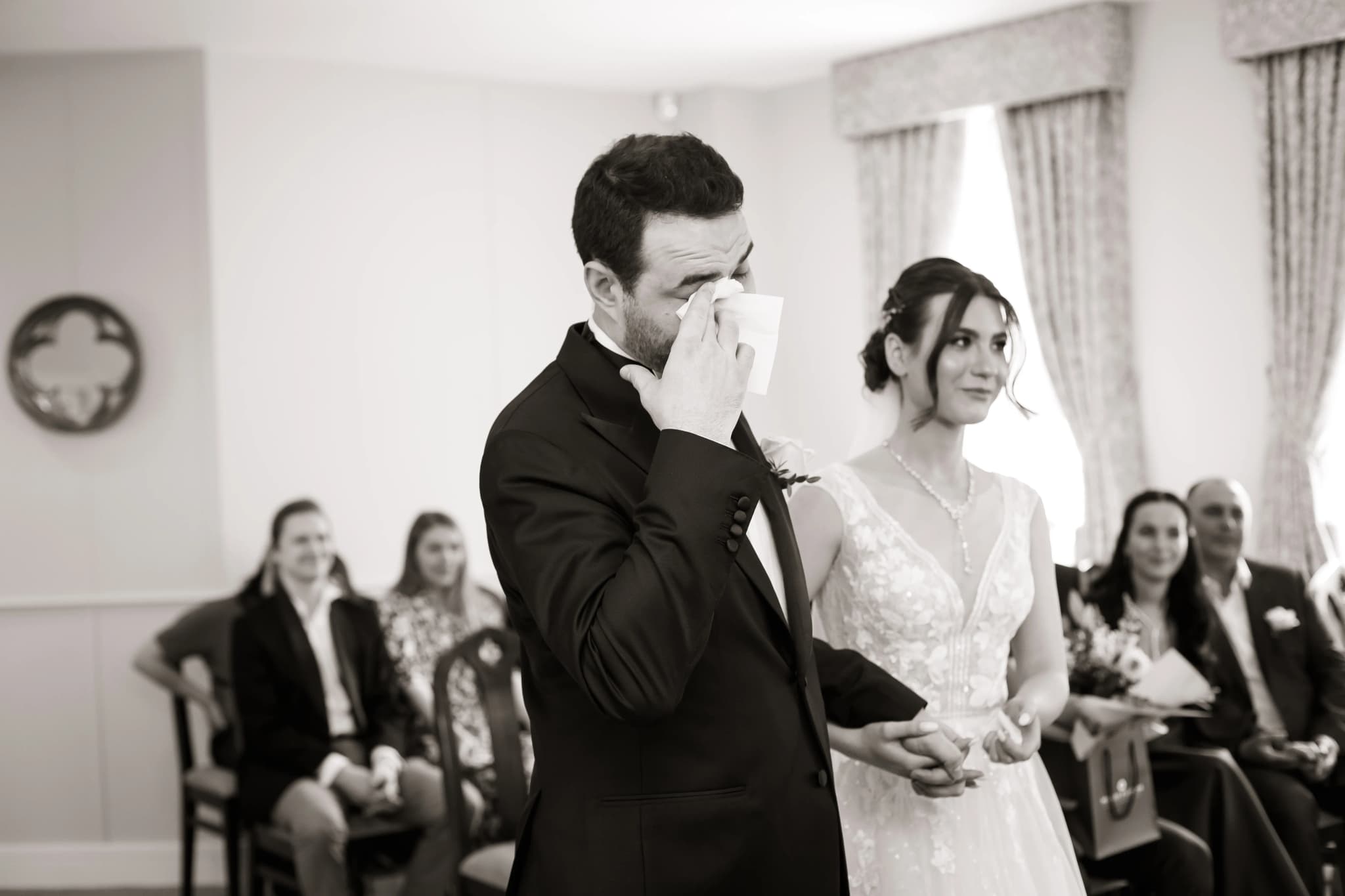
Wedding photographers frequently benefit from frequency separation because wedding environments create specific skin challenges: sunburn from outdoor ceremonies, uneven makeup application under stress, mixed lighting colour casts on skin, perspiration and shine, under-eye circles from early mornings and late nights, and the need to bring multiple subjects (bride, groom, bridesmaids, family) to a consistent, polished look across a large number of images. Frequency separation provides the fastest path to even skin tones across these diverse conditions because the low-frequency correction tool works the same regardless of the specific problem — blotchiness, colour casts, and tonal irregularities are all addressed with the same technique.
For wedding workflow efficiency, develop a system: perform your frequency separation setup action, spend 60–90 seconds smoothing the worst low-frequency colour issues on the most important portrait images (bride closeups, couple portraits, family formals), and save. This level of retouching is appropriate for the 50–100 hero images in a wedding gallery. For the remaining several hundred images, basic spot removal without frequency separation is usually sufficient. The time investment — 60–90 seconds per hero image — pays off enormously in perceived quality and client satisfaction, because smooth, even skin tones are one of the most immediately recognisable markers of professional retouching that clients respond to positively.
Professional Retouching for Your Most Important Photographs
As a professional photographer, I bring expert retouching skills — including frequency separation and detailed dodge-and-burn — to every portrait and wedding commission. Your images receive careful, natural skin retouching that preserves your character while presenting you at your absolute best. Every portrait from your session is individually polished by hand.