Noise Reduction in Photography: The Complete Guide to Luminance Noise, Colour Noise, AI Denoise, and Professional Noise Management
Noise in digital photography — the random variation in brightness and colour that appears as grain, speckle, or colour mottling — is an inherent property of every digital image, present in varying degrees depending on the sensor, the ISO setting, the exposure, and the ambient conditions. While noise is often considered a flaw to be eliminated, it is more accurately understood as a signal characteristic that must be managed: reduced where it degrades the image, preserved where it adds texture and life, and balanced against the competing demand for detail retention. Effective noise management is one of the most important technical skills in digital photography, directly impacting the usable quality of images captured in low light, the dynamic range available in post-processing, and the maximum printable size of any photograph.
The physics of noise are straightforward: digital sensor pixels detect photons of light, and the signal generated by each pixel is proportional to the number of photons it collected during the exposure. When light is abundant (bright scenes, low ISO, long exposures), each pixel collects many photons, and the signal greatly exceeds the inherent electronic noise of the sensor — the image is clean. When light is scarce (dark scenes, high ISO, short exposures), each pixel collects few photons, and the signal is closer to the noise floor of the sensor — the image is noisy. Raising the ISO amplifies the signal but also amplifies the noise equally, so the signal-to-noise ratio remains constant or worsens. The only way to genuinely improve the signal-to-noise ratio is to collect more photons: longer exposure time, wider aperture, brighter light, or a larger sensor (which has larger pixels that collect more photons per pixel).
Types of Noise: Luminance and Chrominance
Digital image noise comes in two distinct forms that behave differently and require different correction approaches. Luminance noise (also called brightness noise or luma noise) appears as random brightness variations — a grainy, speckled pattern that resembles traditional film grain. Luminance noise is monochromatic: it affects the brightness of individual pixels without changing their colour. In moderate amounts, luminance noise can actually be aesthetically pleasing, contributing a textured, organic quality reminiscent of film. This is why many photographers add grain overlays to noise-free digital images — they are deliberately adding luminance noise for aesthetic reasons.
Chrominance noise (colour noise or chroma noise) appears as random colour variations — blotches, speckles, or splotches of incorrect colour, typically in the blue-purple-green range, concentrated in the shadow areas of the image. Colour noise is universally regarded as unpleasant — it makes the image look technically flawed rather than organically textured. Colour noise is typically more pronounced than luminance noise because the colour channels (particularly the blue channel) are inherently noisier than the luminance signal. Fortunately, colour noise is much easier to remove in software than luminance noise because it can be identified and filtered based on its colour characteristics without significantly affecting the underlying luminance detail. This is why even high-ISO images from modern cameras often look acceptable: the in-camera JPEG processing applies aggressive colour noise reduction, and RAW processors apply colour noise reduction automatically or with minimal user intervention.
Noise Reduction in Lightroom Classic
Lightroom Classic's Detail panel provides dedicated noise reduction controls for both luminance and colour noise. The Luminance slider controls the intensity of luminance noise reduction: at 0, no luminance NR is applied; increasing the value progressively smooths the grain. The Detail sub-slider controls how aggressively the algorithm distinguishes between noise and fine detail — higher values preserve more detail but may leave some noise; lower values are more aggressive at removing noise but may soften fine detail. The Contrast sub-slider preserves or sacrifices local contrast variations — higher values preserve edge contrast but may leave noise around edges; lower values smooth more uniformly.
The Color slider controls colour noise reduction: at 25 (the default for RAW files), Lightroom applies moderate colour NR automatically. Increasing the value to 50–75 handles more aggressive colour noise from high ISO captures. The Detail and Smoothness sub-sliders fine-tune the colour NR — Detail controls the threshold for colour noise versus legitimate colour detail (higher values preserve more colour detail but may leave some colour mottling), and Smoothness controls the size of the colour blotches that are targeted (higher values smooth larger blotches). For most images, the default Color value of 25 is sufficient — only increase it if visible colour mottling remains after default processing. Luminance NR, on the other hand, defaults to 0 and must be manually increased when needed — Lightroom does not apply luminance noise reduction automatically because it always involves a trade-off with detail retention.
AI-Powered Denoise in Lightroom and Camera Raw
Adobe introduced AI-powered Denoise in Lightroom Classic and Camera Raw in 2023, representing a transformational advance in noise reduction quality. Unlike traditional noise reduction (which applies mathematical filters that inevitably soften detail along with noise), AI Denoise uses a deep-learning neural network trained on millions of image pairs to distinguish noise from detail with unprecedented accuracy. The algorithm produces results that genuinely look like the noise was never there — detail is preserved sharply while noise is removed cleanly, with no visible smoothing, softening, or artifact. At moderate ISO values (3200–12800), AI Denoise produces results that are, for the first time, virtually indistinguishable from a clean low-ISO capture.
To use AI Denoise, select an image in the Develop module and click the "Denoise" button in the Detail panel (or choose Photo > Enhance > Denoise). A preview dialog appears showing the AI-processed result alongside the original. An Amount slider (0–100) controls the intensity — values of 50–70 work well for most high-ISO images. Click "Enhance" to process the image. AI Denoise creates a new DNG file alongside the original, containing the denoised result. The processing is computationally intensive and may take 30–120 seconds per image depending on your hardware (GPU acceleration makes a significant difference).
The practical impact of AI Denoise is profound for low-light photographers. Images shot at ISO 6400 or ISO 12800 — previously considered marginally usable due to noise — now clean up to a quality level comparable to ISO 400-800 captures. This effectively extends the usable range of every camera by 2-4 stops, which is the equivalent of upgrading to a camera with a much larger, more expensive sensor. Wedding photographers who capture dimly lit receptions, event photographers working in dark venues, and photojournalists shooting in challenging conditions all benefit enormously. The only significant limitation is processing speed — AI Denoise is too slow to apply to thousands of images in a batch (though Adobe is improving speed with each update), so most photographers apply it selectively to their most important high-ISO images rather than batch-processing entire galleries.
Third-Party AI Denoise: Topaz DeNoise AI, DxO PureRAW, and ON1
Several third-party applications offer AI-powered noise reduction that can be used alongside or instead of Lightroom's built-in tools. Topaz DeNoise AI was among the first AI denoisers available to photographers and remains widely used. It operates as a standalone application or a Photoshop plugin, processing images through a trained neural network with adjustable strength and detail-preservation controls. DxO PureRAW processes camera RAW files through DxO's AI denoising and lens correction pipeline, producing a corrected DNG file that can then be imported into Lightroom for further editing. ON1 NoNoise AI offers similar functionality with additional masking capabilities.
The quality differences between these tools are increasingly narrow — all major AI denoisers produce excellent results on moderate-noise images (ISO 1600–6400), and the differences become more apparent at extreme ISO values (ISO 12800–51200) where the most challenging noise patterns test the limits of each algorithm. DxO PureRAW has a particular advantage for its simultaneous lens correction, which removes optical aberrations at the RAW level before denoising — producing a cleaner starting point for the AI to work with. Topaz DeNoise AI provides the most user-controllable parameters, which experienced users leverage to fine-tune results per image. For most photographers, Adobe's built-in AI Denoise provides sufficient quality without the cost and complexity of third-party tools, but serious low-light specialists may benefit from testing multiple options on their specific camera and ISO range to identify the best performer for their particular sensor.
Noise Reduction Strategy: When and How Much
The fundamental trade-off in noise reduction is noise versus detail: every increase in noise reduction intensity smooths noise but also softens fine detail to some degree (traditional NR) or risks introducing AI artifacts (AI NR). The optimal noise reduction strategy depends on the intended output: an image destined for large prints requires more aggressive noise reduction because noise becomes highly visible at large print sizes and close viewing distances. An image destined for web sharing (Instagram, blog, gallery) can tolerate significantly more noise because the small display size and viewing distance render noise nearly invisible. An image destined for social media squares (1080×1080 pixels) has so few pixels that noise is virtually invisible regardless of ISO.
The practical approach: view the image at the intended output size (or 50% screen size for typical web use) and evaluate whether the noise is visible and objectionable. If it is not visible at the output size, no noise reduction is needed — applying NR would only soften detail without any visible noise benefit. If noise is visible, apply progressive NR until the noise is no longer objectionable, then stop. Resist the temptation to zoom to 100% and eliminate every last pixel of noise — this leads to over-processing that looks smooth and clinical at 100% but may appear over-softened and lifeless at normal viewing sizes. Judge at output size, not at pixel-peeping magnification.
Noise Prevention During Capture
The most effective noise reduction is prevention — capturing images with the maximum signal-to-noise ratio possible. The primary strategies are: use the lowest ISO that achieves the desired shutter speed and aperture (obvious but important — many photographers use needlessly high ISOs when a wider aperture or slower shutter speed would produce a cleaner image with acceptable creative trade-offs). Expose to the right (ETTR): deliberately overexpose the image as much as possible without clipping important highlights, then adjust exposure downward in post-processing. ETTR works because the right side of the histogram (highlights) has much more signal data per stop than the left side (shadows) — by pushing the shadows into brighter territory during capture, you capture them with a higher signal-to-noise ratio.
Additional noise prevention strategies: use a camera with a large sensor — full-frame sensors have larger pixels that collect more photons per pixel than APS-C or Micro Four Thirds sensors at the same ISO, producing inherently cleaner images. Use faster lenses — a f/1.4 lens admits 2 stops more light than a f/2.8 lens, allowing you to use 2 stops lower ISO for the same shutter speed. In low-light situations, consider using on-camera or off-camera flash to add light to the subject rather than raising ISO — flash illuminates the subject with abundant photons, producing a clean subject signal even at moderate ISO. For long-exposure applications (landscape, astrophotography), longer exposure time collects more photons and produces a cleaner image than shorter exposure at higher ISO. Every stop of light you can add or recover during capture is worth more than any amount of post-processing noise reduction.
Noise Reduction for Specific Photography Genres
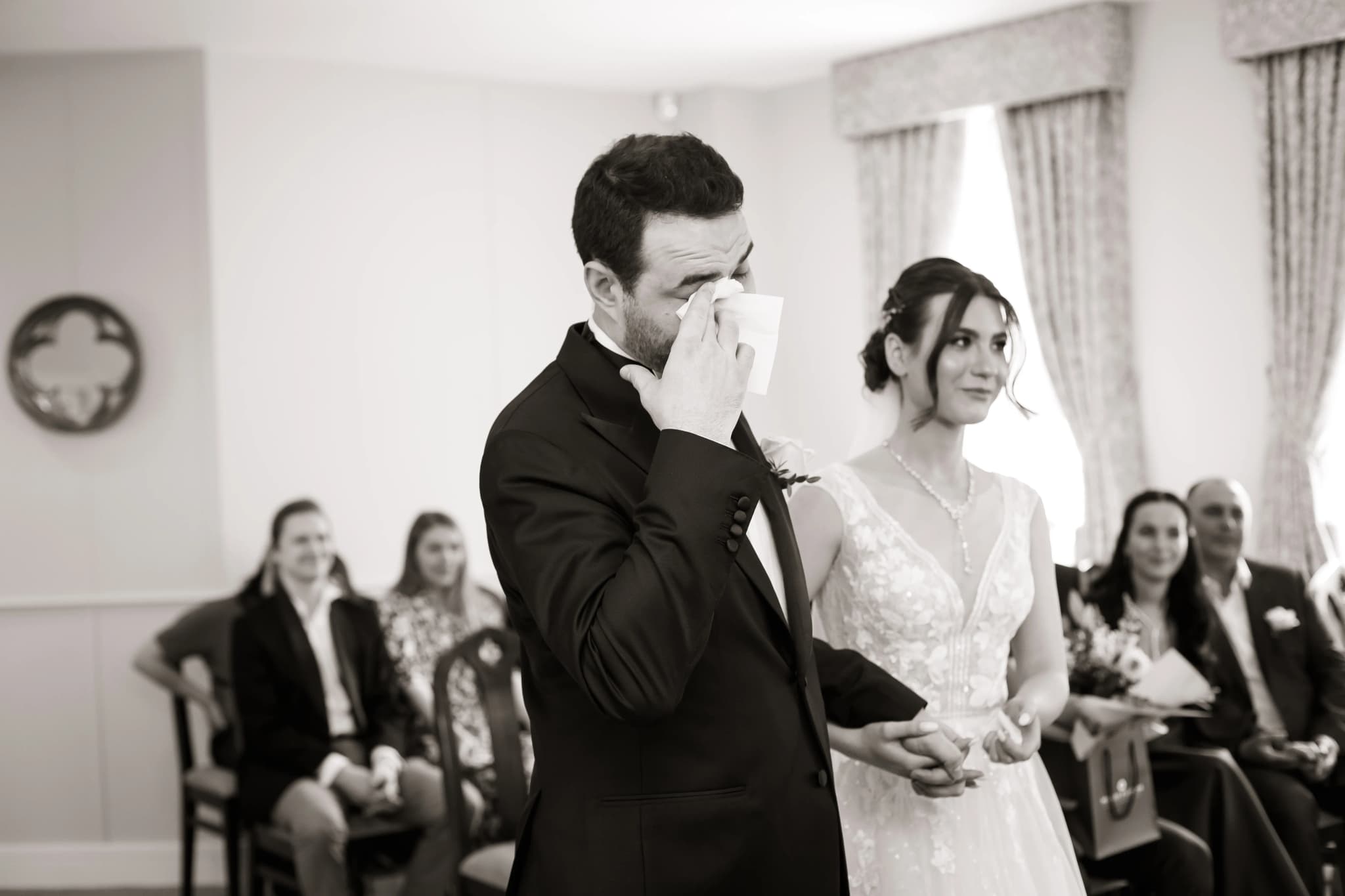
Different genres have different noise tolerance. Wedding photography regularly requires ISO 3200–12800 for ceremony and reception coverage in churches and dimly lit venues. Moderate noise in wedding images is generally acceptable because the emotional content of the images outweighs technical concerns — a slightly noisy first-dance image that captures a genuine moment is infinitely more valuable than a technically clean but emotionally sterile alternative. Apply moderate noise reduction (Luminance 30-50 in Lightroom) or AI Denoise at moderate intensity to clean high-ISO wedding images while preserving the atmosphere and texture of the scene.
Landscape photography typically uses ISO 100-400 on a tripod, so noise is minimal and noise reduction requirements are modest. The exception is astrophotography landscapes — Milky Way images captured at ISO 3200-6400 with 15-30 second exposures contain significant noise. For astro landscapes, AI Denoise is transformative: it cleanly removes noise from the foreground and sky while preserving the fine detail of stars and the Milky Way structure. Portrait and studio photography usually operates at low ISO with controlled lighting, requiring minimal noise reduction. Sports and action photography at high ISO (3200-12800 under arena lights) benefits significantly from AI Denoise applied selectively to the best frames, where the clean result is particularly striking compared to the noisy original.
Creative Noise: Adding Film Grain
While most noise reduction aims to remove unwanted noise, many photographers deliberately add simulated film grain to their digital images for aesthetic reasons. Film grain provides a textured, organic quality that makes digital images feel more analogue, more handmade, and more emotionally warm. Lightroom's Effects panel provides three grain controls: Amount (overall grain intensity), Size (grain particle size — larger sizes simulate faster film, smaller sizes simulate slower film), and Roughness (regularity of the grain pattern — lower values produce smoother, more uniform grain; higher values produce more irregular, film-like patterns). A subtle grain overlay (Amount 15-25, Size 20-30, Roughness 50-60) adds a film-like texture to digital portraits that masks any remaining noise and creates a cohesive, organic aesthetic.
The strategic use of grain can actually improve the perceived quality of noisy images by masking the noise with a more pleasant, uniform grain pattern. Instead of applying aggressive noise reduction (which softens detail) and then adding grain back (which adds texture without detail), apply moderate noise reduction to remove only the worst color noise and obvious blotchy noise, then overlay grain at an intensity that visually dominates the remaining luminance noise. The result is an image that appears intentionally grainy (aesthetic) rather than accidentally noisy (technical flaw). This grain-masking technique is widely used in wedding and editorial photography, where the grain contributes to the visual style while solving the practical noise problem simultaneously.
Crystal-Clear Photography in Any Light
I use the latest AI noise reduction technology and professional techniques to deliver clean, detailed images regardless of lighting conditions. From candlelit ceremonies to twilight portraits, your photographs are processed with expert noise management that preserves atmosphere while maintaining professional quality.
Book your photography session with expert low-light editing →