Output Sharpening for Print and Screen: The Complete Guide to Capture Sharpening, Creative Sharpening, Output Sharpening, Resolution Targets, and Delivering Crisp Photographs for Every Medium
Sharpening is one of the most misunderstood stages in the photographic workflow — and it is also one of the most critical. Every digital photograph requires sharpening at multiple points in the editing process, and the sharpening required for a print viewed at arm's length is fundamentally different from the sharpening required for a web image viewed on a retina display. Understanding the three-stage sharpening workflow — capture sharpening to recover detail softened by the sensor's anti-aliasing filter and lens diffraction, creative sharpening to enhance specific details within the image, and output sharpening to optimise the image for its final delivery medium — is the foundation of consistently sharp, professional-quality photographs that look their best whether displayed on a screen, printed on glossy paper, or reproduced in a magazine.
The core principle is that sharpening does not add detail — it enhances the perception of detail by increasing local contrast along edges. When a sharpening algorithm encounters an edge (a transition from dark to light), it makes the dark side slightly darker and the light side slightly brighter, creating a micro-contrast halo that the human visual system interprets as increased sharpness. The art of sharpening lies in applying enough enhancement to make edges crisp and details pop without creating visible halos, exaggerating noise, or producing that harsh, crunchy, over-sharpened look that immediately marks an image as amateur.
Stage One: Capture Sharpening
Capture sharpening (also called input sharpening) is applied during RAW processing to compensate for the inherent softness introduced by the camera's anti-aliasing (AA) filter, lens diffraction at smaller apertures, and the demosaicing process that converts the Bayer-pattern sensor data into a full-colour image. This sharpening is not creative — it is restorative, aiming to recover the actual optical detail captured by the lens and sensor without adding artificial enhancement. In Lightroom Classic, capture sharpening is controlled by the Detail panel: Amount (the strength of sharpening), Radius (the width of the edge halos — smaller for fine detail, larger for bold edges), Detail (how much fine texture is enhanced versus coarser edges), and Masking (which restricts sharpening to edges only, protecting smooth areas like skin and sky from noise amplification).
The recommended starting point for most images is Amount 40–60, Radius 1.0–1.2, Detail 25–35, Masking 50–80. Hold Alt/Option while dragging the Masking slider to see the mask — white areas receive sharpening, black areas are protected. For portraits, increase Masking to 70–90 to protect skin from sharpening (which exaggerates pores and texture); for landscapes and architecture, reduce Masking to 20–40 to sharpen fine foliage and texture detail. For Photoshop workflows, the equivalent is Camera Raw's sharpening controls (identical to Lightroom's) or a gentle Smart Sharpen or Unsharp Mask applied to the RAW-converted file at full resolution.
Stage Two: Creative Sharpening
Creative sharpening (also called local sharpening) is selective, targeted sharpening applied to specific areas of the image to draw the viewer's eye and enhance the perceived detail of key subjects. Unlike capture sharpening (which is applied globally and uniformly), creative sharpening is artistic — you decide which areas receive extra sharpness based on your creative vision. In a portrait, you might sharpen the eyes and eyelashes while leaving the skin smooth. In a landscape, you might sharpen the foreground rocks and distant peaks while leaving the sky unsharpened. In a product shot, you might sharpen the product texture while softening the background.
In Lightroom, creative sharpening is applied using local adjustment tools — the Adjustment Brush, Graduated Filter, or Radial Filter — with a positive Sharpness slider (+25 to +50). In Photoshop, the most precise method is high-pass sharpening on a separate layer: duplicate the layer, apply Filter > Other > High Pass (radius 1–3 pixels), set the layer blend mode to Overlay or Soft Light, and add a black layer mask. Then paint white on the mask over the areas you want sharpened — eyes, hair, jewellery, fabric texture — while leaving skin, sky, and smooth areas untouched. This gives you completely non-destructive, infinitely adjustable selective sharpening with a visual mask that shows exactly where the effect is applied.
Stage Three: Output Sharpening
Output sharpening is the final sharpening pass applied after the image has been resized to its output dimensions and resolution — and it is the stage most photographers skip or get wrong. Resizing an image (especially downsampling for web or social media) introduces new softness because the resampling algorithm must interpolate new pixel values from the original data, smoothing edges in the process. Output sharpening compensates for this resize-induced softness and optimises the image for the specific viewing conditions of its destination medium.
For screen/web output, the image is typically 72–96 PPI, viewed on a monitor at approximately 2–3 feet distance, and displayed on a luminous screen where edges appear naturally sharp due to the high contrast of transmitted light. Output sharpening for screen should be moderate: Unsharp Mask with Amount 50–80%, Radius 0.3–0.5 pixels, Threshold 0. The small radius is critical — web images are viewed at 100% pixel size, so large-radius halos are clearly visible. For print output, the image is typically 240–360 PPI, printed with ink on paper that absorbs and scatters light (reducing apparent sharpness), and viewed under reflected light at varying distances. Output sharpening for print should be stronger: Amount 80–120%, Radius 0.8–1.2 pixels, Threshold 0–1. Matte papers absorb more ink and scatter more light than glossy papers, requiring slightly stronger sharpening (+10–15% Amount) for the same perceived result.
Lightroom Export Sharpening
Lightroom Classic's Export dialog includes built-in output sharpening that automatically applies the correct amount of sharpening for the selected output medium. In the Export dialog, under "Output Sharpening," you can select "Sharpen For: Screen" or "Sharpen For: Matte Paper" or "Sharpen For: Glossy Paper" with strength Low, Standard, or High. This system was developed by the late Bruce Fraser and refined by Jeff Schewe — both legendary figures in digital imaging — and it is remarkably effective for most photographic output. Standard strength for the appropriate medium is the correct choice for the vast majority of images; increase to High only for images with extremely fine detail (architecture, textiles, macro subjects) or when printing on heavily textured fine-art papers that absorb significant ink.
The Lightroom output sharpening algorithm considers the output resolution, the image dimensions, and the selected medium when calculating the sharpening parameters — it is not a simple Unsharp Mask. It applies a sophisticated multi-pass sharpening that enhances edges at appropriate scales for the viewing conditions. For photographers who prefer manual control, the alternative is to export without output sharpening and apply it manually in Photoshop using Unsharp Mask or Smart Sharpen on the resized, export-ready file. This provides pixel-level control but requires understanding the correct parameters for each output medium and size combination.
Resolution Targets for Different Output Media
Understanding resolution targets is essential for output sharpening because sharpening parameters depend on the PPI of the output file. For inkjet prints: 240 PPI is sufficient for most printers; 300 PPI provides slightly finer detail on high-resolution printers but the difference is minimal; 360 PPI matches the native resolution of many Epson printers and is optimal for the highest quality. For lab prints (silver halide, dye sublimation): 300 PPI is the standard; some labs accept 150–200 PPI but interpolate internally. For screen display: the physical PPI is irrelevant (browsers and operating systems display images based on pixel dimensions, not PPI metadata); what matters is the pixel dimensions of the image. For social media: Instagram optimally accepts 1080 pixels on the longest side; Facebook 2048 pixels; web portfolios 1600–2400 pixels depending on layout width.
Resize your image to the target pixel dimensions before applying output sharpening — never sharpen at full resolution and then resize, as the resize will undo part of the sharpening and potentially create moiré artifacts where the sharpening halos interact with the resampling algorithm. The correct workflow is always: (1) complete all editing including capture sharpening and creative sharpening at full resolution, (2) resize to the output dimensions and resolution, (3) apply output sharpening at the final size. This ensures the sharpening is optimised for the actual viewing size and medium.
Common Sharpening Mistakes and How to Avoid Them
Over-sharpening is the most common mistake, producing visible bright halos along edges (especially along the boundary between a dark building and a bright sky), exaggerated noise in shadow areas, and a harsh, crunchy texture on skin and organic surfaces. If you can see the sharpening as a visible effect rather than simply perceiving the image as sharp, you have applied too much. The second most common mistake is sharpening JPEG artifacts — applying heavy sharpening to a JPEG file that already contains compression artifacts amplifies those artifacts, creating blocky, stepped edges that look worse than the original. Always sharpen from RAW or high-quality TIFF sources, never from heavily compressed JPEGs.
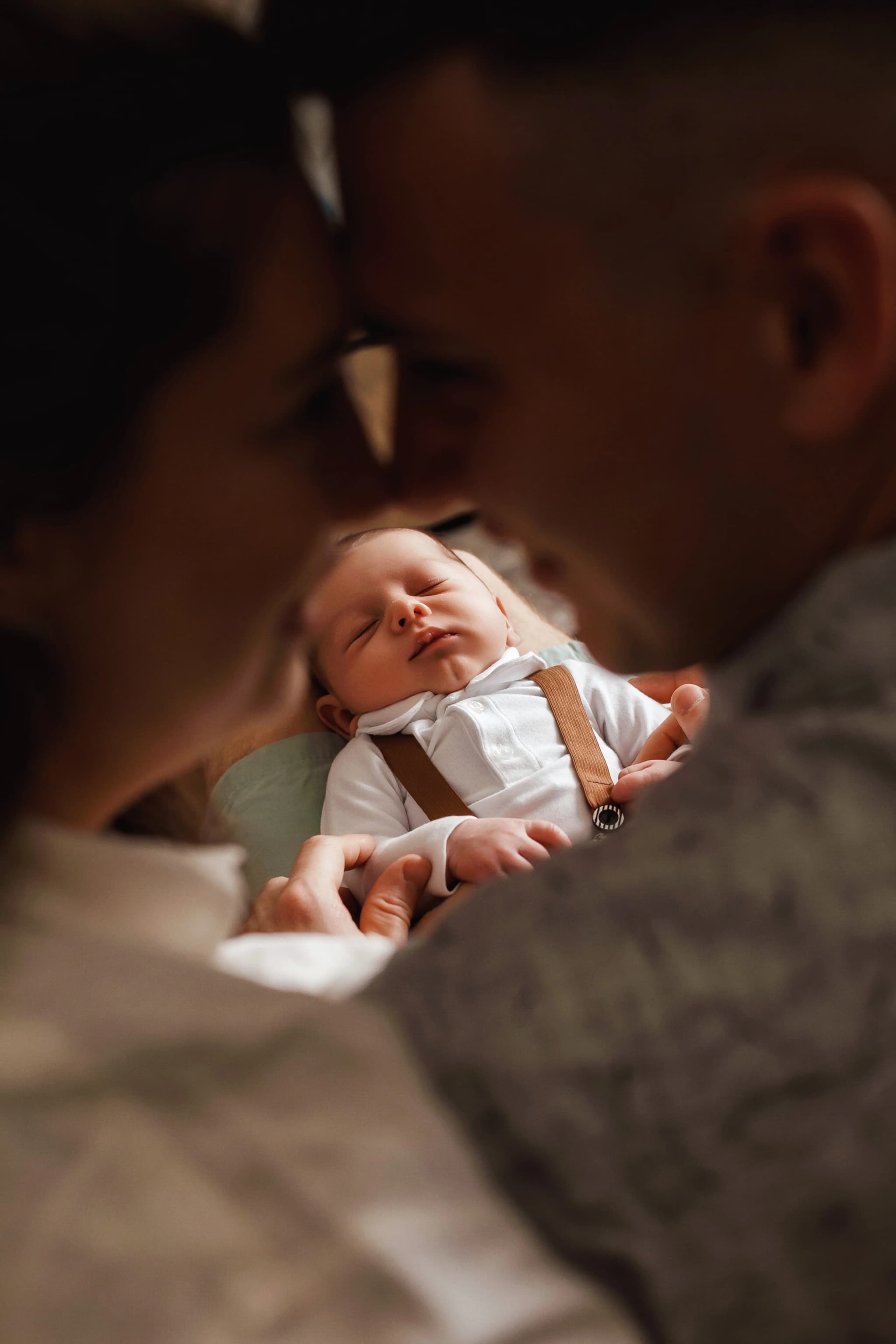
The third mistake is using a single sharpening setting for all images and all outputs. A portrait of a newborn baby requires completely different sharpening than an architectural photograph of a cathedral, and a web-sized Instagram post requires different output sharpening than a 20×30-inch gallery print. Build sharpening presets for your common workflows — one for web portraits (gentle capture sharpening, no creative sharpening, light screen output sharpening), one for web landscapes (moderate capture sharpening, selective creative sharpening on foreground detail, moderate screen output sharpening), one for print portraits (gentle capture sharpening, eye sharpening only, standard matte or glossy output sharpening), and so on. This ensures consistency while respecting the different demands of each output medium.
Tack-Sharp Prints from Every Session
Every photograph I deliver is professionally sharpened for its destination — whether that is a gallery-quality print on archival paper or a pixel-perfect web image for your online portfolio. The result is photographs that look their absolute sharpest in every context.
Book your session and receive expertly finished photographs →