Your wedding stationery — invitations, save-the-dates, order of service, menus, place cards, table numbers, and thank-you cards — represents some of the earliest creative decisions you made for your wedding. It sets the design language for the entire day. Flat lay photography is the technique used to photograph these items from directly above, arranged artfully on a styled surface. When done well, flat lay stationery images are editorial, magazine-worthy, and tell the design story of your wedding in a single frame. This guide covers how flat lay photography works, what items to include, how to style and light them, and what couples can do to prepare.
What Is Flat Lay Photography?
Flat lay is a top-down photography technique where objects are arranged on a flat surface and photographed from directly above. In wedding photography, flat lays typically feature stationery items alongside complementary props — rings, flowers, ribbons, perfume, vow books, and other personal details. The resulting image is clean, graphic, and Instagram-ready.
The technique is borrowed from editorial and commercial photography — think magazine product layouts and lifestyle brand imagery. In weddings, it serves a dual purpose: documenting the stationery design and creating a styled "hero" image that encapsulates the day's aesthetic.
What to Include in a Wedding Stationery Flat Lay
Core Stationery Items
- Invitation suite: the invitation itself, RSVP card, information card, and envelope. If your invitation has multiple inserts, arrange them in a cascading layout so each is partially visible.
- Save-the-date: if the design coordinates with the invitation, include it.
- Order of service/ceremony programme: shows the ceremony structure and readings.
- Menu card: the reception menu — especially if it has custom calligraphy or design that matches the suite.
- Place card or escort card: one example card, ideally with the couple's names or the top table designations.
- Table number or table name card: shows the numbering/naming system you've chosen.
- Thank-you card: if available on the day.
- Vow books or vow cards: if you've written personal vows, these are deeply personal and meaningful items for the flat lay.
Complementary Props
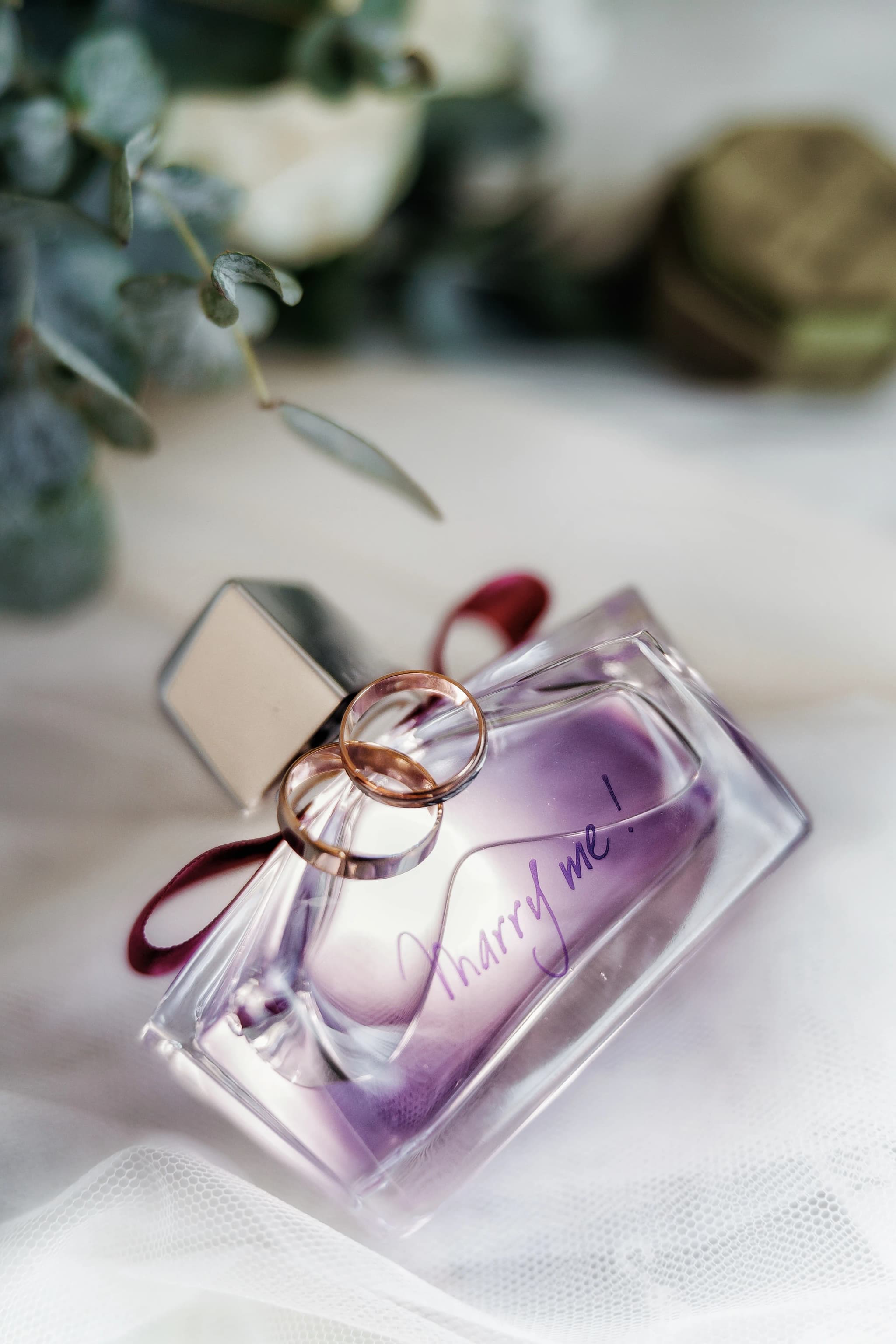
- Wedding rings: often placed on or near the invitation. They anchor the composition and add sparkle.
- Fresh flowers or loose stems: pulled from the bridal bouquet or a centrepiece — they add colour, organic shape, and softness to the geometric lines of the stationery.
- Ribbon or silk fabric: draped loosely across the surface, adding texture and movement.
- Perfume bottle: the bride's perfume is a classic flat lay element — elegant glass, a recognisable design, and personal significance.
- Jewellery: earrings, a necklace, a bracelet — small metallic accents that catch light.
- Wax seal or stamp: if your invitations featured a wax seal, include the stamp or an extra sealed envelope.
- Calligraphy pen: if hand calligraphy was used, the pen adds an artisanal, craft-focused element.
Styling the Flat Lay
Surface Selection
The surface is the background of your entire composition. It should complement — not compete with — the stationery design:
- Linen or silk fabric: soft, textured, and romantically wrinkled. Cream, ivory, or sage green are classic choices.
- Marble slab or tile: clean, modern, luxurious. Works well with minimalist stationery designs.
- Wooden surface: warm, rustic. Suits kraft paper, botanical, or outdoor wedding stationery.
- Vintage tray or book: adds depth and character. Particularly effective for period-inspired designs.
- Simple card stock: a plain sheet of textured card stock in a complementary colour creates a clean, undistracting background.
Arrangement Principles
- Central anchor: place the main invitation in the centre or slightly off-centre. Everything else radiates outward from this focal point.
- Layering: overlap items slightly — an RSVP card peeking from behind the invitation, a ribbon draped across a corner, flowers extending beyond the frame edge.
- Negative space: don't fill every inch. Breathing room between elements makes the composition feel intentional and editorial, not cluttered.
- Odd numbers: groups of 3 or 5 items feel more balanced than 2 or 4. This is a fundamental principle of visual composition.
- Diagonal lines: angling items slightly — a pen at 30 degrees, a ribbon trailing diagonally — adds dynamism to an otherwise flat composition.
- Edge bleeding: allow some elements (flowers, ribbon, fabric) to extend off the edge of the frame. This makes the image feel organic rather than contained.
Lighting
Flat lays demand soft, even lighting. Hard shadows from direct sunlight or overhead lights create distracting diagonal shadows across the stationery.
- Best source: a large window with sheer curtains or diffused daylight. Position your surface near the window so light falls evenly across the entire arrangement.
- Avoid direct sunlight: harsh sunlight creates blown-out hot spots and crisp shadows that distract from the typography and design.
- Overcast days: paradoxically ideal for flat lays. The clouds act as a giant diffuser, producing soft, even light with minimal shadows.
- Reflector/white card: if the window light creates shadows on one side of the arrangement, place a white card opposite the window to bounce light back and fill the shadows.
Camera Settings
- Aperture: f/4.0 to f/5.6 for flat lays — you need everything in the frame to be sharp since all items are at roughly the same distance from the camera. Wider apertures (f/1.4–f/2.0) will blur items at the edges.
- Focal length: 35mm to 50mm. Wider lenses can introduce perspective distortion; longer lenses require more distance from the surface.
- Shooting position: directly overhead, with the camera sensor parallel to the surface. Even a slight tilt will create a skewed perspective. Some photographers use a tripod with a horizontal arm to ensure perfect vertical alignment.
- White balance: set to match the dominant light source. For window light, daylight or auto works well. Shoot in RAW for post-processing flexibility.
Tips for Couples
- Bring a spare set of stationery. If your invitations were sent out months ago, set aside one complete suite for photography. The photographer can't photograph what doesn't exist on the day.
- Include the envelope. Envelopes with calligraphy, liner patterns, or wax seals are beautiful photography subjects. Save one pristine, unaddressed envelope.
- Keep items flat. Transport stationery in a rigid folder or box so nothing is bent, creased, or wrinkled.
- Coordinate with your photographer in advance. If flat lay photography is important to you, tell your photographer before the day. They'll plan time for it during preparations and bring appropriate surfaces and props if necessary.
- Gather small personal items. Rings, perfume, cufflinks, a watch, a sentimental necklace — gather these in one place. The photographer can select complementary items for the flat lay composition without searching through bags and drawers.
Flat lay and detail photography included in every wedding and event package.
Stationery, rings, florals, and personal items styled and photographed with editorial precision. View detail photography examples.