Yana Skakun
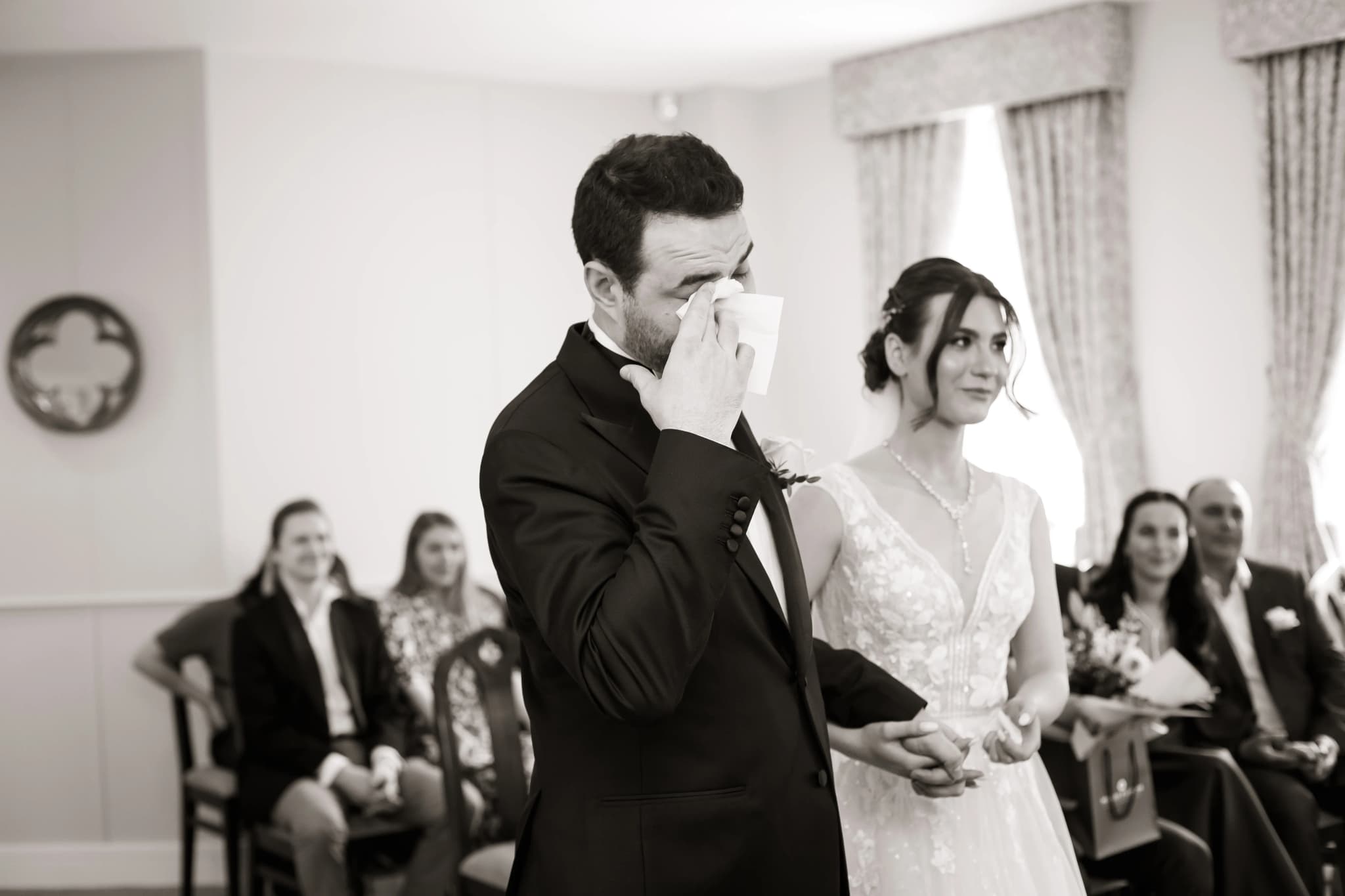
City of London Wedding Photography
City Wedding Photographer London
Banking halls, medieval guildhalls, Lutyens interiors and the empty Saturday streets of the Square Mile — wedding photography in the City of London.
The Square Mile on a Saturday
The City of London on a weekday is the financial engine of Europe — 500,000 people in a single square mile, the density of purpose and the particular energy of global finance concentrated in the ancient boundaries of the Roman and medieval city. On a Saturday it is something else entirely: the same streets, the same extraordinary architecture, the same two-thousand-year layering of history — and almost nobody in it.
Wedding photography in the City at weekends uses this emptiness as a resource. The middle of Threadneedle Street, the steps of the Royal Exchange, the approach to Guildhall along Gresham Street — all of these are accessible in ways that would be physically impossible during the working week. The architecture remains, the light falls exactly as it does on Monday morning, but the crowd is gone.
Combined with the extraordinary interiors of The Ned, the medieval gravity of Guildhall and the views from The Gherkin, the City of London provides wedding photography settings of genuinely world-class architectural grandeur.
City of London Wedding Venues & Settings
Banking halls, medieval guildhalls, Wren churches and the modern towers of the Square Mile.
The Ned
Poultry, EC2 — Lutyens banking hall
Edwin Lutyens' 1924 Midland Bank headquarters — the great banking hall with its corinthian columns, coffered gilt ceiling and original marble counter fit-out is among the grandest interior spaces available for a London wedding. The Ned's conversion has preserved virtually every inch of Lutyens' original design while adding the intimate warmth of a members' club. Wedding photography in the main banking hall operates in a space of genuine architectural magnificence.
Guildhall
Gresham Street, EC2 — medieval livery hall
The medieval heart of the City of London — the Great Hall dates from 1411 and survived both the Great Fire of 1666 and the Blitz relatively intact. Guildhall's Great Hall is one of the three largest medieval guildhall spaces surviving in England, with the coloured glass roundels of the City guilds illuminating the windows. The combination of genuinely medieval stonework, livery hall ceremonial character and City financial district location is unique.
Searcys at The Gherkin
30 St Mary Axe, EC3 — Foster & Partners
The private dining and event space at the top of Norman Foster's 2003 Swiss Re tower — one of London's most architecturally celebrated buildings. Wedding photography at the Gherkin operates at the apex of the building with panoramic views of the City, Canary Wharf, the Thames and the London skyline. The specific character of photography at 180 metres with a curved glass wall and the City spread below is singular.
The Counting House
Cornhill, EC3 — former bank
A Grade II listed former bank on Cornhill — the original Victorian banking hall interior with its glass dome, marble floors and ornate stonework preserved within a current bar and events space. The Counting House's domed ceiling and the quality of diffused daylight entering through the central dome provide one of the most distinctive interior available-light photography settings in the City.
Wren City Churches
Across the City of London
The 23 surviving Christopher Wren churches within the Square Mile — St Bride's Fleet Street, St Mary-le-Bow, St Stephen Walbrook, St Lawrence Jewry — each represent a distinct piece of late-17th-century architecture rebuilt after the Great Fire. Several host civil wedding ceremonies. Photography within Wren church interiors combines historic religious architecture with the specific quality of Wren's controlled domed light.
Smithfield & Barbican Area
EC1/EC2 — Victorian market and Brutalist arts complex
The Victorian iron and tile of West Smithfield market, the extraordinary Brutalist residential and arts complex of the Barbican Estate, and the medieval priory church of St Bartholomew-the-Great — all within a few hundred metres of each other in EC1/EC2. This concentration of architectural genres from Gothic to Victorian to 1960s Brutalism provides an unmatched range of exterior portrait settings within walking distance.
City of London Wedding Photography Packages
No travel charge within London. Weekend City street access included.
Essential
£1,395
- 6 hours coverage
- 300+ edited images
- Online gallery
- Personal licence
Most Popular
Full Day
£2,395
- 10 hours coverage
- 500+ edited images
- Online gallery
- Engagement session
Premium
£3,495
- 12 hours coverage
- 700+ edited images
- Fine art album
- Pre-wedding venue visit
Why City of London Photography Is Exceptional
The Square Mile's Architectural Layers
The City of London compresses 2,000 years of architectural history into one square mile — Roman walls and amphitheatre, medieval churches and guildhalls, Georgian trading halls, Victorian banking palaces, Edwardian insurance houses, post-war reconstruction, and the glass towers of financial modernity. Wedding photography in the City uses these architectural layers as a palimpsest: old stone in the foreground, modern towers visible behind, all of it expressing the accumulated history of England's financial capital.
The Empty City at Weekends
The City of London's 500,000 weekday working population contracts to approximately 10,000 residents at weekends. A Saturday City wedding — The Ned, Guildhall, The Gherkin — takes place in a neighbourhood that is functionally empty of the crowds that define it during the week. The broad streets, the unobstructed views toward landmarks, the freedom to photograph at pavement level without managing crowds: this is a specifically City weekend quality unavailable on weekdays.
Banking Hall Grand Interiors
The great banking halls of the City — The Ned's Lutyens hall, The Counting House's domed Victorian interior, the Natwest Tower's former banking hall — represent a specific typology of interior grandeur: vast, marble-finished, column-lined spaces built to communicate institutional permanence and financial gravitas. Wedding photography in these spaces requires an approach to large interior space that is different from domestic photography — wider lenses, a feel for how architecture frames and scales the human subjects within it.
The Thames and City Bridges
Tower Bridge, London Bridge, Millennium Bridge — all within a few minutes of City venues. The Thames riverfront between London Bridge and Tower Bridge provides exterior portrait settings with some of London's most celebrated architectural views: Tower Bridge framed from the south bank, The Shard and the City skyline reflected in the Thames at golden hour, the medieval Tower of London from across the river.
Wren Church Light Quality
Christopher Wren's City churches are exercises in the management of natural light — the domed lanterns, the clear (not stained) glass that Wren favoured, the white-painted plaster that reflects and bounces that light throughout the interior. Available-light photography in a Wren church produces a quality of daylight that is both plentiful and architecturally controlled in a way that Gothic stained-glass churches cannot replicate.
No Travel Charge Within London
All City of London venues are covered without travel supplement. The entire range of City photographic settings — from The Ned to The Gherkin to Smithfield — is within a 20-minute walk of each other, making a varied exterior portrait session walking to multiple City locations entirely practical within a full wedding day.
Frequently Asked Questions
What does photography at The Ned's banking hall look like?
The main banking hall at The Ned is approximately 100 metres long and 20 metres wide with original Corinthian columns running its full length. The ceiling height and the scale of the space means portrait photographs show the architectural grandeur as contextual backdrop rather than filling the frame. The light enters from high-level windows along both sides of the hall; the specific quality of Lutyens' proportioned banking light — directional, architectural, morning-quality — means the hall is best photographed before noon or in the soft interior lamp light of evening. The marble floors, the original bronze counter fittings and the gilt of the coffered ceiling all contribute to a colour palette that is warm, weighty and specifically 1920s institutional gold.
Can couples take portraits outside on City streets during a wedding?
Yes — and weekend City streets are ideal for this. On Saturday afternoons the great financial streets of the City (Threadneedle Street, Lombard Street, Gresham Street) are essentially empty of pedestrians and traffic. This allows portrait sessions in the middle of streets that would be completely inaccessible during the working week — the columns of the Royal Exchange, the steps of the Bank of England, the pedestrian approach to St Paul's along Queen Victoria Street — all available as portrait backdrops specific to the City.
Is Tower Bridge viable as a photography location for City weddings?
Absolutely — and it is best used as a defined portrait session location rather than walked past en route. The south bank approach to Tower Bridge from Potters Fields provides the clean view of the bridge with the City towers behind. The north bank east of the bridge at Shad Thames (Butler's Wharf) provides the Victorian warehouse character with Tower Bridge in the background. A 20-minute portrait session at Tower Bridge, incorporated into the couple photography time between ceremony and reception, is straightforward from any City venue.
How does The Guildhall compare to The Ned for wedding photography?
Very differently. The Ned is grand, warm and Edwardian — the most luxuriously appointed interior banking photography setting in London, with a contemporary luxury hotel overlay. The Guildhall's Great Hall is austere, medieval, genuinely ancient — stone, coloured glass, the accumulated atmosphere of 600 years of City government and ceremonial. The Ned produces warm gold-toned interior documentary imagery; the Guildhall produces more dramatically lit, more historically weighted interior photography. Both are exceptional in their own right.
What is the best time of year for outdoor City photography at golden hour?
June — the longest days give a golden hour at approximately 9pm, when the City's empty Saturday evening streets can be used for late-light portrait sessions just before the evening reception dances. The low summer sun at 9pm in east-facing streets (Cornhill, Lombard Street) produces a warm raking light across the Victorian stone façades specific to this time of year. October is also exceptional — the golden light is at 6pm (more integrated into reception timing) and the low sun angle across the City produces a dramatic quality unavailable in summer.
Getting Married in the City?
Whether The Ned, Guildhall, The Gherkin or another City venue — get in touch to discuss wedding photography in the Square Mile.
Get in Touch
Let's Create Together
Tell me about your vision and I'll be in touch within 24 hours.