Yana Skakun
Small Ceremony & Intimate Wedding Photography
Intimate Wedding Photographer UK
Deeply personal documentary coverage for small weddings and intimate ceremonies — 10 to 50 guests, register offices to country houses, elopements to home celebrations.
Small Wedding, Deep Coverage
An intimate wedding is a deliberate choice — to prioritise depth over breadth, the people who genuinely matter over the formal requirements of a large guest list, the quality of the experience over the scale of the production. Photography for an intimate wedding should reflect those priorities: deeply personal coverage of each person present rather than the wide documentary sweep required by a 200-person event.
The gallery from an intimate wedding contains more genuine emotional content per image than a large wedding gallery — because with 25 guests rather than 180, the photographer's full attention can be given to each relationship, each conversation, each genuine moment at the table. The result is a set of images that tells a more specifically personal story.
Register office to country house, home ceremony to outdoor elopement — intimate wedding photography across the UK, from 2 to 50 guests.
Intimate Wedding Settings
Every format, every scale — the intimate wedding photography approach adapts to any setting.
Register Office Ceremonies
Civil ceremony, local register office
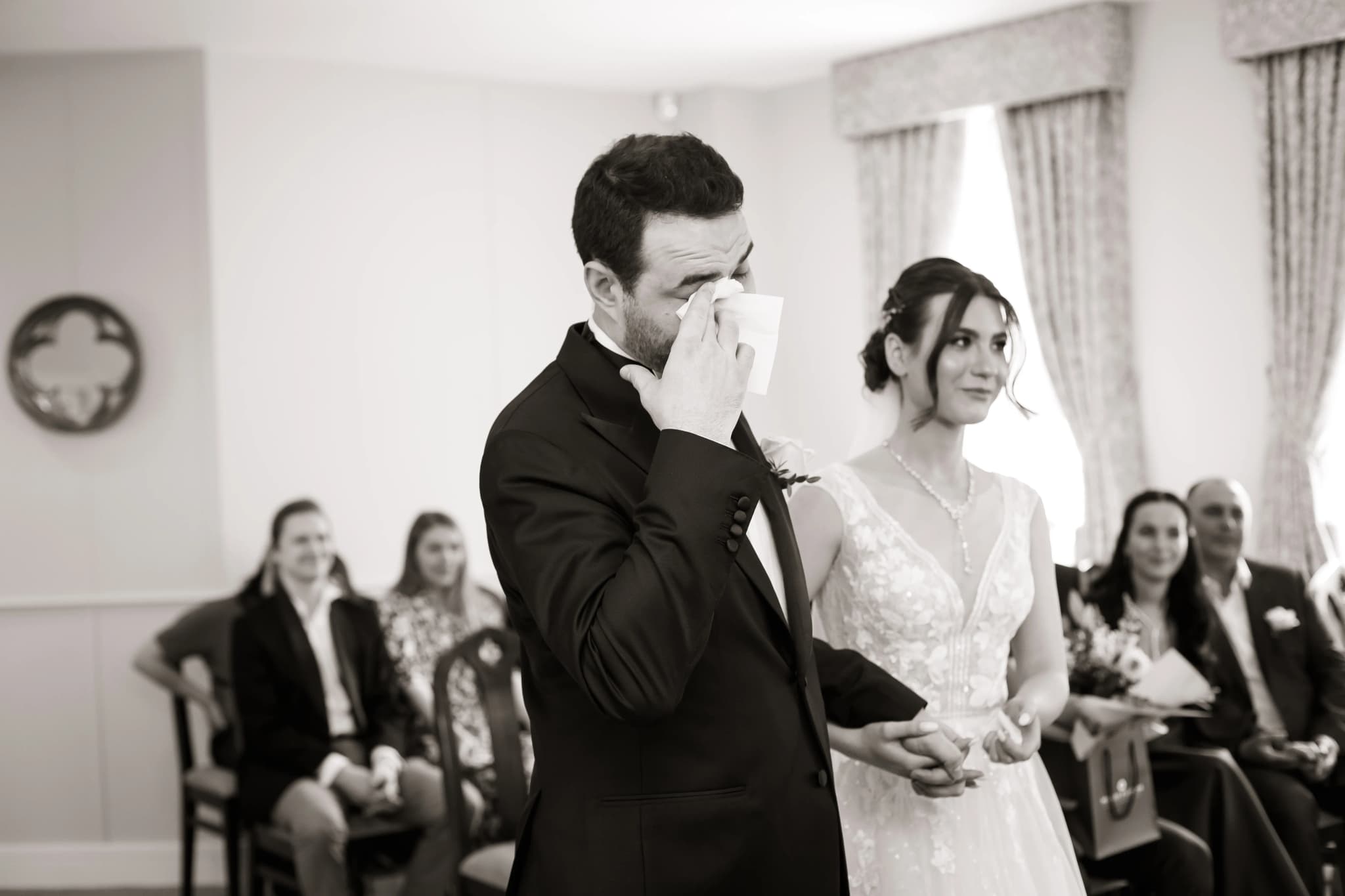
A register office ceremony — ten minutes of legal significance, the moment of formal commitment in the most stripped-back setting — is one of the most emotionally concentrated wedding photography settings. There is no ceremony length to fill, no processional or recession to choreograph, no programme to follow: just the specific moment of the vow exchange and the reactions of the small group of people closest to the couple. The photography is focused precisely because the event is.
Home Wedding Ceremonies
Private house, garden or flat
A wedding ceremony at home — in the living room of a family home, the garden of a rented house, the flat where the couple actually lives — provides the richest possible photographic context: the objects and spaces of real life, the family photographs on the mantelpiece, the garden that someone has actually gardened, the kitchen where the catering is happening. Home wedding photography captures a specific texture of real life that no venue, however beautiful, can replicate.
Restaurant and Private Dining
Gathering of 20–40 around a shared table
A restaurant or private dining room wedding — a gathering of 20–40 people specifically chosen for their closeness to the couple — provides an intimate photography environment of extraordinary warmth. The table, the food, the conversation and the celebration are all happening at the same scale as a family gathering rather than a public event, and the photography captures that intimacy with a depth of individual coverage that larger weddings cannot achieve.
Country House Small Hire
Whole-house hire for a small gathering
A country house hired for 20–30 guests for a weekend produces an intimate wedding of quite different character from the same house hosting 200 for a formal reception. The guests have the run of the whole property — the morning in the kitchen, the afternoon by the pool or in the garden, the evening dinner by candlelight. The photography follows the natural flow of a weekend gathering rather than a choreographed event programme.
Outdoor Ceremonies — Woodland, Fell, Beach
Licensed or informal outdoor commitment
A small outdoor ceremony — in an ancient woodland clearing, on a fell above a valley, by a specific beach at a specific time — is photographically among the most beautiful and most genuine wedding formats available. The chosen natural setting is part of the declaration: this place that means something to us, with the people who matter most. The photography captures the landscape and the people within it as a single composition rather than venue and guests as separate elements.
Elopement and Two-Witness Ceremonies
Just the two of you (+ witnesses)
A two-witness ceremony — two people, a registrar, two witnesses, a photographer — is both the most legally minimal and potentially the most emotionally intense wedding photography setting. Without the social management required by a larger gathering, the couple is entirely focused on each other, and the photographer is entirely focused on documenting that focus. Elopement photography in the UK can be conducted on any day, at any licensed venue or civil ceremony space, anywhere in the country.
Intimate Wedding Photography Packages
From elopements to celebrations of 50 — coverage scaled to your day.
Essential
£1,395
- 6 hours coverage
- 300+ edited images
- Online gallery
- Personal licence
Most Popular
Full Day
£2,395
- 10 hours coverage
- 500+ edited images
- Extended portrait time
- Online gallery
Premium
£3,495
- 12 hours coverage
- 700+ edited images
- Fine art album
- Multiple location option
Why Intimate Weddings Photograph Differently
Deeper Individual Coverage
With 30 guests rather than 180, the photography naturally goes deeper with each individual — genuine portraits of every guest at the table rather than the wide sweep that covers the crowd; real conversations photographed rather than a glimpse of each group. The gallery from an intimate wedding contains more genuine intimacy per image than a large wedding gallery, because the photographer's attention can be given to each person and interaction rather than distributed across a ballroom.
The Couple as Focus
Large weddings necessarily divide the photographer's attention between the couple, the guests, the venue, the programme. An intimate wedding restores the couple to their rightful central position: the photography follows them through their day rather than tracking a choreographed event. The portraits are more extensive, the documentary coverage is more personally focused, and the gallery tells a more specifically personal story.
Natural Pace, Natural Moments
Intimate weddings run at a human pace rather than an event programme pace — there is no requirement to move 180 guests from ceremony to drinks to dinner on schedule, which means the day flows naturally and the photographer moves with it. Unexpected moments — a spontaneous toast, a walk in the garden, an hour by the fire — are photographed as they occur rather than navigated around a rigid timetable. The gallery from an intimate wedding reflects the genuine texture of a day that happened rather than a day that was managed.
More Time for Landscape Portraits
Intimate weddings typically have significantly more flexibility for couple portrait time — without the requirements of seating 180 guests for dinner at a specific time, a 30-minute portrait session can extend to an hour if the light is beautiful, or relocate to a discovered landscape opportunity. This flexibility produces portrait sessions of genuine depth: more images, more locations, more of the light at the best time.
Budget Conscious Without Compromise
An intimate wedding is often a conscious choice to spend the wedding budget on quality rather than quantity — fewer guests but better food, a more beautiful location, vendors chosen for their excellence rather than their capacity to serve 200. Photography for an intimate wedding should match this philosophy: high quality, deeply personalised coverage rather than the volume photography required by larger events. The investment in photography per guest is higher, but the photography is proportionally more meaningful.
Works With Any Format
Intimate wedding photography applies regardless of the legal format — a register office followed by a restaurant dinner, a licensed outdoor ceremony followed by a house party, a church ceremony with a small congregated guest list, an elopement followed by a long weekend away: the intimate photography approach adapts to any format where the defining characteristic is the close, personal scale of the gathering rather than the institutional scale of a large-format wedding event.
Frequently Asked Questions
What is the minimum guest count for an intimate wedding?
The legal minimum for a marriage ceremony in England and Wales is two witnesses in addition to the couple and the registrar — so a wedding can be as small as 5 people total. Photographically, the intimate wedding approach works best with 5–50 guests: enough people for genuine social energy and documentary richness, few enough for deep individual coverage. Above 50 guests, the photography naturally moves toward the wider-coverage documentary approach of larger weddings, though the transition is gradual rather than abrupt.
How many hours do I need for an intimate wedding?
A 6-hour Essential coverage typically handles an intimate wedding comfortably — a register office ceremony in the morning, a restaurant lunch or afternoon gathering, and an early evening with the closest friends and family. For home weddings or those with more extended celebrations, 8–10 hours provides comfortable coverage of the full arc without the couple feeling photographically watched all day. The coverage is structured around what is actually happening rather than a predetermined schedule.
Can I have intimate wedding photography at a register office?
Yes — register office ceremonies are one of the core settings for intimate wedding photography. Most register offices have rules about photographer positioning during the ceremony (typically not in the front rows or directly in front of the ceremony area) and some prohibit flash entirely. The photographer arrives before the ceremony to identify the optimal positions within the rules, and the ceremony is covered from those positions throughout. The 10–15 minute ceremony is photographically intense precisely because every moment matters and nothing is repeated.
Is an intimate wedding easier to photograph than a large wedding?
Different, rather than simply easier. An intimate wedding provides more time per person, more flexibility in schedule, and a more manageable logistical environment — but the expectation for individual portrait quality is also higher, because there are fewer guests to spread the coverage across. A large wedding can carry 15 images of the dance floor; an intimate wedding needs 15 images that tell 15 different personal stories. The depth requirement per image is higher, which requires a different kind of skill and attention.
Can we have portraits in an additional location for an intimate wedding?
For intimate weddings with flexible schedules — particularly elopements or ceremonies not tied to a formal venue format — additional portrait locations are straightforward to incorporate. A register office ceremony in the morning and a portrait session in the afternoon at a landscape location of the couple's choice, before an evening restaurant dinner: this is a natural intimate wedding structure that produces a gallery with significant variety of setting and visual character. Multiple location days are discussed and planned in the booking conversation.
Planning an Intimate Wedding?
From elopements to small celebrations — deeply personal coverage across the UK.
Get in Touch
Let's Create Together
Tell me about your vision and I'll be in touch within 24 hours.