Yana Skakun

Bluebell Engagement Sessions: England's Most Fleeting and Beautiful Portrait Setting
By Yana Skakun·17 April 2026·9 min read
There are a handful of weeks each spring when English ancient woodland does something no other setting in the photography calendar can match. The floor of the wood turns dense violet-blue almost overnight, new leaves overhead let through a soft, cool, filtered light, and the whole scene has a quality that photographs describe as fairytale far too often but which, for once, genuinely earns the word. Bluebell engagement sessions exist to make the most of that narrow window — and having shot several seasons of them now, I still find the light in a good bluebell wood properly startling.
A Very Short Window
English native bluebells typically peak somewhere between late April and the first week of May, though the exact dates shift a little each year depending on how cold the preceding winter was and how warm the spring has been. The peak itself — the few days when the carpet is at its densest and the colour at its most saturated — often lasts no more than ten days to two weeks. Once flowering passes its peak, the colour starts to shift toward a duller purple-brown and the visual density that makes these sessions so striking begins to fade quite quickly.
Because of this, I book bluebell sessions with more built-in flexibility than almost any other type of session I offer. Couples who want to time their engagement shoot to the bloom need to hold a rough date but stay open to shifting by a few days in either direction as the season develops. I watch the woodlands I use closely from early April onwards and will tell you honestly if a particular week looks like it is going to be early, on schedule, or running late.
Native Bluebells, Not Garden Hybrids
It is worth knowing that not every patch of blue flowers in spring is the same plant. The native English bluebell has a distinctive deep violet-blue colour, a narrow drooping bell shape, and a strong, sweet scent, and it grows almost exclusively in ancient woodland — land that has been continuously wooded for centuries, sometimes since the last ice age. Spanish bluebells and garden hybrids, which have escaped into parks and verges in many parts of the country, are paler, more upright, and simply do not have the same visual density or depth of colour when photographed en masse.
This is one of the reasons I keep a small, carefully chosen list of ancient woodland sites for these sessions rather than shooting wherever blue flowers happen to be visible. The difference between a proper ancient bluebell wood at its peak and a scattering of garden-escape bluebells along a path edge is enormous in photographs, even though both would technically qualify as "bluebells" in conversation.
Woodland Locations Around Cambridgeshire
Cambridgeshire itself is not a heavily wooded county, but there is genuine ancient woodland within comfortable reach, and I have built relationships with several sites over the years that let me photograph there responsibly. Hayley Wood, near Longstowe, is a Site of Special Scientific Interest with one of the most reliable and dense bluebell displays in the region, though the access road is narrow and I plan arrival times carefully around it. Hardwick Wood, a smaller ancient coppice to the west of Cambridge, has a more intimate, enclosed character that suits couples wanting a quieter, less expansive feel to their images.
Overhall Grove near Knapwell, managed as a National Nature Reserve, has an exceptional bluebell density in a relatively small area, which makes for a concentrated, immersive backdrop without a long walk to reach it. For couples happy to travel a little further, the ancient woodlands of the Chilterns and North Hertfordshire extend the options considerably, and some years the timing works out better there than it does locally, depending on how the season has progressed county by county.
Timing a bluebell session
Bluebell engagement sessions are booked with a flexible date and confirmed closer to the time as the bloom develops — get in touch early in the year to be near the front of the queue.
Enquire about a bluebell sessionWhat to Wear Among the Bluebells
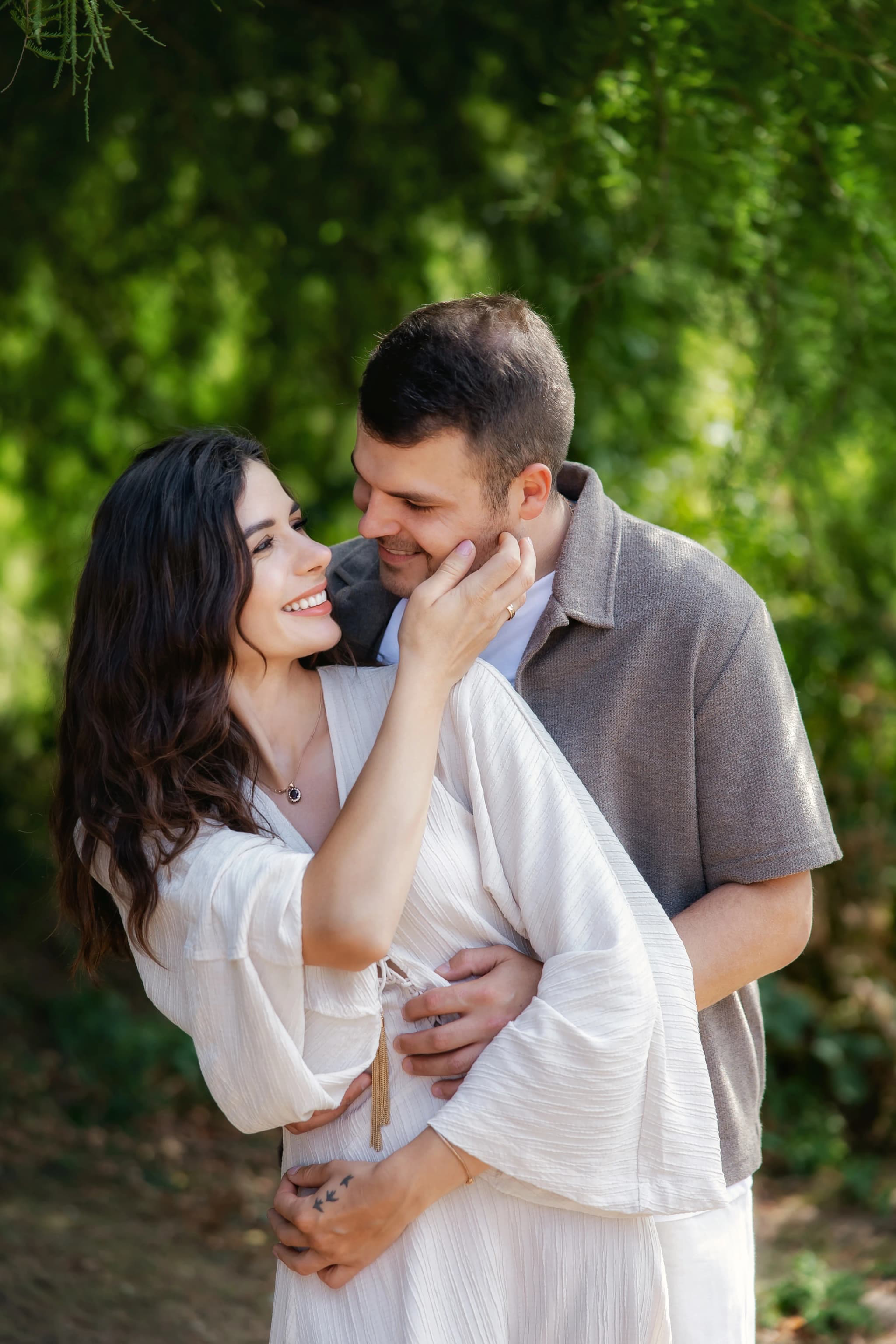
Clothing needs a little more thought for a bluebell session than for most locations, because the backdrop itself is such a strong, specific colour. Soft creams, warm whites, dusty pink, sage green and other muted neutral tones sit beautifully against the violet-blue of the flowers and the fresh green of the new woodland canopy. I generally steer couples away from strong blue clothing, which tends to compete with the flowers rather than let them stand out as a distinct backdrop, and away from anything with bold pattern or logo, which can pull the eye away from the woodland setting entirely.
Natural fabrics — linen, cotton, soft knitwear — tend to move well in the light breeze that often accompanies these mornings and photograph with a softness that suits the setting. Footwear is worth planning properly: ancient woodland paths are uneven, often muddy even in dry weather, and covered in leaf litter and root systems that are not kind to delicate shoes. I always suggest bringing a pair of boots or flats to walk in and, if needed, a second pair to change into for the more static portrait moments.
Light in the Wood
Early morning, before the sun has climbed above the woodland canopy, produces the cool, soft, almost ethereal light that I associate most strongly with the best bluebell photography I have made. It is quiet, the wood is often still slightly damp with dew, and the light has an evenness that is very hard to replicate later in the day. Late afternoon offers a different but equally beautiful option, with warmer shafts of light breaking through gaps in the canopy at a lower angle.
Full midday sun, by contrast, tends to create harsh, high-contrast pockets of light and deep shadow wherever it breaks directly through gaps in the trees, which is rarely flattering and can also wash out the saturation of the flowers themselves. Slightly overcast conditions, counter-intuitively, are often ideal for bluebell photography — the diffused light evens out the whole scene and tends to render the blue of the flowers with more genuine depth than bright sunshine does.
How a Bluebell Session Differs From a Standard Woodland Shoot
Couples sometimes ask whether a bluebell session is really so different from an ordinary woodland engagement shoot booked at any point in the year, and the honest answer is yes, quite significantly. The whole session has to be built around the flowers being at their best, which means the date is set by nature rather than by diary convenience, the location has to be chosen specifically for its bluebell density rather than general woodland appeal, and the whole shoot tends to be planned for the very start or end of the day, when both the light and the flowers themselves are at their finest.
That extra planning is exactly what produces the images that make bluebell sessions so sought after in the first place — a woodland shoot booked on a random weekend in July will never look like this, however lovely the location, simply because the specific conditions that make bluebell photography so striking only exist for those few weeks each spring.
Booking Early
Because the season is so short and so weather-dependent, I recommend couples get in touch about a bluebell session well before spring arrives — ideally in January or February, while there is still time to hold a flexible date and plan around it properly. Booking this far ahead does not commit you to an exact day; it simply means you are in the queue and I can keep you updated as the season develops, rather than trying to arrange everything at short notice once the bluebells have already started to bloom.
Bluebell season in England lasts a matter of weeks, and within that window the true peak is shorter still. If you would like to build an engagement session around this particular piece of the English spring, get in touch as early in the year as you can, and I will help you find both the right woodland and the right week.

Yana Skakun
Photographer · England
Professional wedding, family and portrait photographer based in England. Passionate about capturing authentic emotions and timeless moments.
About Yana →bluebell engagement session UKbluebell wood engagement photos UKspring engagement session Englandbluebell woodland couple photographyApril May engagement session UKCambridgeshire bluebell engagement
Engagement — Engagement & Love Story Photography in Cambridge & England
Engagement and pre-wedding sessions with Yana Skakun offer a natural way to get comfortable in front of the camera before your wedding day. Sessions take place at meaningful personal locations — Cambridge, the Cambridgeshire countryside, coast, woodland, or wherever your story began. This guide — Bluebell Engagement Sessions: England's Most Fleeting and Beautiful Portrait Setting — is part of the photography journal: practical, experience-based advice drawn from real sessions across England. Whether you arrived searching for bluebell engagement session uk or bluebell wood engagement photos uk, the same care and attention shapes every session Yana photographs.
Engagement & Love Story Photography sessions are available year-round, with bookings open across Cambridge, Ely, Huntingdon, Peterborough, and further afield — East England, London, the Midlands, and beyond. If you have specific questions about spring engagement session england, mention it in your enquiry. Get in touch through the contact form above to check availability and discuss your session. Enquiries are welcomed from anywhere in the UK.
Frequently Asked Questions
What is the point of an engagement shoot?+
An engagement shoot lets you and your partner get comfortable in front of the camera before your wedding day. You'll learn how to move, where to look, and how to interact naturally — so wedding portraits feel relaxed rather than awkward. It also gives you and your photographer a chance to work together before the big day.
How long does an engagement photo session take?+
Most engagement sessions last 60–90 minutes. This gives enough time to warm up, explore two or three locations, try a few different looks, and capture a variety of shots without feeling rushed.
What should you wear for an engagement photoshoot?+
Wear outfits that feel like you — not something you'd only wear once. Complementary colours work well (you don't have to match exactly). Avoid bold logos and very small patterns. Bring a second outfit if you'd like variety. Think about where the shoot is happening and dress for the setting.
When should you do an engagement shoot?+
Ideally 6–12 months before your wedding — early enough that you can use the images for save-the-dates, but close enough to your wedding that the images feel current. Early morning or the hour before sunset gives the best natural light.
Where are good locations for engagement photos in England?+
Cambridge's Backs and botanic garden, London's parks and riverside, the Cotswolds countryside, coastal spots in Cornwall and Dorset, and historic estate gardens all make beautiful backdrops. Your photographer can suggest locations that suit your style and will photograph well in the season you're shooting.
Continue Reading
Related Articles

Engagement
Cotswolds Engagement Photography: Honey-Stone Villages & Rolling Hills
7 min read · Read Article
Engagement
Suffolk Countryside Engagement Shoot: Lavender Fields & Country Lanes
6 min read · Read Article
Engagement
Norfolk Coast Engagement Photos: Windswept & Beautiful
7 min read · Read Article
Get in Touch
Ready to Book Your Session?
Get in touch to discuss your vision — I'll reply within 24 hours.