Yana Skakun
Clare College Cambridge Wedding Photography: The Backs' Most Beautiful College
By Yana Skakun·2 April 2026·9 min read
Ask most Cambridge photographers to name one college they would choose above all others for a wedding, and a great many will say Clare. There is a reason for that beyond simple prettiness. Clare College sits directly on The Backs, its honey-coloured stone catching the low afternoon sun, its seventeenth-century bridge arching over the Cam in a curve that has been photographed for nearly four hundred years, and its gardens descending toward the river with a formality that somehow still feels alive rather than manicured into stiffness. For wedding photography specifically, Clare offers something rare: a genuinely small number of world-class settings within a two-minute walk of one another, which means couples get variety without the logistics of crossing half the city between shots.
Clare Bridge: The Oldest Crossing on the Cam
Clare Bridge was built in 1638, which makes it the oldest surviving bridge in Cambridge — older than the Mathematical Bridge at Queens', older than the Bridge of Sighs at St John's, and older than every other crossing on the Cam still standing in its original form. Its three arches sit low over the water, and the stone balustrade along the top carries fourteen carved stone balls, one of which is missing a wedge-shaped segment. The story goes that the bridge's builder was never paid the full amount agreed, and cut the ball as a quiet act of protest — nobody knows for certain, but the detail has become one of the small, tellable facts every good Cambridge guide and every photographer who works here knows to point out.
As a photography location, the bridge works two ways. Photographed from the meadow side, low down, with the arches reflected in the water, it becomes a backdrop of real architectural weight behind a couple. Photographed from on top of it, looking along the balustrade toward Old Court, it becomes a vantage point rather than a subject — one of the few places in Cambridge where you can stand and see centuries of college architecture in a single frame. I use both approaches depending on the couple and the light, and I always try to include at least one frame of the missing ball segment close up, because it is the kind of detail that means something once someone has told you the story.
Morning light on Clare Bridge is soft and slightly cool, good for close portrait work where you want even skin tones without harsh shadow. By late afternoon, particularly from around four o'clock in spring and autumn, the light comes in low and warm from the west and catches the stone directly, turning the whole structure a deep gold. That window — call it ninety minutes before sunset — is when the bridge photographs at its absolute best, and it is the slot I try hardest to protect when building a wedding day timeline that includes Clare.
Old Court and Its Four-Range Symmetry
Old Court is Clare's architectural centrepiece, and it is unusual even by Cambridge standards. Rather than the more common asymmetrical growth of buildings added court by court over centuries, Old Court was built as a coherent seventeenth-century scheme — four ranges of matching honey-coloured stone arranged around a clean rectangular lawn, with a level of visual discipline you don't often find in colleges that grew more organically. The uniformity is what makes it so useful for photography: wherever you stand in the court, the proportions are already balanced, so a couple standing more or less anywhere within it looks intentionally placed.
The stone itself is worth understanding as a photographer. It reads warm gold in direct sun, cools toward grey-buff under open cloud, and takes on an almost amber cast in the final hour of light. Because all four ranges share the same stone and the same window rhythm, Old Court gives remarkably consistent results across the day compared with colleges built from mismatched materials over different centuries. The south-facing range in particular holds strong directional light for much of the afternoon, and the shadow lines it throws across the lawn by early evening are some of the most useful natural framing tools I have found anywhere in Cambridge.
The Fellows' Garden
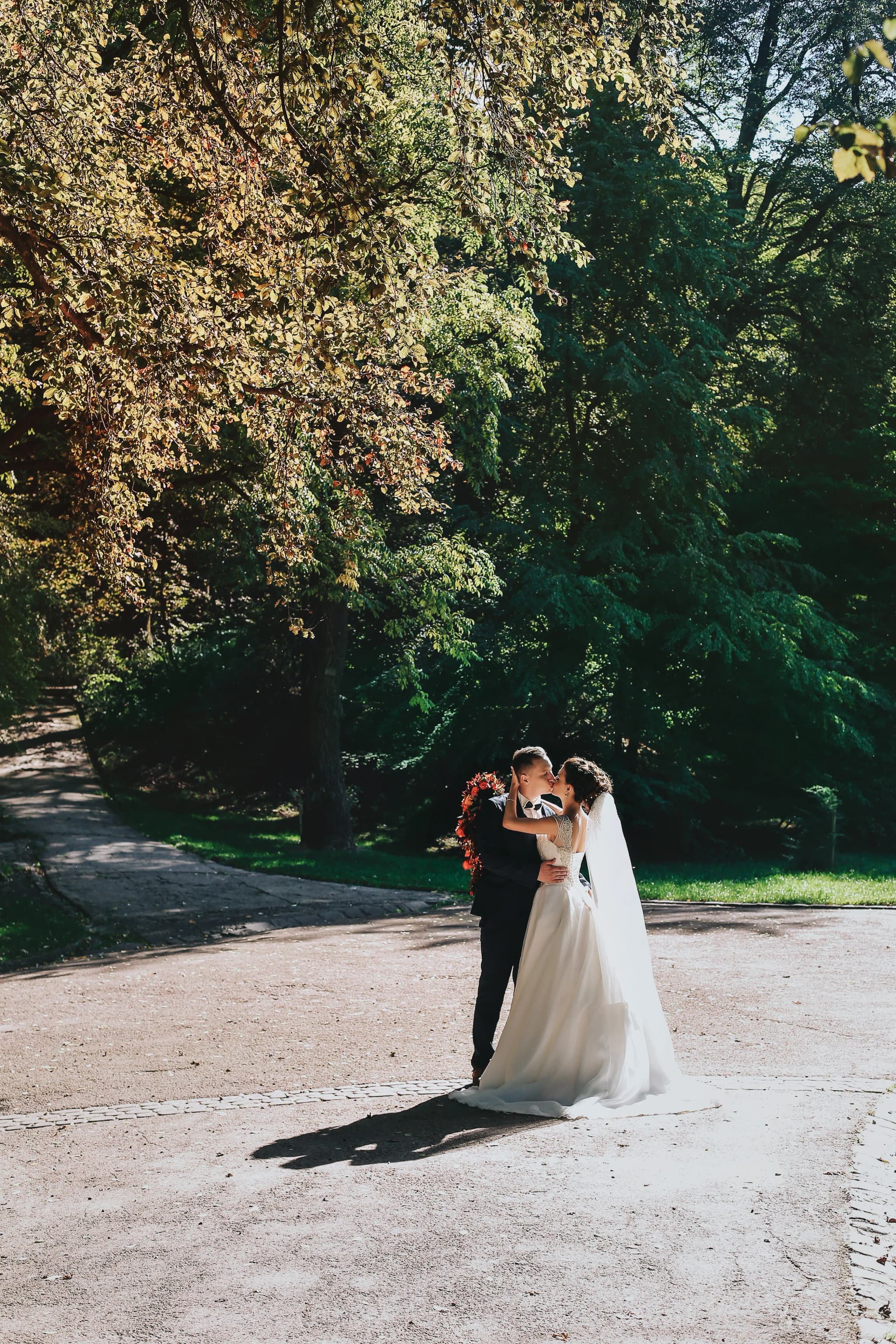
Beyond the court and across the bridge lies Clare's Fellows' Garden, generally considered one of the finest private college gardens in Cambridge. It is laid out with a formality that gives it real structure in photographs — clipped borders, mature trees, defined sightlines — but it is planted generously enough that it never feels stiff or municipal. The garden descends gradually toward the river, so as you move through it the Cam keeps reappearing between trees and hedges at slightly different angles, which gives a session real variety without needing to leave the grounds.
For portraits, the Fellows' Garden is the counterweight to Old Court. Where the court is architectural, symmetrical and quite formal, the garden is soft, textured and seasonal — the backdrop changes meaningfully from month to month in a way stone never does. Spring brings blossom and fresh green growth along the borders; high summer brings dense, layered foliage and a canopy that filters light beautifully; autumn turns the mature trees toward copper and gold; even winter, with bare branches and low light, has a stark elegance that some couples specifically request. Because access is generally restricted to college members, their guests, and booked visitors, the garden also tends to be far quieter than the public Backs, which matters enormously on a wedding day when you want ten calm minutes without spectators.
I usually plan for a short sequence in the garden separate from the bridge and court portraits, treating it almost as its own mini-session within the day — a change of backdrop, a change of pace, and often the moment in the timeline when a couple visibly relaxes because the crowds and formality of the ceremony are briefly behind them.
The Backs: River, Meadow and the Wider View
Clare's position on The Backs — the run of gardens, meadows and riverside land behind the colleges facing the Cam — is part of what makes it so valuable for a wedding day. From Clare Bridge you can walk in either direction along the river and find open meadow, mature trees, and views back toward the college that are unavailable from inside the court itself. The wider Backs give a photographer room to work with landscape as well as architecture: wide shots with Clare small in the frame against sky and water, alongside the tighter architectural portraits closer to the bridge.
This is also where seasonal and time-of-day planning matters most. Punting traffic on the Cam builds steadily from late morning through early evening in spring and summer, and by mid-afternoon on a warm Saturday the stretch of river by Clare Bridge can be genuinely busy with punts, tourists and student groups. I schedule portrait time either earlier than the traffic peaks, or later, in that golden hour when punting naturally thins as operators wind down. Sunrise sessions, a harder ask of a wedding party, give completely empty meadows and a stillness no other time of day can offer — an option worth considering for bridal prep nearby, or a next-day portrait session when a couple wants Clare without a single stranger in frame.
A note on access and permissions
Cambridge colleges are working institutions as well as historic sites, and wedding photography on college grounds generally requires advance arrangement with the college — either because your ceremony or reception is being held there, or through a separate visitor or photography booking. Timings, group size and specific areas of access can vary and are worth confirming well ahead of the day. I have photographed at Clare many times and can help couples think through what is realistic for their timeline, but the college itself always has the final say on access.
Get in touch about wedding photographyClare Compared to Other Colleges, and Pairing It With a Venue
Every Cambridge college has its own photographic character, and it is worth being honest about how Clare compares. King's has scale and drama — that vast chapel dominates every composition. Trinity and St John's have grander, more imposing courts with a cooler, greyer stone. Queens' has the timber-framed President's Lodge and the Mathematical Bridge, wonderful but distinctly different in tone from Clare. What Clare offers that few others match is warmth — literally, in stone colour, and in the overall feeling of the place. It is grand without being intimidating.
Because Clare is not typically a full wedding venue for ceremony and reception, most couples pair a portrait session here with a ceremony or reception held elsewhere nearby. The proximity of Clare to the rest of The Backs and to the city centre makes this straightforward: a wedding party can realistically fit thirty to forty minutes at Clare into a portrait window without the day feeling stretched. I plan this kind of route carefully in advance, walking the timing myself so travel between locations never eats into the light we came for.
Planning a Wedding Portrait Session at Clare
The single biggest factor in how a Clare session turns out is timing relative to light and crowds, not the season itself — Clare photographs beautifully in every month of the year, just differently. Spring gives fresh colour in the Fellows' Garden and generally quieter meadows before the tourist season builds. Summer gives the longest light and the richest greens, at the cost of managing punt and visitor traffic more carefully. Autumn gives some of the best colour of the year against that honey-coloured stone, with noticeably fewer crowds than summer. Winter, if a couple is willing to work with shorter days, gives clean, quiet, almost monochrome elegance and virtually empty grounds.
Whatever the season, I always build in a buffer either side of the Clare portion of the day. Weather, dress logistics, and the simple unpredictability of moving a wedding party through a historic site all eat time, and Clare rewards a few unhurried minutes far more than a rushed dash between bridge and court. Having worked this location repeatedly, I know where the light lands at different hours, where a punt is likely to drift into a shot, and which corners of Old Court and the Fellows' Garden are quietest when the main paths are busy — knowledge that lets me plan a route through Clare that makes the most of whatever time we have on the day.
If Clare College is somewhere you are considering for wedding portraits, or you would like help thinking through how it might fit alongside your ceremony and reception venues, get in touch and I can talk you through the practical side of planning a session there.


Yana Skakun
Photographer · England
Professional wedding, family and portrait photographer based in England. Passionate about capturing authentic emotions and timeless moments.
About Yana →Clare College Cambridge weddingClare Bridge wedding photosClare College wedding photographerGetting married Clare College CambridgeClare Fellows Garden photograph
Venue Spotlights — Wedding & Portrait Photography in Cambridge & England
Yana Skakun photographs weddings and portrait sessions at venues across Cambridge, East England, London, and beyond. Venue scouting and creative collaboration are part of every booking — every location is worked with rather than against. This guide — Clare College Cambridge Wedding Photography: The Backs' Most Beautiful College — is part of the photography journal: practical, experience-based advice drawn from real sessions across England. Whether you arrived searching for clare college cambridge wedding or clare bridge wedding photos, the same care and attention shapes every session Yana photographs.
Wedding & Portrait Photography sessions are available year-round, with bookings open across Cambridge, Ely, Huntingdon, Peterborough, and further afield — East England, London, the Midlands, and beyond. If you have specific questions about clare college wedding photographer, mention it in your enquiry. Get in touch through the contact form above to check availability and discuss your session. Enquiries are welcomed from anywhere in the UK.
Frequently Asked Questions
What should I look for when visiting a wedding venue?+
Look at the natural light at the time of day your ceremony will take place. Walk outside and consider where portraits will happen — is there an area with shade, a garden, a meaningful backdrop? Ask about vendor restrictions (some venues require you to use their preferred photographer list). Check logistics: where do guests park, where does the bridal party get ready, is there a bridal suite?
How far in advance should you book a wedding venue?+
Popular venues book 18–24 months ahead, especially for peak season (May–September) Saturdays. If you're flexible on date and day of week, 12 months is usually sufficient. Always view a venue before booking — photos online rarely show the full picture of scale, light, or atmosphere.
What questions should you ask a wedding venue?+
Ask: what's included in the venue hire? Can you bring your own caterer? What are the noise restrictions and finishing times? Is there accommodation on site? What's the plan if it rains for outdoor ceremonies? What is the minimum and maximum guest capacity? Are there any vendor restrictions or preferred supplier lists?
How do venue locations affect wedding photography?+
Venue architecture, grounds, and natural light dramatically affect the quality of wedding photography. Beautiful venues with varied backdrops, good natural light in the key rooms, and outdoor space for portraits make the photographer's job much easier. When choosing a venue, visiting at the same time of day as your planned ceremony is helpful for assessing the light.
What makes a venue photogenic for weddings?+
Natural light (large windows, north-facing rooms), textured backgrounds (stone walls, wooden beams, floral arrangements), varied outdoor spaces (gardens, courtyards, woodland, water features), and interesting architectural details. Venues that feel authentic to their setting — a barn that's actually rustic, a manor house with period features — photograph better than generic white box venues.
Continue Reading
Related Articles

Venue Spotlights
Beach and Coastal Portrait Photography in England
13 min read · Read Article
Venue Spotlights
Autumn Photography Locations in Cambridgeshire: The Complete Seasonal Guide
12 min read · Read Article
Venue Spotlights
Cherry Blossom Photography Locations in England: Where & When to Shoot
11 min read · Read Article
Get in Touch
Ready to Book Your Session?
Get in touch to discuss your vision — I'll reply within 24 hours.