Yana Skakun

How to Organise Kids for Wedding Photos Quickly (Before They Cry)
By Yana Skakun·2 February 2027·5 min read
Family formals with young children are the most logistically demanding photographs of any wedding day, and it is worth being honest about that upfront rather than pretending they simply happen smoothly with no planning. Children under seven have a genuinely finite window of cooperation that evaporates rapidly, particularly after a ceremony, when they are already tired, hungry, and overstimulated by a day that has been unusual and exciting for them from the moment they woke up. Here is how to get the shots you actually need in a few focused minutes, before the crying starts.
Plan the Shot List in Advance
Every minute spent standing around deciding who should be in which photograph is a minute of a young child's cooperation burning away for no good reason. Creating a formal shot list before the wedding, and sharing it with your photographer along with a trusted coordinator on the day, means that when the moment comes, everyone already knows the order and who needs to be where. Assembling each group becomes a matter of seconds rather than several minutes of confused shuffling and calling out names across a lawn.
For groups involving children specifically, it is worth prioritising them early in the sequence, before they become hungry, tired, or simply more interested in something else entirely. A shot list that leaves every group containing children until the very end of the formals session is setting itself up for difficulty that was entirely avoidable with a small amount of reordering.
Designate a Child Wrangler
The single most impactful thing you can do for family formals involving children is to designate one specific person, not a busy bridesmaid mid-way through her own responsibilities and not a distracted parent-in-law, whose only job during the formal portrait session is rounding up children, keeping them roughly in place, and deploying whatever treats and distractions are needed to hold their attention for a few more seconds.
This person should ideally be someone the children already know and respond well to, and they should have no other wedding duties during this window of time so their attention is not split. Giving them a copy of the shot list means they know in advance which child needs to be where and when, rather than reacting on the fly to instructions shouted across the group.
The Snack Strategy
Hungry children cooperate for approximately zero seconds, and making sure children have eaten reasonably recently before the formal portrait session removes a large share of the potential problems before they even arise. Keeping a small supply of snacks available is not about bribing children into a particular photograph — it is about maintaining a baseline blood sugar level, and with it a baseline level of ordinary human patience that a hungry three-year-old simply does not have access to.
It is worth avoiding anything that stains easily, such as berries or chocolate, or that makes visible mess on formal clothes, since a smeared outfit becomes its own separate problem that then needs solving before any photographs can continue.
A note on working with children during formals
I am experienced in working quickly and patiently with children of all ages during formal portraits, and I build extra time into the schedule wherever a wedding day includes younger guests.
Get in touch about your weddingThe "Quick One" Technique
Children respond well to speed and a sense of finality. Telling a child "we just need one quick photograph, then you can go back to your game" is far more effective than the vague and open-ended instruction to "stand still for as long as we need," which offers no end point a young child can hold onto. A good photographer should be shooting from the moment the group actually assembles, since often the first few seconds of a group gathering, before anyone feels fully ready or posed, produce the most natural images of the whole sequence anyway.
It helps enormously not to over-pose and not to pause repeatedly to review images on the camera screen mid-session. Keeping the group moving through the shot list at a brisk pace, rather than lingering on any single grouping, keeps children's attention from wandering and keeps the whole formals session shorter and more pleasant for everyone involved. The goal at this stage of the day is genuinely good images, not an unattainable idea of technical perfection.
Timing and Managing Different Ages
The best window for child-involving formal photographs is immediately after the ceremony, before any long gaps arise in which children become bored and restless waiting around with nothing to do. If the day includes a drinks reception, it is worth starting formals immediately rather than leaving everything until afterwards, since every additional half hour of waiting works against you. Children's energy and patience are generally at their highest in the early afternoon; by five o'clock at a full-day wedding, even the most naturally cooperative toddler has usually reached the end of what they can reasonably give.
Weddings often involve children across a wide age range within the same formal groupings — a toddler barely walking, a school-age child capable of following simple instructions, and a teenager who may be more self-conscious about being photographed than genuinely difficult to manage. Treating every child in a group the same way rarely works well. Toddlers respond to play and immediate, tangible rewards, school-age children respond to clear, simple instructions and a sense of being trusted with a small responsibility, and teenagers generally respond best to being spoken to as near-adults rather than herded alongside much younger children.
Where a formal grouping spans several age groups, it is often worth photographing the youngest children first within that grouping, since their patience runs out fastest, and building the rest of the group around them once they are already in position rather than making them wait while older family members get organised first.
Accept Imperfection
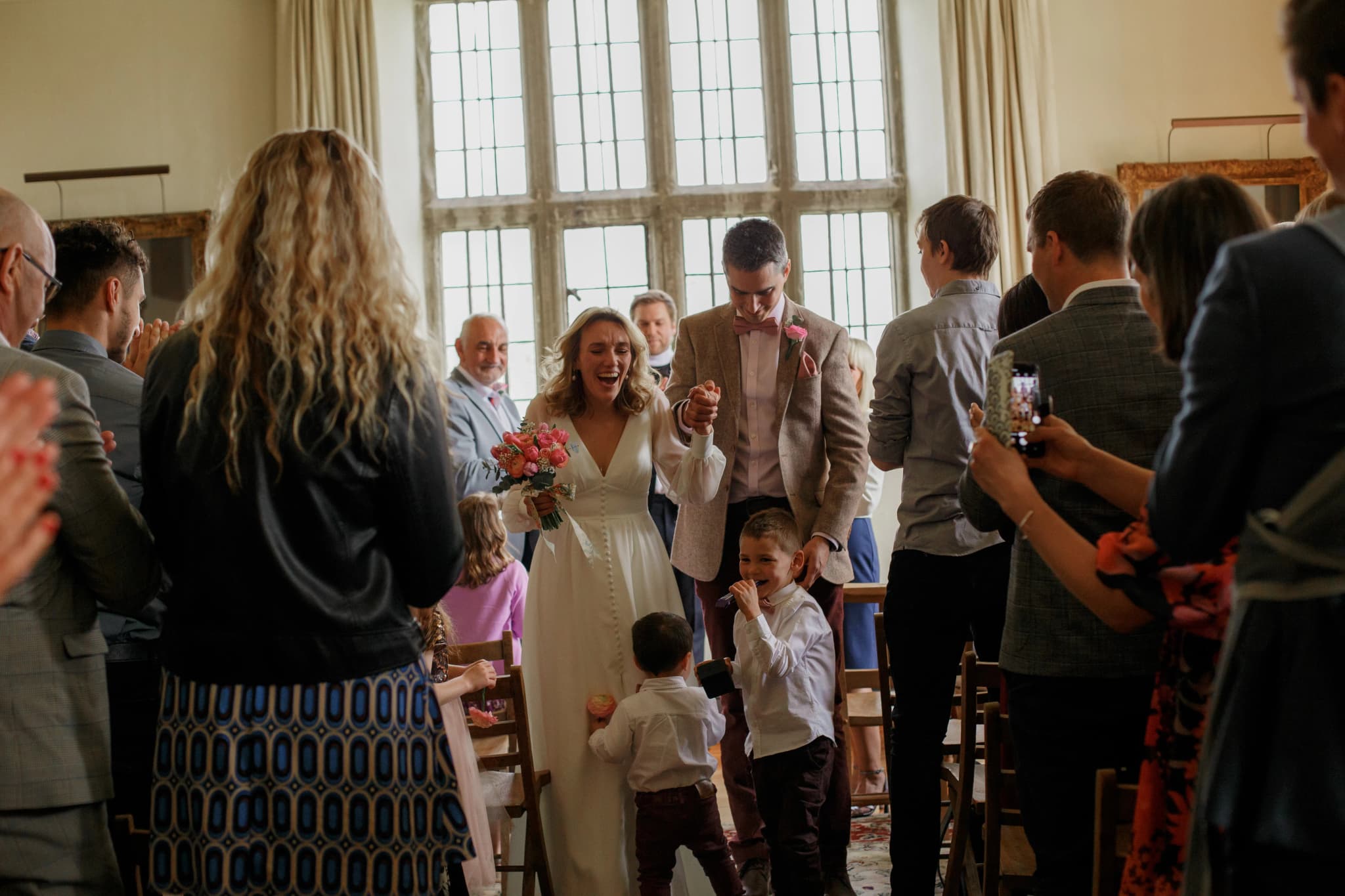
A photograph with one child looking sideways at something off-camera, another pointing at a passing dog, and a third pulling an inscrutable face is not a failure of the session — it is simply what life with small children genuinely looks like. These images are very often cherished by families precisely because they are unpredictable and true to the moment, rather than a stiff, artificially arranged tableau that bears little resemblance to how the day actually felt.
Insisting on repeated retakes in pursuit of one flawless, perfectly composed shot tends to cost far more in a child's patience than it gains in the final result, so it is usually better to accept the reality in front of the camera and move on to the next group. A good photographer will typically take several frames in quick succession for any grouping involving children specifically, on the reasonable assumption that at least one frame across that short burst will have every child looking roughly where they need to, which removes much of the pressure to force a single perfect take on demand.
Ultimately, the formal photographs involving children tend to become some of the most looked-at images in the entire wedding album years later, not despite their imperfections but partly because of them — a genuine, slightly chaotic family group photograph ages far better than an artificially composed one, because it actually looks like the family it is meant to represent.
A short conversation with your photographer before the day, covering roughly how many children will be involved, their ages, and any specific groupings that matter most to you, is usually enough to build a formals plan that respects everyone's time without sacrificing the shots that genuinely matter. If you are planning a wedding with children in the family and want help thinking through the formals timeline in advance, get in touch and we can plan it together properly.


Yana Skakun
Photographer · England
Professional wedding, family and portrait photographer based in England. Passionate about capturing authentic emotions and timeless moments.
About Yana →formal wedding photos with kidsorganising children wedding photosgroup photos with children weddingkids in wedding photos tips
Wedding Tips — Wedding Photography in Cambridge & England
Yana Skakun is a professional wedding photographer based in Cambridge, covering weddings across England — from intimate elopements to full-day ceremonies at country houses, barns, and city venues. Every couple receives a relaxed, documentary approach that captures the day as it truly unfolds. This guide — How to Organise Kids for Wedding Photos Quickly (Before They Cry) — is part of the photography journal: practical, experience-based advice drawn from real sessions across England. Whether you arrived searching for formal wedding photos with kids or organising children wedding photos, the same care and attention shapes every session Yana photographs.
Wedding Photography sessions are available year-round, with bookings open across Cambridge, Ely, Huntingdon, Peterborough, and further afield — East England, London, the Midlands, and beyond. If you have specific questions about group photos with children wedding, mention it in your enquiry. Get in touch through the contact form above to check availability and discuss your session. Enquiries are welcomed from anywhere in the UK.
Frequently Asked Questions
How much does a wedding photographer cost in England?+
Wedding photography in England typically ranges from £1,500 to £4,000+ for a full day. Price depends on experience, coverage hours, and whether albums or engagement shoots are included. Most photographers charge between £2,000–£3,000 for 8–10 hours of coverage.
How early should you book a wedding photographer?+
For peak season (May–September), book 12–18 months in advance. For autumn and winter weddings, 9–12 months is usually sufficient. Popular photographers at popular venues fill up fast — as soon as you have a date and venue confirmed, start reaching out.
How many photos do you get from a wedding photographer?+
Most professional wedding photographers deliver 400–800 edited images for a full-day wedding. The exact number depends on coverage hours, how many guests there are, and the photographer's editing style. Quality matters more than quantity — a curated gallery of 500 images tells the story better than 1,500 unedited files.
Do you need a second photographer at your wedding?+
A second photographer is helpful if you want simultaneous coverage of getting-ready moments in different locations, multiple angles during the ceremony, or more candid coverage during the reception. It adds cost but significantly increases the variety and completeness of your gallery.
What is the difference between documentary and editorial wedding photography?+
Documentary (reportage) wedding photography captures moments as they happen — the photographer observes and doesn't intervene. Editorial photography involves deliberate direction: placing you in good light, shaping compositions, creating intentional portraits. Most photographers blend both styles throughout the day.
Continue Reading
Related Articles
Wedding Tips
Sustainable Eco-Friendly Wedding Guide — Planning a Green Celebration
15 min read · Read Article
Wedding Tips
Trash the Dress Session — Complete Planning and Photography Guide
14 min read · Read Article
Wedding Tips
Client Communication for Photographers — From Enquiry to Gallery Delivery
15 min read · Read Article
Get in Touch
Ready to Book Your Session?
Get in touch to discuss your vision — I'll reply within 24 hours.