Register office weddings account for roughly a third of all marriages in England and Wales. They're often treated as the "simple" option — quick, efficient, done. But simple doesn't mean insignificant, and the photography at a register office wedding can be every bit as beautiful, emotional, and meaningful as a grand venue affair. It just requires different planning.
This guide covers the specific challenges and opportunities of register office wedding photography: the light, the space, the timing constraints, and how to get remarkable photographs from a setting that wasn't designed for visual spectacle.
Understanding the Register Office Setting
Register offices vary enormously across England. Some are purpose-built ceremony rooms with good natural light and attractive interiors. Others are functional council buildings with fluorescent lighting, beige walls, and a desk where the registrar sits. The quality of the space directly affects the photography approach — but even the most uninspiring room can yield beautiful images when the photographer knows how to work with it.
Typical Room Characteristics
- Size: most ceremony rooms are compact — 15–30 guests is typical capacity
- Light: varies from large windows with natural light to entirely artificial lighting
- Background: some have floral displays or decorative elements; many are plain
- Restrictions: many register offices restrict photographer movement during the ceremony
- Duration: ceremonies themselves last 15–30 minutes
Pre-Ceremony: Where the Best Photos Often Happen
Because the ceremony itself is brief and the room may impose limitations, the pre-ceremony period is often where the strongest emotional photographs happen. The arrival — stepping out of a car, walking up the steps, greeting waiting guests on the pavement — carries genuine anticipation and nervous energy.
If both partners arrive separately, the moment they first see each other outside the register office is effectively a "first look" — and it's often more emotionally raw than staged first looks at larger venues, because there's no production layer between the couple and their feelings.
A photographer who arrives 30–45 minutes before the ceremony start time can capture:
- Final preparation details (buttonhole pinning, checking hair, calming nerves)
- Guests arriving and greeting each other
- The building exterior for context — this is your "venue shot"
- Candid interactions between family members meeting, possibly for the first time
During the Ceremony: Working Within Constraints
Many register offices ask photographers to remain seated or to stand in one position during the ceremony. Some prohibit flash. Some allow movement but ask for discretion. Before the wedding, your photographer should contact the register office directly to confirm:
- Where they're permitted to stand or move
- Whether flash is allowed (most say no — which is actually better for the photographs)
- Whether there's a specific "photo opportunity" moment after the legal signing
- How long the room is available after the ceremony ends
Working With Difficult Light
Fluorescent overhead lighting is the most common challenge in register office rooms. It produces greenish, unflattering colour casts and creates shadows under the eyes. Professional photographers compensate by:
- Positioning near windows: if there's any natural light source, the photographer will work the angles to make it the primary light
- Shooting wider: including more of the room in the frame reduces the impact of overhead lighting because the focus shifts to the scene rather than skin tones
- Using a longer lens from the back: compression and shallow depth of field blur the background and reduce the visual impact of the room itself
- Post-processing correction: colour temperature and skin tone corrections in editing can completely remove the fluorescent cast
The Signing of the Register
The legal signing is unique to civil ceremonies and register office weddings. This moment — pen in hand, making the marriage legal — is photographically rich. Close-ups of hands signing, the couple looking at each other across the register, the registrar guiding the process, and the witnesses watching — all of these tell a story that exists nowhere else in the wedding day.
Post-Ceremony: Making the Most of Your Time
After the ceremony, most register offices give you the room for five to ten minutes before the next booking. This is your window for the formal group photographs and any posed couple portraits inside the room.
Because time is limited, have your group photo list prepared in advance and pre-arranged by grouping. The photographer calls each group, shoots, and moves to the next. No browsing, no "who else should we include?" — that decision should be made before the day.
The Steps Photograph
The exterior steps of a register office are one of the most iconic images from civil weddings. The couple emerging as married, guests cheering, confetti (if permitted — check the policy) — this moment captures the transition from inside to outside, from ceremony to celebration. Many register offices have impressive period buildings with columned entrances that photograph beautifully.
Extending the Photography: Before and After the Office
A register office ceremony might last 20 minutes. If that's your entire photography coverage, you'll get 50–100 images. Many couples extend the photography to include:
Pre-Ceremony Portrait Session
Meeting the photographer an hour before the ceremony at a nearby location — a park, a street, a riverside — for relaxed couple portraits. This produces the romantic, editorial-style images that the register office room itself may not support.
Post-Ceremony Walk
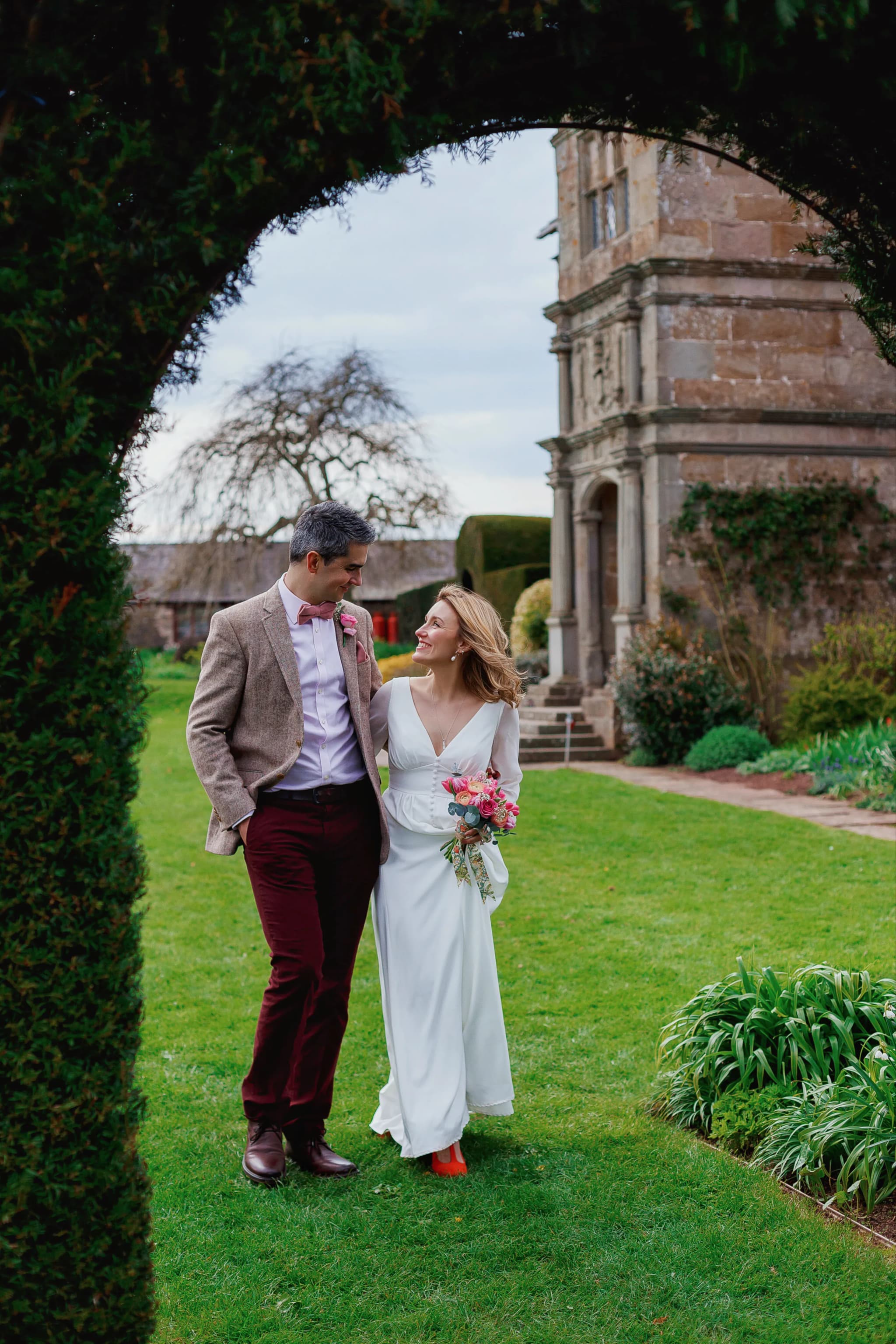
After the formalities, walk to a nearby location with your photographer. Many register offices are in town centres near parks, historic streets, or interesting architecture. Thirty minutes of walking photography after the ceremony — just the two of you, freshly married, exploring your town — produces some of the most joyful and natural images of the day.
The Celebration Venue
If you're heading to a restaurant, pub, or private venue after the register office, having your photographer cover the first hour or two of the celebration captures the toasts, the relaxed interactions, and the general atmosphere of a new marriage being celebrated.
Wardrobe for Register Office Weddings
Register office weddings span the full spectrum from full bridal gown to smart casual. From a photography perspective:
- Traditional wedding dress: works beautifully, especially for the exterior and walking shots. The contrast of a formal gown against everyday street surroundings creates visually interesting images.
- Cocktail dress or elegant separates: suits the scale of a register office and photographs well in smaller rooms. Less risk of a train catching on furniture.
- Suits: a well-fitted suit in a colour that contrasts with the room's walls will always photograph well. Avoid matching the wall colour — if the room is cream, don't wear cream.
- Accessories matter more in small rooms: a statement shoe, a distinctive hat, an unusual buttonhole — small details become focal points in close-quarter photography.
Confetti, Petals & Celebrations
Many register offices have specific confetti policies — some allow biodegradable petals outside only, some prohibit confetti entirely. Check before the day. If confetti is allowed, brief your guests on timing: wait until the couple is fully out of the door and down a step or two, then throw. The photographer needs the couple positioned against sky or a neutral background for the confetti to be visible.
If confetti isn't allowed, the celebratory moment can still be captured through cheering, clapping, and spontaneous embraces. The energy is what matters — confetti is decoration, not substance.
How Long Should Register Office Photography Coverage Be?
- Ceremony only (1 hour): arrival, ceremony, groups, and steps. The minimum for a complete record.
- Extended coverage (2–3 hours): pre-ceremony portraits, ceremony, groups, and a post-ceremony walk or celebration lunch. The sweet spot for most couples.
- Half-day coverage (4–5 hours): getting ready at home, travel, ceremony, celebrations. Appropriate when you want the full story documented.
Most photographers offer flexible packages for register office weddings rather than the full-day pricing typical of venue weddings. The investment is proportional to the coverage time, not the venue prestige.
A Register Office Wedding Is Still a Wedding
The most important thing to understand about register office photography is that the setting is incidental. What matters is the commitment, the emotion, and the people present. A tearful mother watching her child get married in a council building is no less powerful than the same moment in a cathedral. A couple laughing as they sign the register at a desk is no less joyful than one dancing in a ballroom.
The photographer's job is to see past the setting and capture the substance. If they can do that, a register office wedding produces photographs that are just as meaningful, just as beautiful, and just as worth preserving as any other.
I offer flexible coverage for register office weddings — from one hour to half a day.
Every celebration deserves to be beautifully documented. Check availability and pricing.