Yana Skakun
Including your pet in family photos: Tips for beautiful results
By Yana Skakun·26 April 2026·5 min read
Pets are family, and increasingly that is exactly how people want them treated in their photographs — not tucked in as an afterthought at the end of a session, but woven properly into the images of the people who love them. I understand the instinct completely. I am a dog owner myself, and some of the portraits I am proudest of are the ones where the family dog is mid-leap, or has photobombed a hug, or is simply lying across everyone's feet looking entirely unbothered by the camera. Getting those images well takes a slightly different approach than photographing people alone, and it helps enormously if you know what to expect before the day arrives. Here is everything I tell families and couples who want their pets included, from preparation through to what actually happens once we are on location.
The Honest Truth About Photographing Dogs
Dogs do not pose. They do not hold still on command, and they are, on the whole, completely unbothered by polite instructions to "look here, please". This is both the central challenge of pet photography and the entire source of its charm. A dog will not give you the composed, patient stillness that an adult can manage for a few seconds when asked. What a dog will give you, if the session is approached in the right way, is something better: genuine behaviour, unrepeatable and specific to that animal.
The best pet portraits are almost never staged. They are caught — a dog leaping at a child in pure joy, a Labrador resting its head heavily in someone's lap with a sigh, a terrier spinning in tight circles around the family's legs because it senses something exciting is about to happen. These are the images that make people laugh out loud when they open their gallery, and often the ones they print largest. My approach with animals is never to chase stillness. It is to create the conditions where natural behaviour happens somewhere within reach of my camera, and then to be ready for it.
That means I spend less time directing the dog and more time directing the humans, positioning them so that whatever the dog naturally does — investigating a smell, trotting alongside, leaning into a leg — happens within a frame that already looks good. It is a subtly different skill to portrait photography of people alone, closer in some ways to documentary work, and it rewards patience over instruction.
How to Prepare Your Dog for the Session
A small amount of preparation in the days and hours before a session makes a genuine difference to how relaxed your dog is, and a relaxed dog is a far more photogenic one than an overstimulated or anxious one. A few things I ask every family to think about in advance.
Exercise your dog properly before we start, ideally with a good walk or run one to two hours ahead of the session, then let them settle and rest in the car or at home for a while before we begin. A dog who arrives with pent-up energy will spend the first twenty minutes of the session tearing around at full pace, which can be wonderful for a handful of action shots but makes it very hard to get anything calmer. A dog who has already had a proper outlet for that energy is much easier to work with across the whole range of images, from the boisterous to the quiet.
Bring genuinely high-value treats, not the everyday kibble they get at home. Small pieces of cooked chicken, cheese, or whatever your dog goes properly wild for are worth their weight for getting a moment of focused attention and eye contact towards the camera. For dogs who could not care less about food, a favourite ball or tug toy held just above or beside the camera lens works brilliantly — that classic head-tilt, ears-up expression almost always comes from a toy rather than a treat.
Keep dogs on a lead for the first part of the session even if their recall is excellent at home. It gives everyone a settled start while the dog adjusts to a new location, new smells, and often a stranger with a camera pointed at them. We can build up to off-lead moments once your dog has had a chance to properly explore and has clearly relaxed into the environment. Speaking of which — give them that exploration time. Ten minutes of unhurried sniffing and investigating at the start of a session is never wasted. A dog who has satisfied its curiosity about a new field or woodland is dramatically easier to photograph than one who is still on high alert trying to work out where it is.
What about cats?
Cats are a different proposition entirely, and honesty matters here: most cats do not travel well and do not enjoy being taken somewhere unfamiliar for a photography session. If you have an outdoor cat who happily follows you on walks around the garden or a nearby lane, that familiar territory can work beautifully. For indoor cats, the far better option is a relaxed session in the comfort of home, where they can move about a room on their own terms while I work quietly around them.
Ask about a pet-inclusive sessionBest Locations for Pet-Friendly Family Sessions
Not every beautiful photography location is a dog-friendly one, and it is worth thinking about the location and the animal together rather than choosing a setting purely on how it looks in photographs. A handful of settings work particularly well and are ones I return to often for sessions that include dogs.
Open countryside and farmland on the edges of Cambridgeshire give a dog genuine freedom to run, which is especially valuable for higher-energy breeds who need the space to properly stretch their legs before they can settle. The light across open fields, particularly in the early morning or late afternoon, tends to be soft and even, and there are rarely other people or dogs around to cause a distraction.
Woodland paths offer dappled light and, depending on the season, wonderful colour and texture underfoot, and most dogs are instinctively drawn to exploring woodland in a way that produces natural, unforced movement. The filtered light through a canopy is also genuinely flattering for portraits, softening shadows on both the human and canine subjects.
The coast, out of peak season, is one of my favourite settings for dogs. From roughly October through to April, most English beaches allow dogs off the lead without restriction, and the combination of open space, big skies, and a dog properly enjoying itself in the sand and shallows tends to produce some of the most alive, joyful images of a whole session. Summer beach access is far more restricted for dogs along much of the English coast, so this is very much an autumn and winter option rather than a peak-season one.
And sometimes the most natural images of all come from the most familiar setting available — your own garden or a local park you visit every day. A dog who is completely relaxed in a place it knows intimately will often show more of its real personality than it will anywhere new, however picturesque. For nervous or older dogs particularly, I will often recommend staying close to home rather than introducing the extra variable of an unfamiliar location.
Working with Nervous, Elderly, or Reactive Dogs
Not every dog is a bounding, confident extrovert, and a good pet-inclusive session should accommodate that rather than working against it. For nervous dogs, I keep my own movements slow and predictable, avoid crouching directly in front of them with a large lens pointed at their face, and let the family do most of the interacting while I work from a slight distance with a longer lens. Nervous dogs often photograph beautifully once they stop noticing the camera at all, which usually happens faster than people expect once I stop being the centre of their attention.
For older dogs with less mobility or energy, we simply slow the whole session down. Rather than chasing action shots, we lean into the quieter images — a grey muzzle resting against a hand, a dog lying in a patch of sun while the family sits nearby, the particular tenderness that comes with photographing a much-loved older pet. These are often the images families treasure most, precisely because they capture a stage of the dog's life that will not last forever.
If your dog is reactive around other dogs or unfamiliar people, tell me in advance and we will choose a quiet, less-trafficked location and time of day specifically to avoid that stress. There is no reason a reactive dog cannot have a wonderful, calm session — it just needs a bit more planning around the setting.
What to Expect from the Photographs
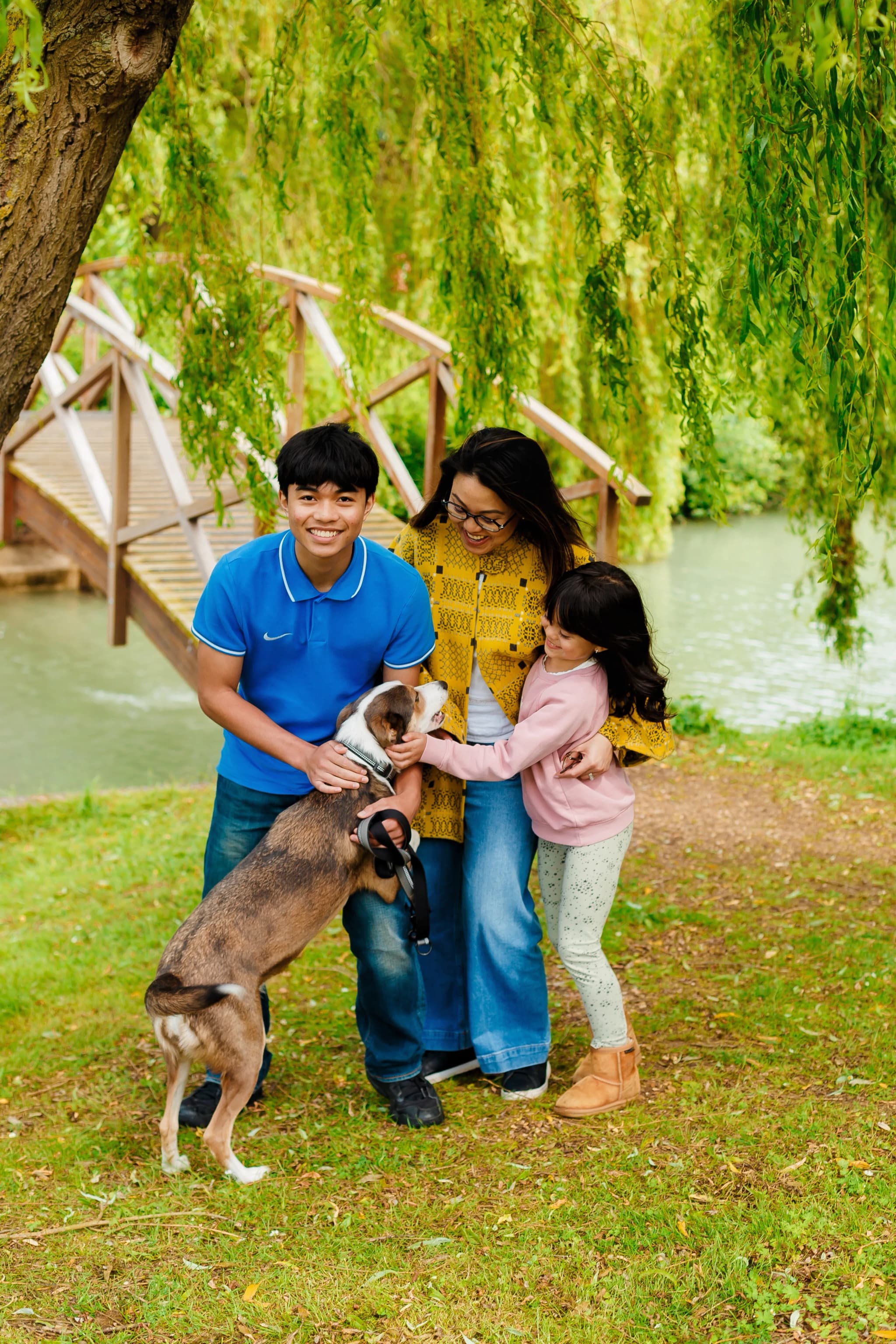
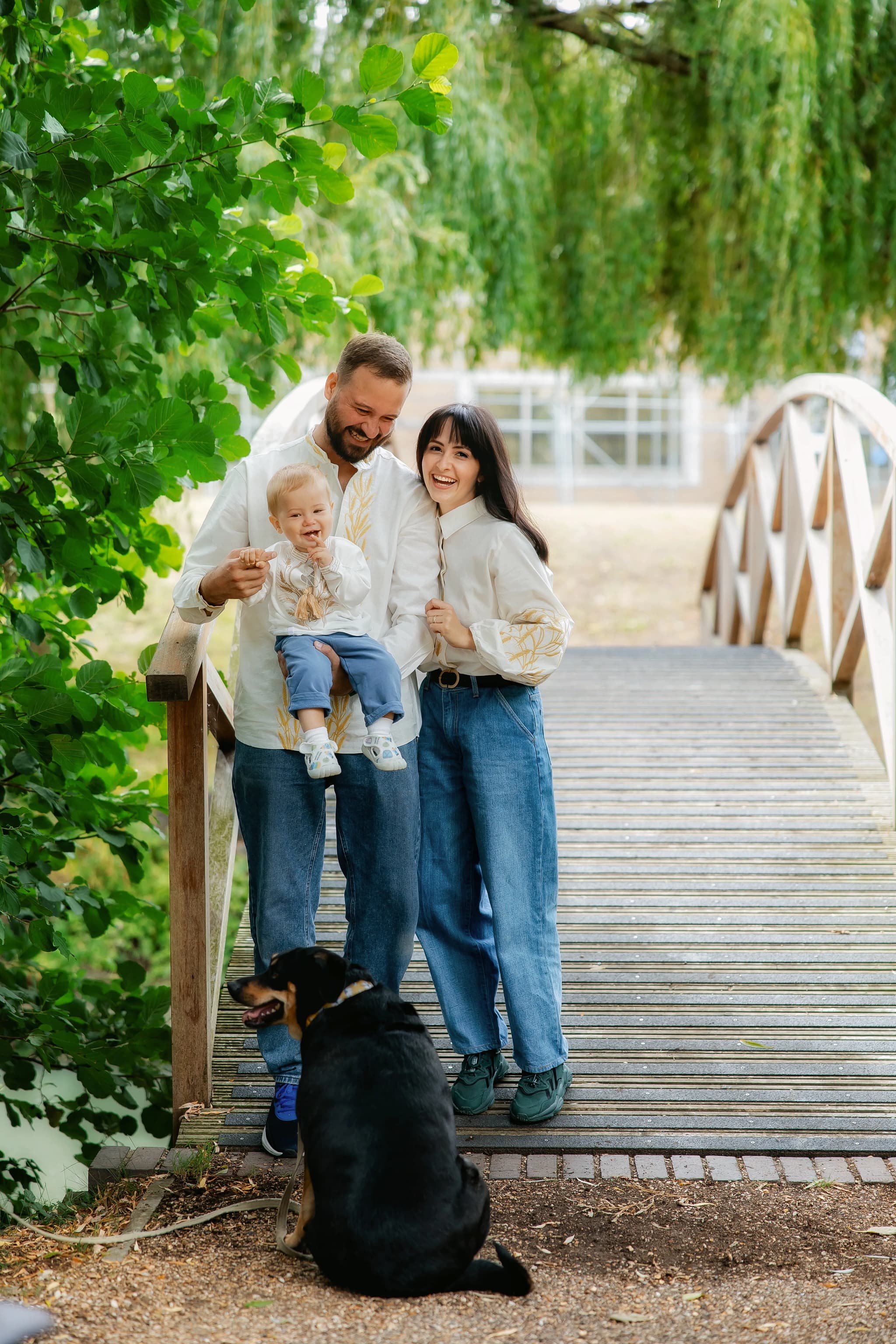
The resulting images tend to be joyful, occasionally a little chaotic, and full of genuine life. You will get proper portraits of the whole family together, composed and considered, but you will also get those irresistible documentary moments that only happen when an animal is part of the scene — the dog stealing somebody's hat, sitting squarely on someone's feet as though guarding them, photobombing a family hug at exactly the wrong or exactly the right moment, depending on how you look at it. Both kinds of image matter, and a well-balanced gallery will include plenty of each.
Because animals are unpredictable, I generally shoot more frames during pet-inclusive sections of a session than I would for a posed adult portrait, simply to make sure the fleeting, perfect moment — the exact tilt of the head, the exact mid-air leap — is actually captured rather than missed by a fraction of a second. It also means the edited gallery from a pet-inclusive session often has a slightly different character to a purely human one: more movement, more candid expressions, more moments that clearly could not have been directed even if we had tried.
On the Day: What Actually Happens
A pet-inclusive session usually starts with the exploration period mentioned earlier, giving the dog time to settle while I chat with the family and get a feel for the location's light. From there, we typically move through a mix of set-ups: some images with the dog held or sitting calmly among the family, some with the dog moving freely nearby while I photograph the humans and simply stay alert for the moments the dog wanders into frame, and usually a dedicated block of time focused purely on the dog itself — running, playing, being generally adorable — because those solo pet portraits are often exactly what families want printed and framed on their own.
Breaks matter too. Dogs, much like small children, do not have unlimited patience for being photographed, and building in a few minutes of simply playing or walking without a camera in front of their face keeps the whole session feeling relaxed rather than relentless. A relaxed dog reads as a relaxed dog in every image, and that ease is usually what makes a photograph feel genuinely warm rather than posed.
If you would like your dog, cat, or any other much-loved animal included in your next family session, it is something I plan for properly rather than squeezing in as an afterthought at the end. Mention your pets when you get in touch and we can talk through the right location, the right time of day, and the right pace for your particular animal, so the whole family — four-legged members included — comes away with images that actually feel like them. Get in touch and we will start planning.

Yana Skakun
Photographer · England
Professional wedding, family and portrait photographer based in England. Passionate about capturing authentic emotions and timeless moments.
About Yana →pet family photos UKdog included family photoshoot Englandpet photography tips UKfamily photographer with dogs Cambridgeincluding dog family portraits
Family Tips — Family Photography in Cambridge & England
Yana Skakun offers natural, relaxed family photography sessions across Cambridge, Cambridgeshire, and the wider East of England. Sessions take place outdoors — in parks, woodland, and countryside — or at your family home, wherever everyone feels most at ease. This guide — Including your pet in family photos: Tips for beautiful results — is part of the photography journal: practical, experience-based advice drawn from real sessions across England. Whether you arrived searching for pet family photos uk or dog included family photoshoot england, the same care and attention shapes every session Yana photographs.
Family Photography sessions are available year-round, with bookings open across Cambridge, Ely, Huntingdon, Peterborough, and further afield — East England, London, the Midlands, and beyond. If you have specific questions about pet photography tips uk, mention it in your enquiry. Get in touch through the contact form above to check availability and discuss your session. Enquiries are welcomed from anywhere in the UK.
Frequently Asked Questions
How do you prepare children for a family photoshoot?+
Keep it low-key beforehand — don't over-explain or build it up too much. Make sure children are fed and rested. Bring a snack and a favourite toy or comfort item. Let them warm up at their own pace rather than forcing poses from the start. The best family photos happen when children forget there's a camera.
What should a family wear for photos?+
Choose a colour palette — 2–3 complementary tones — rather than identical outfits. Earthy neutrals, blues and greens, or cream and blush all work beautifully outdoors. Avoid large logos, neon colours, and very small patterns that create visual noise. Dress for the location and season, and make sure everyone is comfortable.
When is the best time for an outdoor family photoshoot?+
The golden hour — the first hour after sunrise or the last hour before sunset — gives the softest, warmest light. Overcast days are also excellent: the cloud acts as a natural diffuser, eliminating harsh shadows. Midday summer sun is the most challenging light to shoot in.
How long does a family photography session take?+
Most family sessions last 45–75 minutes. Mini sessions (30–40 minutes) work well for smaller families and toddlers who have shorter attention spans. Larger extended family groups may need 90 minutes to cover everyone comfortably.
How many photos will I get from a family photoshoot?+
A standard 60-minute family session typically produces 30–60 edited images delivered in a private online gallery. Mini sessions deliver 15–25 images. All images are colour-corrected, naturally edited, and ready for printing.
Continue Reading
Related Articles

Family Tips
Blended Family Photography: A Sensitive Guide to Step-Families, Co-Parenting & Group Portraits
11 min read · Read Article
Family Tips
Baby Milestone Photography: Capturing Every Stage of the First Year
10 min read · Read Article
Family Tips
Maternity Photography in England: When to Book, What to Wear & Where to Shoot
11 min read · Read Article
Get in Touch
Ready to Book Your Session?
Get in touch to discuss your vision — I'll reply within 24 hours.