Yana Skakun
Country House Hotel Wedding Photography: Formal Gardens & Grand Rooms
By Yana Skakun·20 March 2026·6 min read
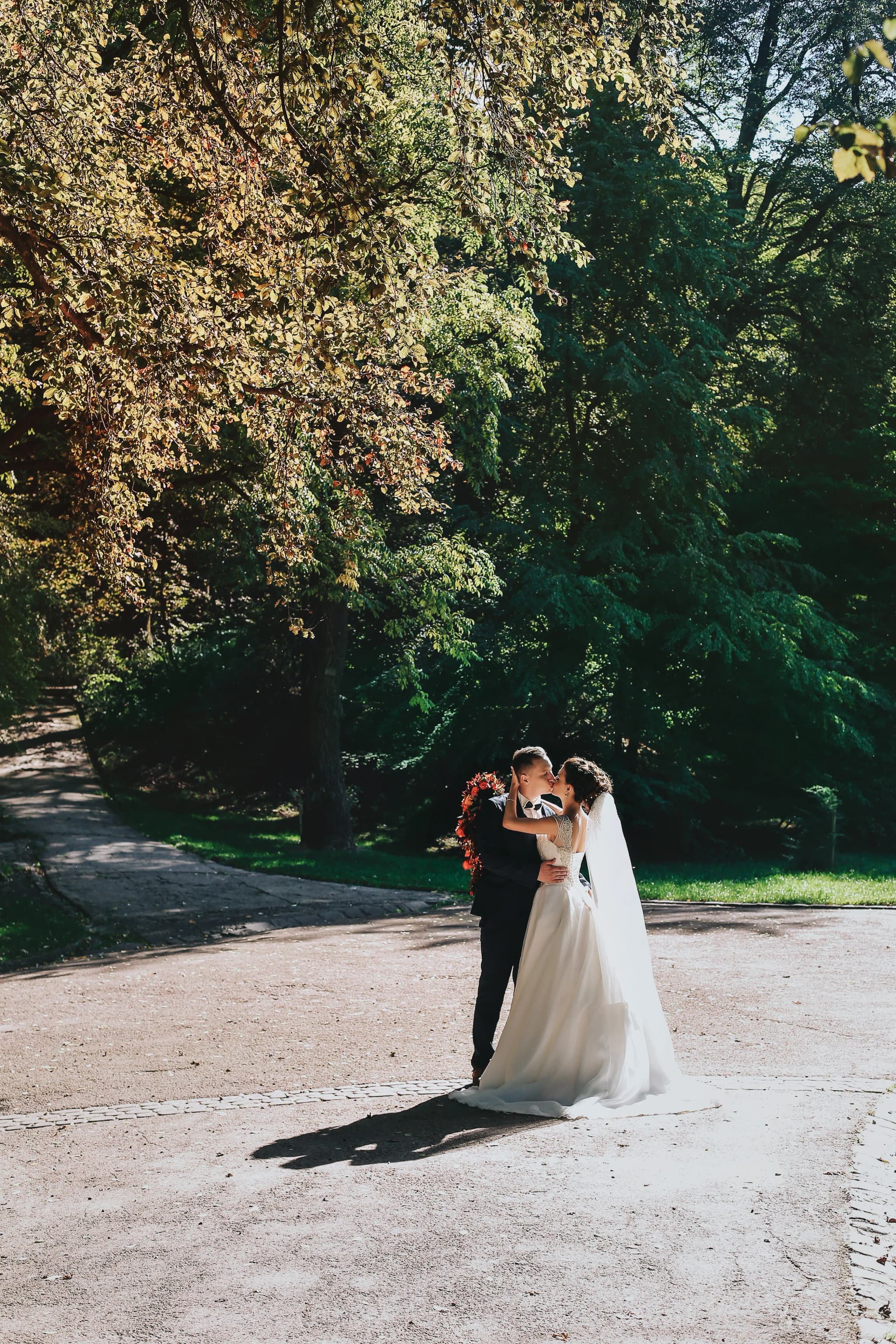
There is a particular quality of stillness that settles over a country house estate on a wedding morning — the dew still on the parkland grass, the facade catching the first warm light, the gardens waiting for the day to begin. Country house weddings are among the most photographically rewarding commissions I take on, precisely because every element of the setting has been considered over centuries: the sightlines, the proportions, the relationship between architecture and landscape. Understanding how to use that considered environment, rather than simply photograph in front of it, is what separates the memorable images from the merely adequate.
Why Country Houses Create Such Distinctive Wedding Images
The English country house tradition gives a photographer something that most modern venues cannot: genuine depth of field in the compositional sense. You have a foreground (the couple), a middle ground (formal gardens or parkland), and a backdrop (the house itself, often set at a considered distance from the formal gardens). That layered landscape means you can build images with genuine visual weight, where the architecture frames and contextualises the portrait rather than simply existing behind it.
Venues such as Elmore Court in Gloucestershire, Prestwold Hall in Leicestershire, or Euridge Manor in the Cotswolds each have this quality. The house is set within grounds that were designed to be seen from specific vantage points, and those vantage points remain the best places to photograph from. Part of my preparation for any country house commission involves researching the estate's history — understanding whether the grounds were laid out by Capability Brown, for instance, tells me there will be a ha-ha, a serpentine lake, and carefully positioned specimen trees, all of which become compositional tools.
Closer to Cambridge, where much of my work is based, venues like Moor Hall in Bury St Edmunds or Marks Hall Estate in Essex demonstrate the same principle: the landscape was designed with an aesthetic intention, and a photographer who understands that intention can work with it rather than against it.
Reading the Light Throughout the Day
Light management at a country house is more complex than at a conventional wedding venue, precisely because the scale of the setting means you are dealing with changing light across a much wider area. A south-facing facade — common in classical house design, where the principal reception rooms faced south to maximise winter light — will be best photographed in the morning and early afternoon. By late afternoon the light will have moved around, and the facade will begin to fall into shadow while the parkland behind the couple glows gold.
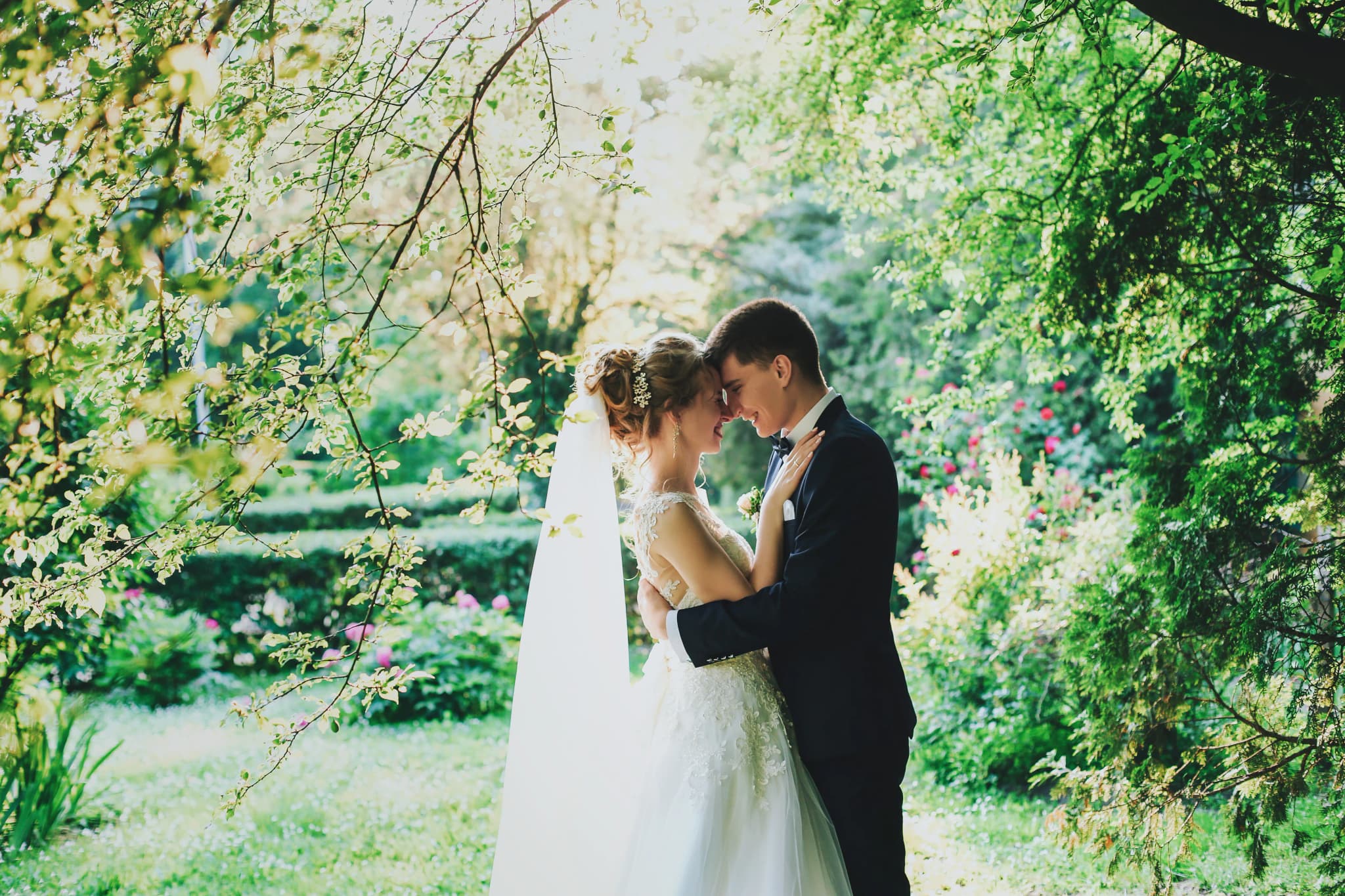
This is not a problem; it is an opportunity. The golden-hour portraits at a country house, taken when the couple walks out through the parkland as the sun drops toward the tree line, are frequently the strongest images of the day. The house recedes into the background, the avenue of limes or oaks catches the low light, and the couple exist within a landscape that looks genuinely timeless. I always walk the estate during the drinks reception, while light is still good, to identify precisely where that sunset position will be and plan the ten-minute portrait session accordingly.
North-facing facades require a different approach. The building itself will be in open shade for much of the afternoon, which produces beautifully even light for portraits against the stonework. The couple should face outward toward the light rather than face the house, using the building as a backdrop rather than a light source. This approach works particularly well for detail-rich facades with columns, pediments, or ornate stonework, where the even light brings out texture that harsh directional sun would flatten or block with shadow.
The Key Compositional Approaches
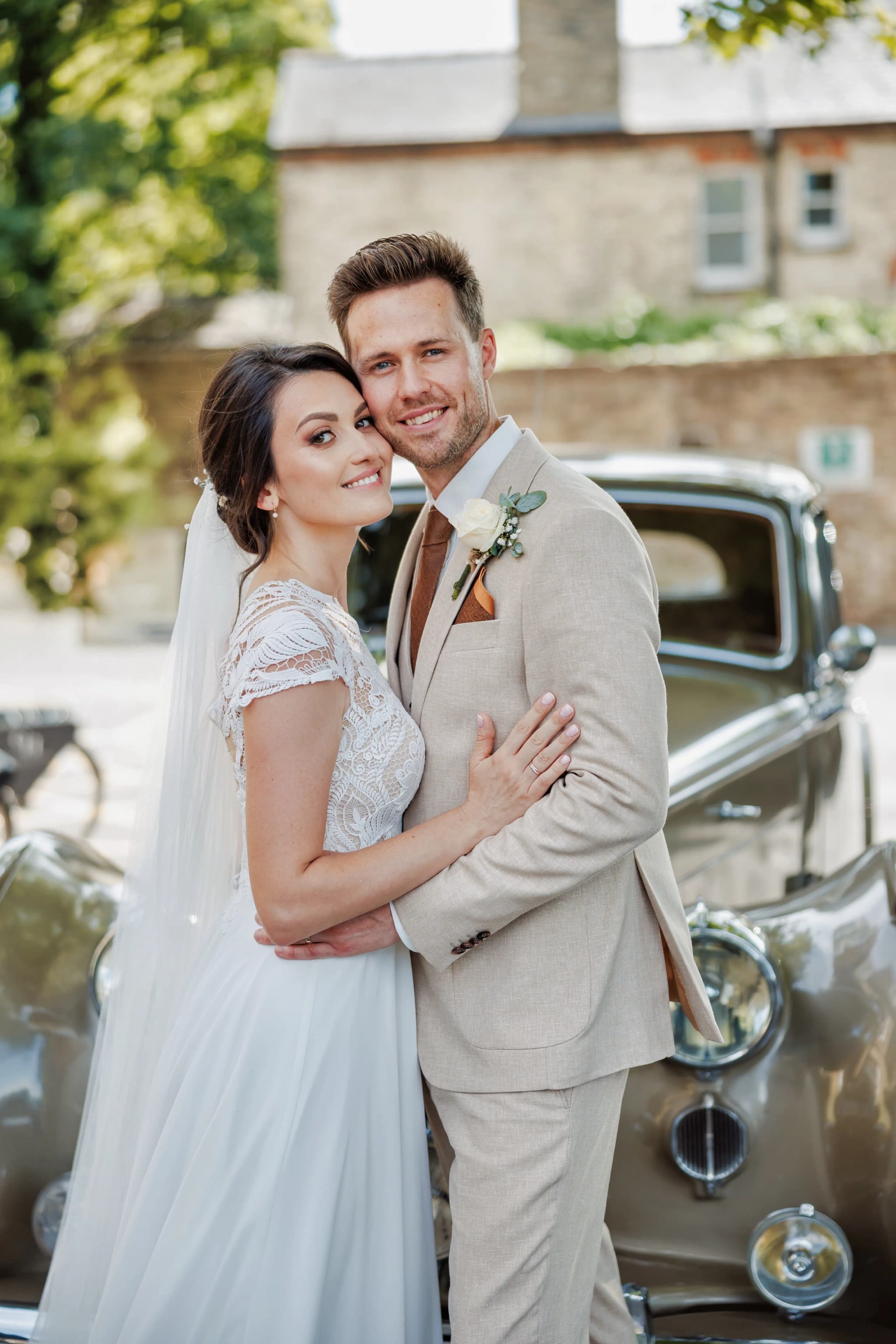
There are four compositional approaches I return to repeatedly at country house weddings, each suited to different lighting conditions and different moments in the day. The first is the classical establishing composition: the full facade visible at middle distance, the couple sharp in the foreground, the house softened slightly by depth of field. This image requires a longer focal length than most photographers would assume — 85mm or 135mm keeps the house proportions realistic and prevents the wide-angle distortion that can make a grand building look squat.
The second approach is the reverse: the couple small within the full landscape, the house visible behind them at a distance. This image is less a portrait and more a document of place — it says "this is where we were married, this is the scale of it." These images are often printed large and hung as statement pieces; they need careful attention to the couple's body language even at small size, because even at a distance, closed or awkward posture reads clearly.
The third approach uses architectural detail rather than the full facade: a grand doorway as a frame, a stretch of classical balustrade as a leading line, a stone archway or garden gate as a contained scene. These images work at any time of day because you can position the couple relative to the available light regardless of which direction the detail faces. The fourth and often most emotionally resonant approach is the garden axis shot: many country houses have a formal axis — a long grass walk, a canal, an avenue of pleached limes — aligned to the building. Place the couple at one end of that axis and photograph along it, and the image has the full geometry of the estate working in its favour.
Group Photographs and the Country House Setting
Country houses are unusually well-suited to group photography. The formal entrance steps or terrace, a feature of almost every classical house, provide natural elevation separation: guests stand on different levels, faces are visible, and the house forms a backdrop that gives the image genuine grandeur. I typically organise the formal family groups on the steps within the first twenty minutes of the drinks reception, while guests are gathered and energy is high, before the group disperses into the grounds.
For larger groups — the full wedding party of sixty or eighty guests — I find a slightly elevated shooting position, often achievable by photographing from the terrace above the main lawn, which gives a slight downward angle that shows all faces clearly and includes the house behind. At venues with a balcony or upper terrace, this position is even more effective. The key is establishing this position during the recce visit rather than discovering it in the fifteen minutes you have available on the day.
Informal group moments — the confetti throw on the gravel sweep in front of the house, guests gathered around a champagne table on the terrace, children running on the lawn with the house behind — benefit from being photographed from a position that includes the architecture. The mistake many photographers make is focusing so tightly on the people that the setting disappears. At a country house wedding, the setting is part of what the couple has paid for and part of what will make these images meaningful in twenty years.
Planning your country house portrait session
I always recommend booking a twenty-minute "golden hour" portrait session during the drinks reception or early evening, separate from the quick portraits immediately after the ceremony. At a country house estate, this is when the parkland light is at its most extraordinary. If you are planning a country house wedding and want to talk through how to structure the photography around your specific venue, get in touch and we can walk through the day together.
Preparing as a Couple: What to Expect and How to Get the Most from Your Shoot
Country house weddings typically offer more time and space for photography than urban or barn venues, but that abundance of space can feel intimidating if you are not someone who feels comfortable being photographed. My advice is always the same: treat the portrait session as a walk in a beautiful garden with your partner, not as a photoshoot. I will guide you through positions and locations, but the images that work best come from genuine movement and conversation rather than posed stillness.
Wear shoes you can walk across grass in — heels that sink into a lawn every few steps create stress during what should be a relaxed twenty minutes. For late-afternoon sessions in particular, bring a light wrap or jacket if the season requires it; the parkland can be cooler than the terrace, and being physically comfortable means you are present in the images rather than thinking about the cold. If the venue has a walled garden, ask the coordinator about access: these enclosed spaces often have the best light of any part of the estate, protected from wind and retaining warmth, and they tend to produce the most intimate portraits of the day.
Interior Photography and the Transition to Evening
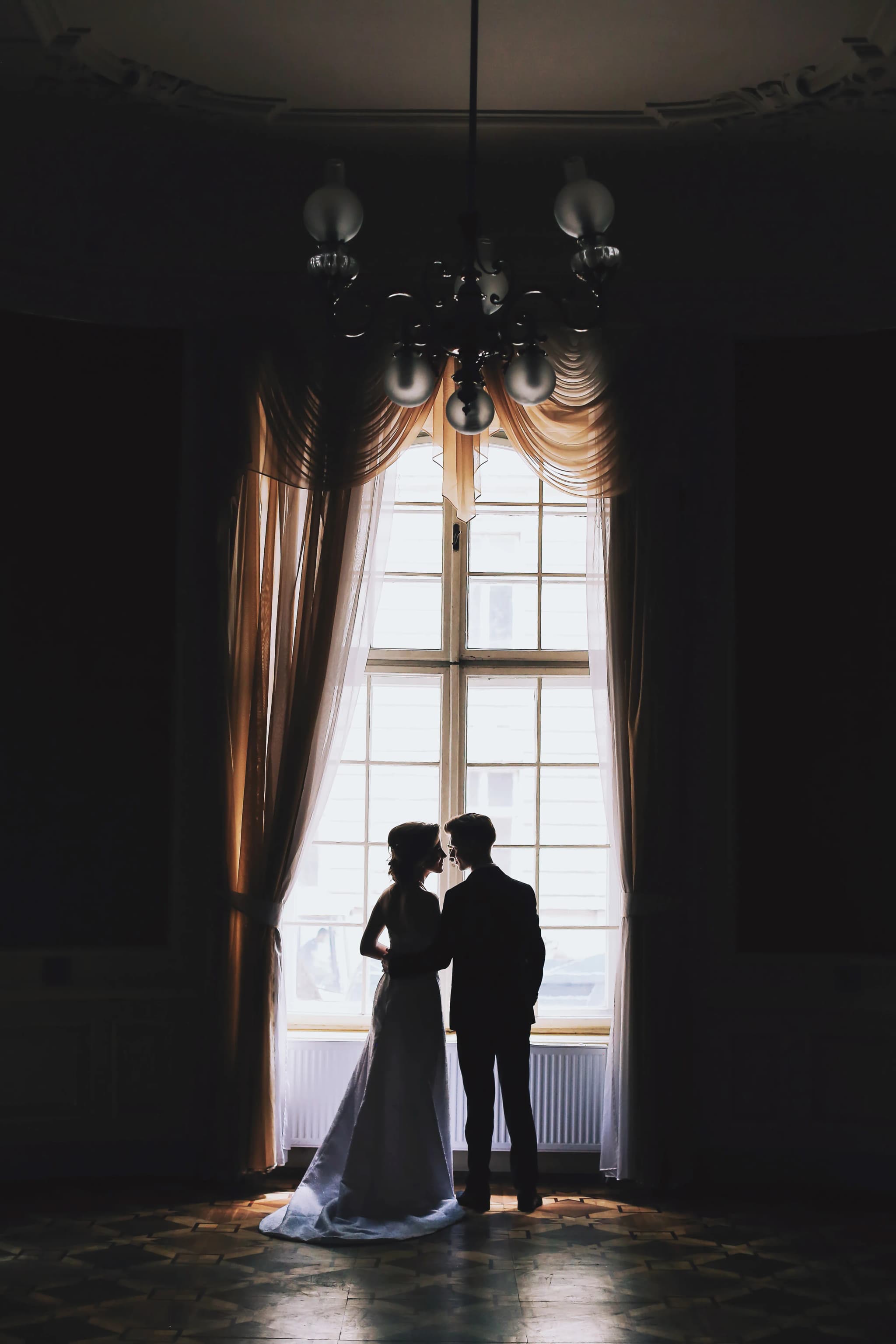
As the day moves into the wedding breakfast and evening reception, the photography shifts from landscape to interior. Country house interiors — drawing rooms converted into dining rooms, ballrooms hung with chandeliers, libraries and orangeries used for drinks — offer a completely different set of challenges and opportunities. The key is balancing the available window light with the warm tungsten or candlelight of the interior, a balance that shifts significantly as dusk falls.
I never use flash for wedding breakfast or evening reception coverage. The quality of light in a country house interior at dusk — the windows still blue, the candles and wall sconces warm orange, the whole scene held in a kind of suspended richness — is irreplaceable by artificial light. Working with higher ISOs and fast primes means the images retain that atmosphere rather than flattening it. The first dance photographed in a candlelit ballroom, the speeches in a room with the evening light coming through tall sash windows behind the speaker: these moments require patience and technical confidence rather than flash and speed.
By the end of a country house wedding day, you have typically worked across parkland, formal gardens, grand architecture, intimate interior spaces, and the low light of an evening celebration. The range is extraordinary, and it is what makes country house commissions so creatively satisfying. The images that result tell a complete story of a day and a place — not just a portrait session, but a document of one of England's most enduring aesthetic traditions, made personal to you.
Every country house estate has its own character, its own light, its own history written into the landscape. The work of photographing a wedding within that setting is, at its best, a collaboration between that history and the story you are beginning — images that belong equally to the place and to you.

Yana Skakun
Photographer · England
Professional wedding, family and portrait photographer based in England. Passionate about capturing authentic emotions and timeless moments.
About Yana →country house wedding photographycountry house hotel wedding photographerestate wedding photography England
Wedding Tips — Wedding Photography in Cambridge & England
Yana Skakun is a professional wedding photographer based in Cambridge, covering weddings across England — from intimate elopements to full-day ceremonies at country houses, barns, and city venues. Every couple receives a relaxed, documentary approach that captures the day as it truly unfolds. This guide — Country House Hotel Wedding Photography: Formal Gardens & Grand Rooms — is part of the photography journal: practical, experience-based advice drawn from real sessions across England. Whether you arrived searching for country house wedding photography or country house hotel wedding photographer, the same care and attention shapes every session Yana photographs.
Wedding Photography sessions are available year-round, with bookings open across Cambridge, Ely, Huntingdon, Peterborough, and further afield — East England, London, the Midlands, and beyond. If you have specific questions about estate wedding photography england, mention it in your enquiry. Get in touch through the contact form above to check availability and discuss your session. Enquiries are welcomed from anywhere in the UK.
Frequently Asked Questions
How much does a wedding photographer cost in England?+
Wedding photography in England typically ranges from £1,500 to £4,000+ for a full day. Price depends on experience, coverage hours, and whether albums or engagement shoots are included. Most photographers charge between £2,000–£3,000 for 8–10 hours of coverage.
How early should you book a wedding photographer?+
For peak season (May–September), book 12–18 months in advance. For autumn and winter weddings, 9–12 months is usually sufficient. Popular photographers at popular venues fill up fast — as soon as you have a date and venue confirmed, start reaching out.
How many photos do you get from a wedding photographer?+
Most professional wedding photographers deliver 400–800 edited images for a full-day wedding. The exact number depends on coverage hours, how many guests there are, and the photographer's editing style. Quality matters more than quantity — a curated gallery of 500 images tells the story better than 1,500 unedited files.
Do you need a second photographer at your wedding?+
A second photographer is helpful if you want simultaneous coverage of getting-ready moments in different locations, multiple angles during the ceremony, or more candid coverage during the reception. It adds cost but significantly increases the variety and completeness of your gallery.
What is the difference between documentary and editorial wedding photography?+
Documentary (reportage) wedding photography captures moments as they happen — the photographer observes and doesn't intervene. Editorial photography involves deliberate direction: placing you in good light, shaping compositions, creating intentional portraits. Most photographers blend both styles throughout the day.
Continue Reading
Related Articles

Wedding Tips
Sustainable Eco-Friendly Wedding Guide — Planning a Green Celebration
15 min read · Read Article
Wedding Tips
Trash the Dress Session — Complete Planning and Photography Guide
14 min read · Read Article
Wedding Tips
Client Communication for Photographers — From Enquiry to Gallery Delivery
15 min read · Read Article
Get in Touch
Ready to Book Your Session?
Get in touch to discuss your vision — I'll reply within 24 hours.