Yana Skakun
Warwick Castle wedding photography: Medieval magic in Warwickshire
By Yana Skakun·12 March 2026·7 min read
There are venues that provide a pleasant backdrop, and there are venues that genuinely change the register of a wedding day — and Warwick Castle belongs firmly in the second category. Rising above the River Avon on a sandstone bluff that has been fortified since the tenth century and rebuilt in its present form from the 1350s onwards, it is one of the very few wedding venues in England where couples are married inside a structure of real medieval weight rather than a building styled to evoke one. I have photographed weddings across Warwickshire and the wider Midlands for several years now, and Warwick Castle remains one of the settings I am most consistently excited to be booked for. This guide sets out what the castle actually offers a wedding photographer — the towers, the state rooms, the gardens, the river — and the practical planning detail that helps a couple get the most from a day at a working visitor attraction that also happens to be one of the most photogenic buildings in the country.
The Approach, the Towers and the Curtain Wall
The first view most guests get of Warwick Castle — across the bridge over the Avon, with the old mill and the sheer curtain wall rising above the water — is one of the great approach shots in English wedding photography. I try to photograph this view early in the day if the light allows, before guests arrive in numbers, because an empty bridge with the castle behind it says everything about the scale of the setting in a single frame. It is also a view I return to for portraits later on, once the light has softened.
Caesar's Tower, dating from the 1350s, and the slightly later Guy's Tower are both accessible to guests and give genuinely dramatic elevated portrait positions, looking out over the estate, the town, and the river below. The mound with its shell keep is the oldest surviving part of the site and has a different, more raw character — less polished than the main towers, and useful when a couple wants something a little wilder in the mix of images. The battlements and arrow slits along the curtain wall create strong, graphic frames that work particularly well for tighter portraits of the couple, where the architecture becomes texture rather than backdrop.
The courtyard inside the main walls, enclosed on all sides by towers and gatehouse, is more intimate than the scale of the castle might suggest, and it is here that many outdoor ceremonies and drinks receptions are held. It has the advantage of feeling sheltered and human in scale even though every wall around you is genuinely medieval — a combination that is difficult to find anywhere else.
The Great Hall and State Rooms
Indoors, the Great Hall is the standout space. Beamed, hung with suits of armour and weaponry, and built on a scale that no amount of styling could replicate in a modern venue, it carries nine hundred years of history in a way that photographs with genuine gravity. Confetti thrown under that ceiling, or a first dance beneath it, has a quality that is very hard to manufacture elsewhere.
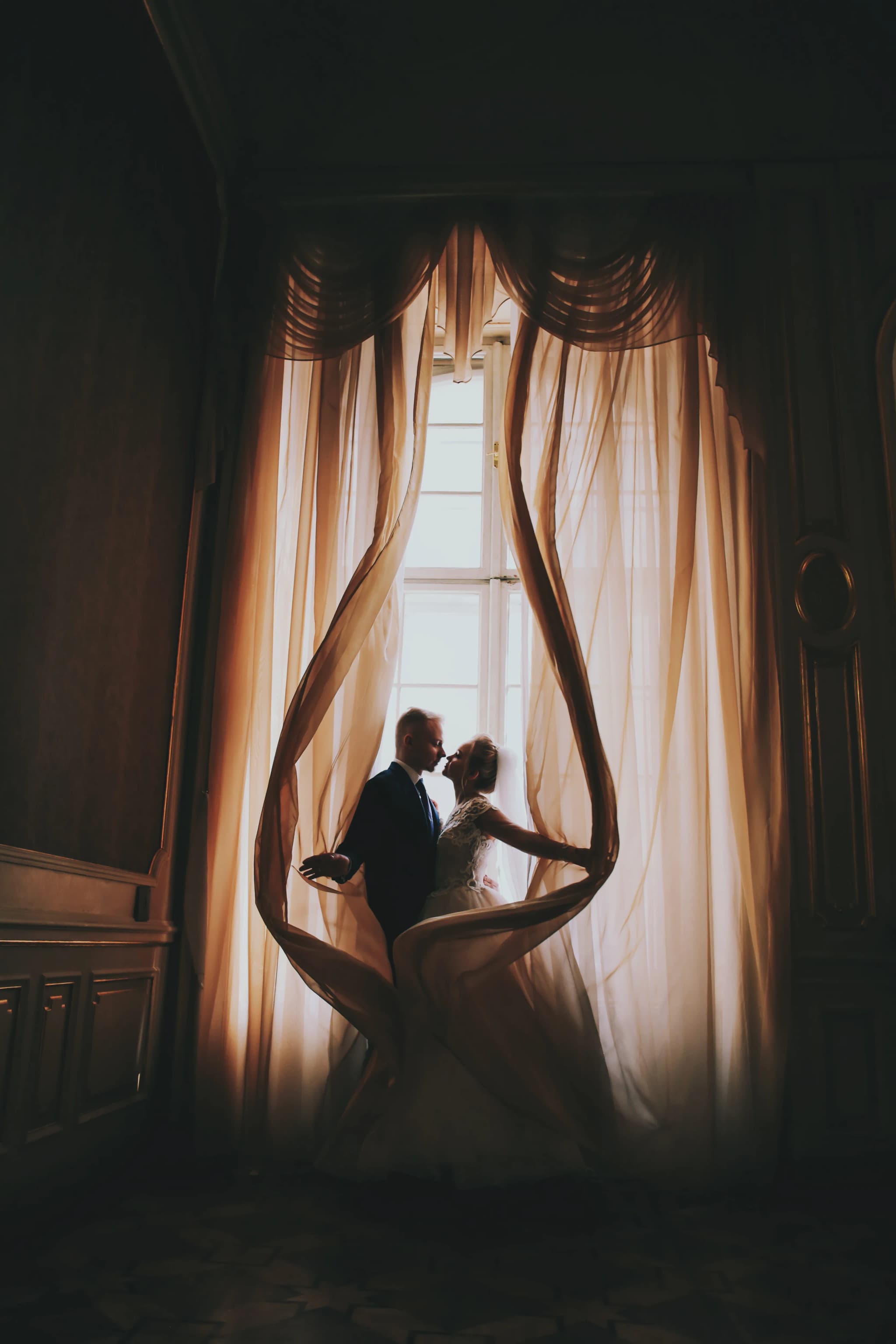
The wider run of State Rooms and the Kenilworth suite give further variety — richly furnished interiors with portraits, tapestries, and period furniture that make excellent backdrops for smaller group shots and detail photography of rings, invitations, and dress. Technically, these rooms are a mixed-light challenge: some are brightly lit near the windows and fall away into deep shadow further in, and the balance between warm interior lighting and cooler daylight from outside needs careful handling so that skin tones stay natural rather than shifting orange or grey depending on where in the room a couple is standing. This is exactly the kind of interior I bring additional lighting for as standard, rather than relying purely on the available light, so the images hold their quality regardless of which room or which time of day.
The Formal Gardens, the Peacocks and the River Avon
Behind the south front of the castle, the formal Victorian rose garden and the adjoining peacock garden are beautifully maintained and give a completely different mood to the towers and battlements — softer, more romantic, and at their best from late spring through to late summer when the roses are out. It is not unusual for one of the resident peacocks to wander into a frame uninvited, which guests generally find delightful rather than distracting.
For me, though, the standout location at Warwick is the river. The Avon runs directly below the castle walls, and from the mill area and the water meadow beside it, you get a view of the castle rising almost sheer above the water that is genuinely one of the finest exterior portrait settings at any castle venue in England. On a still day the reflection in the water doubles the drama of the shot. I build river-side portraits into the timeline for nearly every Warwick Castle wedding I photograph, weather and tide-level permitting, because the resulting images look nothing like a typical castle wedding photograph — they look like something from a period drama.
Beyond the formal gardens, the parkland — landscaped in the eighteenth century and shaped by the hand of Capability Brown — opens out into genuinely open, natural ground: mature cedars, horse chestnuts, and long sightlines back toward the ramparts. This is where I take couples for the more relaxed, walking portraits later in the afternoon, away from the crowds nearer the main buildings. In late summer and autumn especially, golden hour light through the old trees with the castle in the distance produces some of the most naturally beautiful frames of the whole day.
Planning your Warwick Castle wedding photography
Every couple who marries at Warwick has a different mix of locations, guest numbers, and access windows to work with. I put together a tailored shot list and timeline for each Warwick Castle wedding I photograph, built around your specific ceremony and reception spaces.
Enquire about your Warwick Castle weddingWorking Around a Live Visitor Attraction
It is worth understanding, when you are planning a wedding here, that Warwick Castle is managed by Merlin Entertainments and operates as a major visitor attraction alongside its wedding calendar. That is not a drawback — it is simply a scheduling reality that a good photographer plans around rather than fights against. The castle's own events team is experienced at coordinating wedding parties around public opening hours, and exclusive use of specific towers, rooms, or garden areas outside the general visitor zones can usually be arranged for your day. What matters is establishing, well in advance, exactly which locations will be available to you and at what time, because that access window determines the whole portrait sequence.
I always ask to see the confirmed access schedule from the venue coordinator before finalising the photography timeline, so we are not trying to squeeze the state rooms, the towers, and the river portraits into a window that does not actually accommodate all three. On a Warwick Castle wedding day, sequencing is everything: knowing which spaces are ours exclusively, and for how long, lets me plan a route through the castle that uses the light and the crowds — or the lack of them — to best advantage, rather than discovering on the day that a location is unexpectedly closed off or full of day visitors.
Group and family portraits are worth planning with particular care at a venue this large. With so many strong locations available, it is tempting to try to use all of them, but a long guest list moving between the courtyard, the towers, and the gardens for formal photographs eats into time that is often better spent on the couple portraits by the river or in the parkland. I generally recommend concentrating formal groups in one or two nearby locations — typically the courtyard or the lawn near the state rooms — and saving the more distant, more dramatic settings for the couple alone, once family duties are done and the pace of the day can slow down.
Getting There and Practical Notes for Guests
Warwick is genuinely well connected, which matters for a venue that draws guests from across the Midlands and beyond. Warwick station is a short walk from the castle, making it a realistic option for guests travelling by train from Birmingham, Coventry, Leamington Spa, and further afield on the West Midlands and Chiltern lines. By road, the castle sits close to the M40, putting it within comfortable reach of Oxford and London to the south and Birmingham to the north. For a couple weighing up venues, that combination of dramatic setting and genuine accessibility is one of Warwick's real practical strengths, alongside its photographic appeal.
Seasonally, I would encourage couples to think carefully about timing. Late spring and summer give the rose garden and the parkland their fullest colour and the longest daylight for an unhurried portrait session by the river. Early autumn brings a different but equally striking mood, with warmer light on the sandstone walls and the horse chestnuts in the parkland beginning to turn. Whichever season you choose, the castle's scale means the photography rarely feels weather-dependent in the way a purely outdoor venue can — there is always a covered courtyard, a state room, or a sheltered corner of the walls to fall back on if the day turns wet.
Why Warwick Castle Photographs So Well
What sets Warwick apart from many castle venues is the sheer range of genuinely distinct settings within a single site: soaring medieval towers, an intimate enclosed courtyard, a baronial great hall, formal Victorian gardens, and a riverside view that would not look out of place on a film set. A photographer working here is rarely short of options, but the flip side of that variety is that a plan matters more than it would at a simpler venue. Left unplanned, a day at Warwick can spend too long moving between locations and too little time actually with the couple in any one of them. Planned well, it delivers a set of wedding photographs with a range and a depth that few other venues in England can match, moving from the grandeur of the Great Hall to the quiet drama of the river within the same afternoon.
If you are getting married at Warwick Castle, or considering it, I would be glad to talk through how the venue works, which locations suit your guest numbers and the time of year you have in mind, and how a photography timeline for the day might come together. Every Warwick wedding I have photographed has been different — shaped by the couple, the season, and the exact spaces they had access to — and that is exactly what makes the venue worth the planning it asks for. Get in touch to discuss your date and how I can help you make the most of this extraordinary setting.


Yana Skakun
Photographer · England
Professional wedding, family and portrait photographer based in England. Passionate about capturing authentic emotions and timeless moments.
About Yana →Warwick Castle weddingWarwick Castle wedding photographycastle wedding Warwickshiremedieval wedding photography Englandwedding venues Warwickshire
Wedding Tips — Wedding Photography in Cambridge & England
Yana Skakun is a professional wedding photographer based in Cambridge, covering weddings across England — from intimate elopements to full-day ceremonies at country houses, barns, and city venues. Every couple receives a relaxed, documentary approach that captures the day as it truly unfolds. This guide — Warwick Castle wedding photography: Medieval magic in Warwickshire — is part of the photography journal: practical, experience-based advice drawn from real sessions across England. Whether you arrived searching for warwick castle wedding or warwick castle wedding photography, the same care and attention shapes every session Yana photographs.
Wedding Photography sessions are available year-round, with bookings open across Cambridge, Ely, Huntingdon, Peterborough, and further afield — East England, London, the Midlands, and beyond. If you have specific questions about castle wedding warwickshire, mention it in your enquiry. Get in touch through the contact form above to check availability and discuss your session. Enquiries are welcomed from anywhere in the UK.
Frequently Asked Questions
How much does a wedding photographer cost in England?+
Wedding photography in England typically ranges from £1,500 to £4,000+ for a full day. Price depends on experience, coverage hours, and whether albums or engagement shoots are included. Most photographers charge between £2,000–£3,000 for 8–10 hours of coverage.
How early should you book a wedding photographer?+
For peak season (May–September), book 12–18 months in advance. For autumn and winter weddings, 9–12 months is usually sufficient. Popular photographers at popular venues fill up fast — as soon as you have a date and venue confirmed, start reaching out.
How many photos do you get from a wedding photographer?+
Most professional wedding photographers deliver 400–800 edited images for a full-day wedding. The exact number depends on coverage hours, how many guests there are, and the photographer's editing style. Quality matters more than quantity — a curated gallery of 500 images tells the story better than 1,500 unedited files.
Do you need a second photographer at your wedding?+
A second photographer is helpful if you want simultaneous coverage of getting-ready moments in different locations, multiple angles during the ceremony, or more candid coverage during the reception. It adds cost but significantly increases the variety and completeness of your gallery.
What is the difference between documentary and editorial wedding photography?+
Documentary (reportage) wedding photography captures moments as they happen — the photographer observes and doesn't intervene. Editorial photography involves deliberate direction: placing you in good light, shaping compositions, creating intentional portraits. Most photographers blend both styles throughout the day.
Continue Reading
Related Articles

Wedding Tips
Sustainable Eco-Friendly Wedding Guide — Planning a Green Celebration
15 min read · Read Article
Wedding Tips
Trash the Dress Session — Complete Planning and Photography Guide
14 min read · Read Article
Wedding Tips
Client Communication for Photographers — From Enquiry to Gallery Delivery
15 min read · Read Article
Get in Touch
Ready to Book Your Session?
Get in touch to discuss your vision — I'll reply within 24 hours.