Yana Skakun

Don't Choose This Confetti: The Worst Types for Wedding Photos
By Yana Skakun·10 June 2026·5 min read
Not all confetti photographs the same way. After shooting weddings across Cambridgeshire, Suffolk, and London, I've seen couples spend weeks agonising over flowers and stationery — then grab whatever confetti looks prettiest in a shop — only to end up with confetti shots that are blurry, muddy, or just plain unusable. The type of confetti you choose has a genuine impact on the photographs you'll keep for the rest of your life, and some varieties are genuinely difficult to work with no matter how skilled your photographer is.
Why Confetti Type Matters More Than You Think
Most couples think of confetti as a decoration — something thrown in the air for a few seconds while everyone cheers. But from behind the camera, that moment is one of the hardest to capture well. You have a narrow window: typically three to five seconds before confetti hits the ground and people start looking at their feet instead of at each other. In that window I'm reading the light, managing the crowd, watching for the peak moment of expression on both of your faces, and trying to freeze confetti mid-air rather than catching a single blurred streak across the frame.
The confetti itself determines how much of that is possible. Heavy pieces fall fast and photograph as motion blur. Shiny pieces create harsh glare. Tiny pieces scatter so widely that none are visible in the final image unless you shoot at a focal length that loses all sense of place. The best confetti for photographs behaves predictably, moves slowly, and catches light without overwhelming it. The worst does the opposite — and I've shot enough weddings to have a clear list of which types to avoid.
The Worst Offenders: Confetti Types That Rarely Photograph Well
These are the varieties I see most often at UK weddings that cause the most problems in photographs. Some are popular precisely because they look impressive in person — which makes them even more disappointing when the images come back looking flat or chaotic.
- ◆Metallic foil or sequin confetti: These are the single biggest problem I encounter. Foil shapes — stars, hearts, circles — are designed to catch light, and they do exactly that in the worst way. Under direct sun or flash, each piece becomes a tiny mirror, creating blown-out hot spots across your image. The individual shapes are so reflective that they dominate the frame and draw the eye away from your faces. In overcast British light they photograph as dull grey blobs. Either way, the result rarely looks like the Pinterest image that inspired the choice.
- ◆Paper hole-punch dots (standard confetti): The tiny circular confetti sold in bags at every card shop is almost invisible in photographs. The pieces are so small that from even a metre away they reduce to specks. To show them clearly I'd need to shoot tight and lose the context of the venue and crowd entirely. Throw a large bag and the sheer volume creates a visual noise that competes with everything else in the frame. This is the variety most likely to produce photographs where you can't actually see what's being thrown.
- ◆Biodegradable plastic or cellophane: Several venues across Cambridgeshire and the wider UK now ban non-biodegradable confetti entirely, so check your venue rules before you buy anything. Beyond the environmental and venue concerns, cellophane catches light in unpredictable ways and often photographs with a clinical, synthetic quality that sits awkwardly against organic settings like barns, gardens, or churches. It also tends to cling together rather than dispersing into the elegant cloud you're imagining.
- ◆Very dark or single very deep colour: Deep purple, burgundy, or near-black confetti can look stunning against a light dress in a styled flat-lay photograph but is extremely difficult to photograph mid-air. Against a bright sky or pale stone church wall it disappears. Against a dark background it disappears even faster. Without contrast and separation from the environment, the confetti simply doesn't register clearly in the image.
- ◆Oversized novelty shapes: Confetti shaped like giant hearts, initials, or intricate laser-cut designs photograph less like confetti and more like litter. The larger the individual piece, the harder it is for multiple pieces to appear simultaneously in the air with your faces also in frame. One oversized heart floating past your shoulder at the wrong moment can look accidental rather than celebratory. Novelty shapes also tend to be heavier than petal confetti, so they fall quickly and give me less time to shoot.
- ◆Anything sold damp or that clumps: This sounds obvious, but I've shot weddings where confetti stored in a damp church porch — or left in bags in a warm car then a cold churchyard — arrived at the moment completely clumped together. Clumped confetti doesn't scatter. Guests throw dense wet fistfuls that hit rather than float. There's no recovery from this in post-processing. Always store confetti in a cool, dry place and if you're using fresh or dried flower petals, transfer them to open cones or baskets only on the morning of the wedding.
What Actually Works: The Standard I Recommend to Every Couple
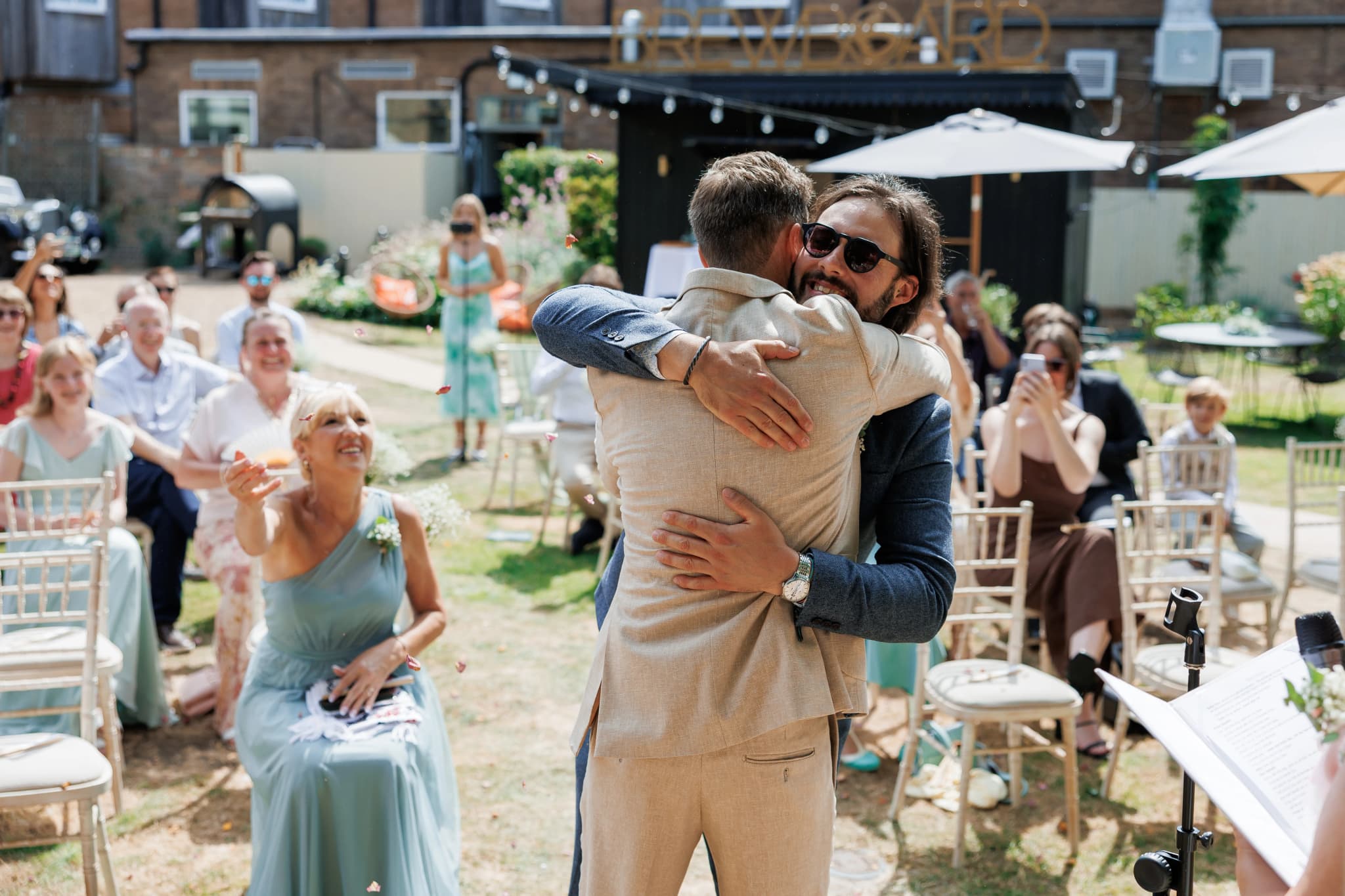
Since I'm telling you what to avoid, it's only fair to tell you what I'd choose myself. Dried flower petals — particularly larkspur, rose, or mixed meadow petal blends — are my consistent first recommendation for UK weddings. They are lightweight enough to hang in the air for two to three seconds rather than dropping immediately, they come in colours that complement almost every palette, they are biodegradable and accepted at the vast majority of UK venues, and they photograph with a softness and texture that looks genuinely beautiful rather than synthetic.
For couples who want something more graphic or modern, larger cut paper confetti in a contrasting light colour — ivory, blush, or pale gold — works well provided the pieces are at least two centimetres across. Enough size to be visible in the frame, light enough to float, matte enough to avoid glare. Biodegradable tissue paper confetti in a similar size range is another solid option, particularly for outdoor ceremonies where the venue may have restrictions.
One practical note that matters enormously: quantity. Underestimating how much confetti you need is almost as damaging to the photographs as choosing the wrong type. I recommend at least one generous cone or cup per guest — not a pinch. The difference between a photograph that feels joyful and one that feels sparse is almost always volume. Brief your guests before the moment, not during, so that everyone throws simultaneously rather than staggering their throws across ten seconds.
UK Venues and Practical Restrictions to Know Before You Buy
This is where couples are most often caught out. A significant number of UK wedding venues — including many of the historic houses, National Trust properties, and church venues across Cambridgeshire and beyond — have specific confetti policies. Some permit only natural dried petals. Some restrict confetti to a designated area outside the main entrance. Some ban confetti entirely indoors, which is relevant if you're planning a covered walkway or indoor ceremony exit. A small number of outdoor venues near nature reserves restrict even biodegradable petals due to seed contamination concerns.
Check your venue's policy in writing before purchasing anything, and check it early — ideally at your first venue visit rather than the week before the wedding. If your venue is restrictive, a good alternative is a petal toss using fresh or dried petals provided in small wicker baskets rather than paper cones, which signals to guests that this is a considered, intentional moment rather than an impromptu scatter. Baskets also look far better in photographs of the preparation than a pile of shop-bought bags.
If your venue prohibits confetti altogether, discuss alternatives with your photographer before assuming the moment is lost. Ribbon wands, dried flower bouquets held aloft, or even a well-timed bubble send-off can create a similarly celebratory exit photograph without involving confetti at all. The goal is always a photograph you love — and there are more ways to achieve that than the confetti aisle at a wedding fair would suggest.
A Note on Timing and Light: The Photographer's Side of the Equation
Even the best confetti will photograph poorly if the timing is wrong. The confetti exit works best in bright, directional natural light — ideally with the sun slightly behind or to the side of the couple so the petals are backlit and appear to glow rather than casting shadow. Flat overcast light flattens confetti and makes even dried flower petals look grey and lifeless. This is not always controllable — British weather is British weather — but it's worth knowing so you can plan your ceremony timing with some awareness of where the light will be.
I always ask couples to plan the confetti exit for immediately after the ceremony rather than saving it for later in the day. Guest energy is highest immediately post-ceremony, the light tends to be more favourable in the early afternoon than the late afternoon at many UK venues, and crucially, guests are still dressed tidily and positioned naturally rather than scattered across a reception room. A confetti exit that happens at the right moment with the right light and the right confetti is one of the most reliably joyful photographs from any wedding day. Getting all three right takes a little planning — but that planning is entirely worth it.
Want Confetti Photographs You'll Actually Love?
Every detail of your confetti exit — timing, light, positioning, and yes, confetti type — is something I plan with you in advance so that when the moment comes, nothing is left to chance. If you're getting married in Cambridge, Suffolk, or anywhere across the UK, I'd love to talk through your day and make sure every moment is captured properly.
Check Your Date →

Yana Skakun
Photographer · England
Professional wedding, family and portrait photographer based in England. Passionate about capturing authentic emotions and timeless moments.
About Yana →worstconfettiforwedding
Wedding Tips — Wedding Photography in Cambridge & England
Yana Skakun is a professional wedding photographer based in Cambridge, covering weddings across England — from intimate elopements to full-day ceremonies at country houses, barns, and city venues. Every couple receives a relaxed, documentary approach that captures the day as it truly unfolds. This guide — Don't Choose This Confetti: The Worst Types for Wedding Photos — is part of the photography journal: practical, experience-based advice drawn from real sessions across England. Whether you arrived searching for worst or confetti, the same care and attention shapes every session Yana photographs.
Wedding Photography sessions are available year-round, with bookings open across Cambridge, Ely, Huntingdon, Peterborough, and further afield — East England, London, the Midlands, and beyond. If you have specific questions about for, mention it in your enquiry. Get in touch through the contact form above to check availability and discuss your session. Enquiries are welcomed from anywhere in the UK.
Frequently Asked Questions
How much does a wedding photographer cost in England?+
Wedding photography in England typically ranges from £1,500 to £4,000+ for a full day. Price depends on experience, coverage hours, and whether albums or engagement shoots are included. Most photographers charge between £2,000–£3,000 for 8–10 hours of coverage.
How early should you book a wedding photographer?+
For peak season (May–September), book 12–18 months in advance. For autumn and winter weddings, 9–12 months is usually sufficient. Popular photographers at popular venues fill up fast — as soon as you have a date and venue confirmed, start reaching out.
How many photos do you get from a wedding photographer?+
Most professional wedding photographers deliver 400–800 edited images for a full-day wedding. The exact number depends on coverage hours, how many guests there are, and the photographer's editing style. Quality matters more than quantity — a curated gallery of 500 images tells the story better than 1,500 unedited files.
Do you need a second photographer at your wedding?+
A second photographer is helpful if you want simultaneous coverage of getting-ready moments in different locations, multiple angles during the ceremony, or more candid coverage during the reception. It adds cost but significantly increases the variety and completeness of your gallery.
What is the difference between documentary and editorial wedding photography?+
Documentary (reportage) wedding photography captures moments as they happen — the photographer observes and doesn't intervene. Editorial photography involves deliberate direction: placing you in good light, shaping compositions, creating intentional portraits. Most photographers blend both styles throughout the day.
Continue Reading
Related Articles

Wedding Tips
Sustainable Eco-Friendly Wedding Guide — Planning a Green Celebration
15 min read · Read Article
Wedding Tips
Trash the Dress Session — Complete Planning and Photography Guide
14 min read · Read Article
Wedding Tips
Client Communication for Photographers — From Enquiry to Gallery Delivery
15 min read · Read Article
Get in Touch
Ready to Book Your Session?
Get in touch to discuss your vision — I'll reply within 24 hours.