Yana Skakun
Second Pregnancy Maternity Photos: Including Your Toddler
By Yana Skakun·24 March 2026·5 min read
Second and third pregnancy maternity sessions carry an extra dimension that first-time maternity photography simply does not have: there is already a small person in the world whose family is about to change forever. Where a first maternity shoot is often quiet and reflective — just the couple, the bump, and the anticipation of who this baby will be — a second-time session is livelier, funnier, and considerably harder to plan around, because it involves an actual toddler with their own opinions about standing still. I love these sessions precisely for that reason. Including your older child creates a document of a transition that families often do not think to capture until years later, when that toddler is grown and asks to see what things were like just before their sibling arrived. Done well, it becomes one of the most treasured sets of images in a family's whole collection, not despite the chaos but because of it.
Choosing the Right Timing in the Pregnancy
For a first pregnancy, the classic advice is to book maternity photography between around thirty and thirty-six weeks, when the bump is well-defined but you are not yet exhausted or overdue. For a second or third pregnancy with a toddler in tow, I generally recommend planning slightly earlier in that window — closer to thirty to thirty-three weeks — simply because energy levels matter twice over. You are managing your own changing body and a small child's naps, moods, and unpredictability, and giving yourself a bit of buffer before the final, most tiring weeks of pregnancy makes the whole day considerably easier to enjoy rather than endure.
It is also worth thinking about your toddler's own schedule rather than only the pregnancy timeline. A session slotted in around nap time, or right before an overdue lunch, is fighting an uphill battle before the camera has even come out. I always ask about a child's typical rhythm when we discuss dates, and I would rather move a session by a week or two to land it in a genuinely good window for the child than keep to a date that looks tidy on a calendar but sets everyone up to struggle.
Managing a Toddler on the Day
Realistic expectations make an enormous difference to how a family session with a young child actually feels, both during and afterwards. A toddler will not hold a pose, will not take direction the way an adult does, and may have a complete meltdown at exactly the moment you hoped they would smile sweetly at the camera. This is entirely normal, and it does not mean the session has gone wrong — it means you have a toddler. A few things consistently help.
Bringing familiar snacks and a favourite toy or comfort object gives a child something to hold onto, literally, between shots. Children who are gripping something they love tend to relax into a session far more readily than children asked to simply stand and wait. I also find it works well to use the child's energy and natural curiosity right at the start, while the location and the photographer are still novel and interesting, rather than saving the family shots for last when a young child has already decided the whole thing is boring. Once the more involved family images are done, I let the child go off to play — with a parent, a grandparent, or whoever has come along to help — while we take a few quieter, more composed portraits of just you and your partner with the bump. That separation of "chaos first, calm after" tends to produce the best of both kinds of images rather than trying to force one mood to hold for the entire appointment.
Perhaps the most important thing I say to parents before these sessions is: let the imperfection exist. Some of the images that families come back to again and again from a second-pregnancy session are not the tidy, everyone-looking-at-the-camera ones. They are the toddler mid-tantrum being scooped up by a laughing dad, the child who point-blank refused to look up and is instead examining a leaf with total concentration, the giggling scramble when a sibling tickle turns into a pile-up. Those are the photographs that actually look like your family, and years later they read as far more honest and more moving than a forced smile ever would.
Poses and Moments That Work With Young Children
Certain images have become classics of second-pregnancy photography for good reason — they capture a genuine relationship rather than a staged arrangement. A child kissing or resting their head on the bump is one of the most timeless, and it rarely needs much prompting; most toddlers are naturally curious about the belly and will approach it on their own if you simply give them the opportunity. A young child "talking" to the bump, or pressing an ear against it to listen, is another moment worth watching for and photographing as it happens rather than trying to stage on command — the natural version is always better than the requested one.
A loose family cuddle, with no attempt at a tidy formation, tends to produce warmer images than any arranged pose. Equally, a child sitting on a parent's lap with the bump visible between them is a natural, unforced seating position that almost every family falls into without direction. For slightly older toddlers, standing next to the bump, pointing at it, or "measuring" themselves against it works well and gives a light, playful energy to the images — this tends to suit children roughly between two and five years old particularly well, once they have enough coordination and interest to engage with the idea but are still delighted rather than self-conscious about it.
I also always build in time for images of the toddler alone with each parent individually, separate from the group shots. A second pregnancy session is not only about the new sibling-to-be; it is also a chance to capture the one-on-one relationship your firstborn currently has with each of you, in the last months before that dynamic shifts to include someone else. Parents often tell me afterwards that these individual portraits, not the bump images, are the ones that mean the most.
Sessions built around family, not just the bump
I photograph maternity sessions with toddlers and older siblings regularly, and I plan the pacing, timing, and locations around real family rhythms rather than a rigid shot list.
Enquire about a maternity sessionPreparing Your Child Beforehand
How you talk to your child about the session in the days before it can shape how the whole appointment goes. For most children under three, something simple and low-key works best: "A lady is coming to take some pictures of our family." Building it up too much, or promising it will be exciting and fun in a big way, can occasionally backfire — a child who has been told this is going to be a huge, special event sometimes arrives already anxious about living up to that expectation. For slightly older children, a bit of gentle anticipation can help, particularly framing it around their upcoming role as a big brother or big sister rather than around the photography itself.
One thing I would actively steer you away from is telling a child they "have to" behave, smile, or cooperate. Almost every parent has tried this at some point out of understandable pre-session nerves, and almost every time it creates the opposite of what you want — a child who now associates the whole event with pressure and resists on principle. Framing the session as something enjoyable that is simply happening, rather than a test the child needs to pass, tends to produce a far more relaxed child and, in turn, far more relaxed and genuine photographs.
It also helps enormously to bring a second adult along if you can — a partner, grandparent, or friend — whose job is purely to help entertain and manage the toddler between the shots that need them, so that you are not simultaneously trying to be photographed and parent a small child at the same moment. This one adjustment alone tends to lower everyone's stress levels on the day more than almost anything else.
Choosing a Location That Works for Everyone
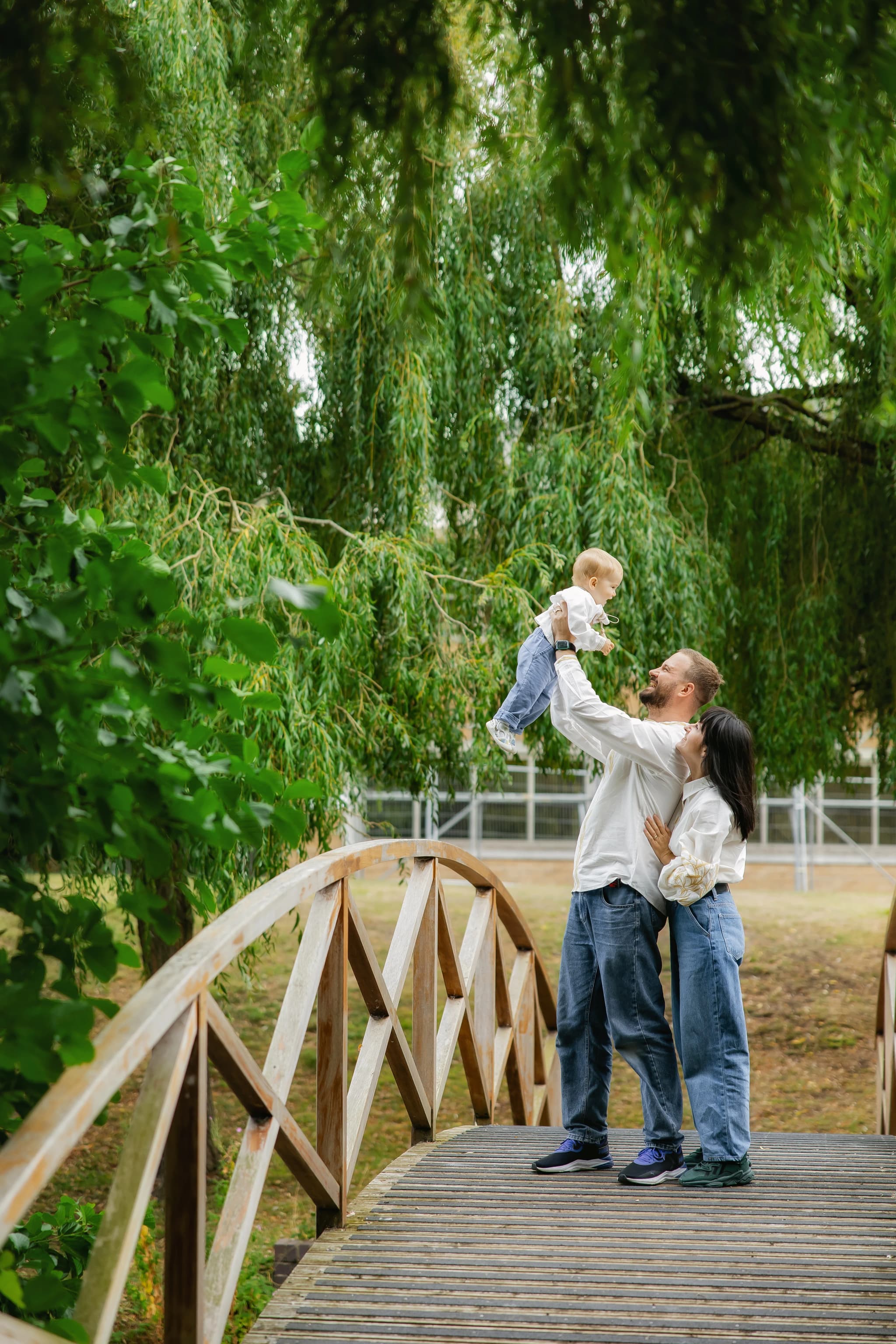
Where a first maternity session might happen in a studio or a single quiet outdoor spot, a second-pregnancy family session generally benefits from somewhere your toddler already feels comfortable and has some freedom to move. Your own home is an excellent option for exactly this reason — a child in familiar surroundings, near their own toys and without the disorientation of a new environment, tends to settle far more quickly than a child taken somewhere unfamiliar. A local park or a garden with some space to run works well too, giving a toddler somewhere to burn off energy between the more posed images.
If you would rather step outside for the session, I am always happy to talk through options around Cambridge that suit families with young children specifically — somewhere with easy parking, flat paths for buggies, and enough open space that a toddler who wants to run does not feel hemmed in. The right location for a family with a toddler is rarely the most dramatic or photogenic spot in the abstract; it is the one where your child can actually be themselves for the twenty or thirty minutes it takes to get the images you will want to keep.
A second-pregnancy maternity session is never going to look like a magazine shoot, and that is exactly the point. It is a record of your family exactly as it is in this particular, fleeting stretch of time — one child, one on the way, and all the ordinary chaos and tenderness of a household about to grow. If you are expecting again and would like to plan a session that makes room for your toddler as they actually are rather than as a photograph might wish them to be, get in touch and we can talk through timing, location, and what will work best for your family.

Yana Skakun
Photographer · England
Professional wedding, family and portrait photographer based in England. Passionate about capturing authentic emotions and timeless moments.
About Yana →second pregnancy maternity shootmaternity photos with toddlerbig sibling maternity sessionsecond baby maternity photography
Maternity — Professional Photography in Cambridge & England
Yana Skakun is a professional photographer based in Cambridge, covering weddings, families, and portraits across England. Every session is personal — planned around your story, your people, and the moments that matter most. This guide — Second Pregnancy Maternity Photos: Including Your Toddler — is part of the photography journal: practical, experience-based advice drawn from real sessions across England. Whether you arrived searching for second pregnancy maternity shoot or maternity photos with toddler, the same care and attention shapes every session Yana photographs.
Professional Photography sessions are available year-round, with bookings open across Cambridge, Ely, Huntingdon, Peterborough, and further afield — East England, London, the Midlands, and beyond. If you have specific questions about big sibling maternity session, mention it in your enquiry. Get in touch through the contact form above to check availability and discuss your session. Enquiries are welcomed from anywhere in the UK.
Frequently Asked Questions
What camera settings should I use for outdoor portraits?+
For outdoor portraits, shoot in aperture priority mode. Use a wide aperture (f/1.8–f/2.8) to blur the background and isolate your subject. Keep ISO as low as possible in good light. In bright conditions, use a neutral density filter or switch to manual to avoid overexposure at wide apertures.
What is the golden hour in photography?+
Golden hour is the period roughly 30–60 minutes after sunrise and before sunset. The sun is low in the sky, producing warm, soft, directional light that flatters skin tones and creates beautiful long shadows. It's widely considered the best natural light for portrait and outdoor photography.
How do you get sharp photos in low light?+
In low light, increase your ISO (accepting some grain), use the widest aperture your lens allows, and slow your shutter speed to the slowest you can hand-hold without camera shake (roughly 1/focal length as a guide). Use image stabilisation if available, and consider a tripod for static subjects.
What is the rule of thirds in photography?+
The rule of thirds divides the frame into a 3×3 grid. Placing your subject on one of the four intersection points — rather than dead centre — creates a more dynamic, visually interesting composition. It's a guideline, not a rule: some of the most powerful images break it deliberately.
How do you edit photos to look professional?+
Professional editing starts with shooting in RAW format. In Lightroom or similar software, correct exposure, white balance, and contrast first. Recover shadow and highlight detail. Apply gentle colour grading for mood. Be conservative with skin retouching — the goal is natural enhancement, not transformation. Consistency across a set of images is what separates professional from amateur editing.
Get in Touch
Ready to Book Your Session?
Get in touch to discuss your vision — I'll reply within 24 hours.