Yana Skakun

Why Midday Sun is Harsh (And How We Fix It for Wedding Photos)
By Yana Skakun·10 July 2026·8 min read
Almost every UK wedding I photograph has a ceremony somewhere between midday and two o'clock, followed by drinks on the lawn, speeches, and a couple of hours set aside for portraits before the wedding breakfast. Which means, more often than not, the best light of the day has not arrived yet and the sun sits almost directly overhead, throwing hard shadows under eyes, carving deep lines under noses, and bleaching out the top of every head in the group. Midday sun is the single most common lighting challenge I deal with as a wedding photographer, and it is worth explaining exactly why it causes problems and, more usefully, what I actually do about it on the day.
What Makes Midday Sun So Difficult
The problem is entirely about angle. Between roughly eleven in the morning and three in the afternoon, especially in the summer months when most UK weddings take place, the sun sits high overhead rather than low on the horizon. Light travelling almost straight down hits the top of a face first, and everything below it — the eye sockets, the underside of the nose, the area beneath the chin — falls into shadow. The result is a set of harsh, unflattering pools of dark under the eyes and a bright, often shiny highlight across the forehead and nose. It is the least flattering angle light can hit a human face from, and it affects everyone, not just people with particular features.
There is a second problem layered on top of the angle issue, which is contrast. Midday sun on a clear day is an extremely small, extremely bright light source relative to the sky around it, which means the difference between the brightest and darkest parts of a scene is much greater than a camera sensor can comfortably record. Expose for someone's face and the sky behind them turns into a featureless white void. Expose for the sky and the same face becomes an underexposed silhouette. Getting both right in a single frame, without additional lighting or careful positioning, is genuinely difficult, and it is why so many midday wedding photographs from inexperienced or unprepared photographers look either flat and grey or contrasty and squinting.
Squinting itself is the third issue, and it is a purely human one rather than a technical one. Ask a group of ten guests to face into bright overhead sun for a group photograph and you will get ten variations of screwed-up eyes and tight, uncomfortable expressions. No amount of technical skill fixes squinting after the fact — it has to be avoided at the point of shooting, which is one of the main reasons positioning and direction matter so much more at midday than at any other time of day.
Finding Open Shade: The Single Most Useful Trick
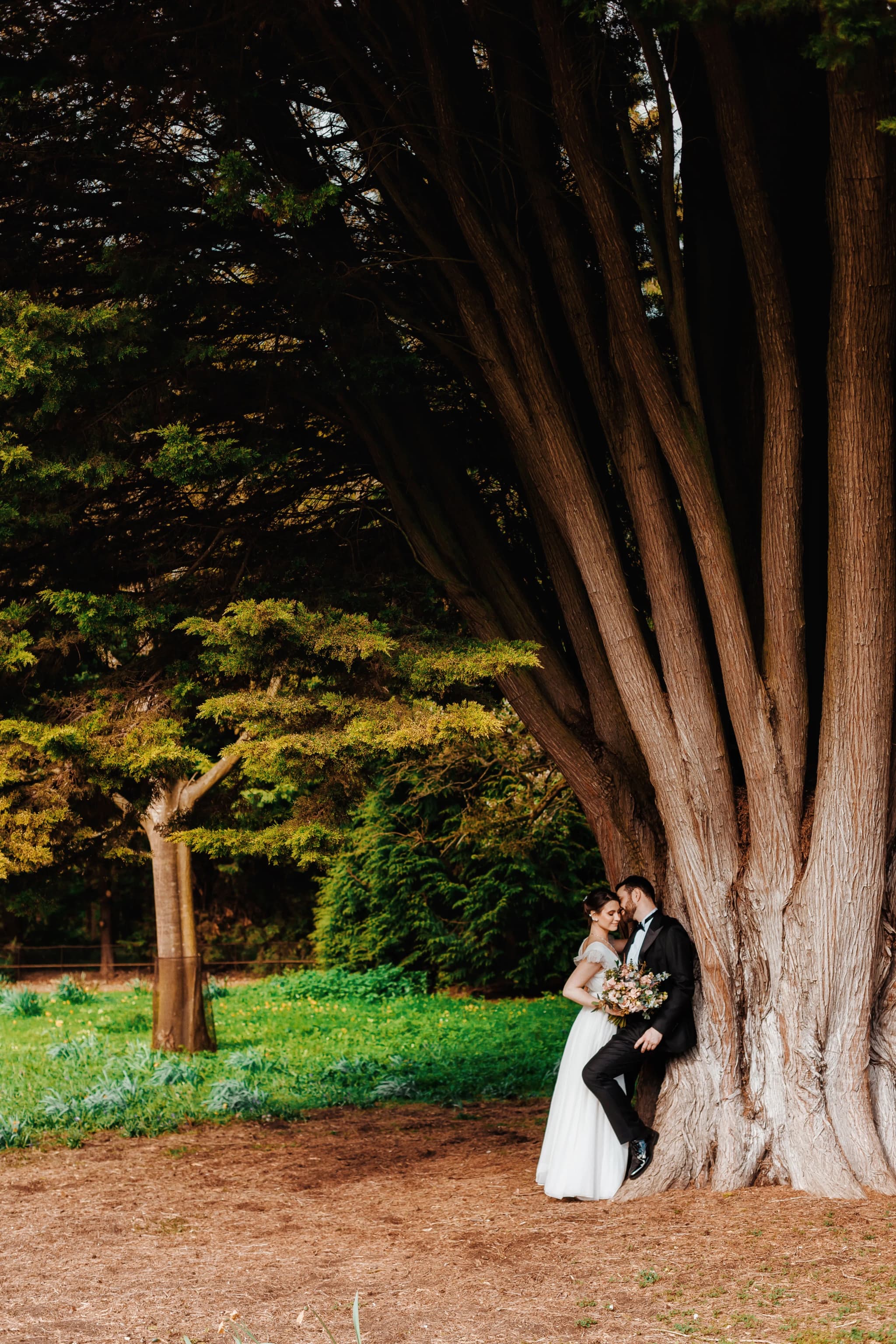
The most reliable fix for midday sun has nothing to do with equipment and everything to do with location scouting. Open shade — the soft, even light found under a large tree canopy, beside a building, or under a covered walkway, where the subject is shielded from direct sun but still facing an open sky — turns harsh directional light into something closer to a giant natural softbox. The shadows soften, the contrast drops to a manageable range, and nobody has to squint. Every wedding venue I work at, I walk before the day itself specifically to identify two or three reliable patches of open shade that will still be in shade whatever time the couple actually steps outside, because shade moves through the day just as sun does.
The key distinction is between open shade and deep shade. Deep shade, such as standing well inside a dense wood or directly under a low, thick canopy, can actually look worse than direct sun because it removes almost all directional light and leaves faces looking flat and slightly muddy, often with a green colour cast from surrounding foliage. What you want is the edge of shade — close enough to open sky that there is still a clear, soft light source lifting the face, but shielded from the direct sun itself. The north-facing side of a building at midday, or just inside the edge of a tree line facing an open field, are both usually excellent.
This is one of the reasons I ask couples, wherever possible, to send me photographs of their venue's grounds in advance, or to walk it with me during planning if they are close enough to Cambridge to do so. Knowing in advance exactly where I will take the couple for portraits regardless of what the sky is doing removes a huge amount of pressure from the timeline on the day itself.
Planning a summer wedding?
If your ceremony falls in the middle of the day, it is worth talking through the timeline before the big day itself. A short conversation about when portraits happen, and where, makes a genuine difference to how the finished photographs look. I am always happy to talk through timing and venue light with couples I am working with.
Get in touchUsing Flash to Overpower the Sun
When open shade genuinely is not available — a marquee wedding on open parkland with no tree cover, or a coastal venue where the couple wants photographs on the beach itself — the alternative is off-camera flash used to overpower or balance the sun. The technique, sometimes called fill flash or high-speed sync depending on the specific approach, involves deliberately underexposing the ambient daylight slightly through camera settings, which darkens and saturates a washed-out midday sky into something with genuine colour and depth, and then adding a burst of flash to properly light the couple's faces so they are not left as dark silhouettes against that now-darker sky.
Done well, this technique produces images that genuinely look like they were taken in beautiful evening light, with rich blue sky, defined clouds, and evenly lit faces, even though the photograph was taken at one in the afternoon. It requires equipment beyond what a single on-camera flash provides — typically a flash on a stand or held by an assistant, positioned off to one side and slightly above the couple to mimic the angle of natural late-afternoon sun — and it requires practice to get consistently right, but it is one of the most useful skills a wedding photographer can bring to a summer wedding with an unhelpful midday schedule.
I carry flash equipment to every wedding for exactly this reason. Even weddings with generally good light and plenty of shade options can throw up a single moment — confetti thrown in direct sun, a group shot on an exposed lawn, a couple portrait the couple specifically requested on an open hillside — where flash is the difference between a photograph that works and one that does not.
Positioning the Couple: Backlighting and Direction
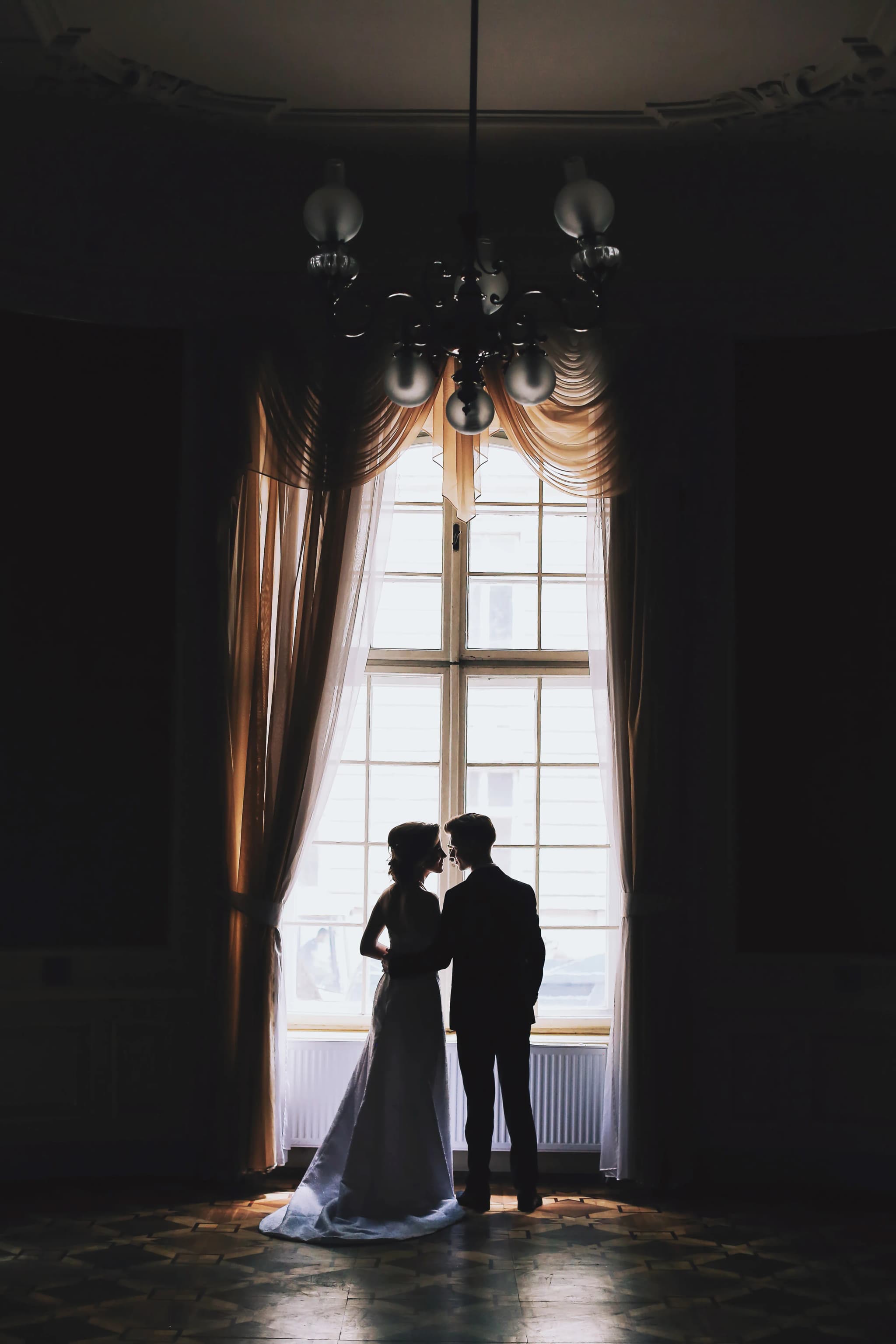
Another approach that works well even without flash is deliberately turning the couple so the sun is behind them rather than in front of their faces. Backlighting at midday puts a rim of light around hair and shoulders and throws the couple's faces into soft, even shadow rather than harsh top-down shadow — the sun is no longer hitting their faces directly at all. The trade-off is that faces then need to be lifted slightly, either with a reflector bouncing some of that backlight back into the face, or with careful exposure and a bit of recovery in editing, but it is a far easier problem to solve than harsh direct top light.
This is a technique I use constantly for couple portraits specifically, as opposed to large group shots, because it only takes two people to reposition rather than fifty guests. Standing the couple with their backs to the sun, finding a slight elevation or a doorway or an avenue of trees that channels the light, and shooting toward the sun rather than with it produces some of the most romantic images from any wedding day, midday sun and all. It is also the technique most likely to catch genuine, relaxed expressions, because nobody is fighting the urge to squint.
For large group photographs, where repositioning fifty people to face away from the sun is not really practical, the priority shifts to finding shade or, failing that, keeping the group photographs brief and functional and saving the more considered portrait work for couple and immediate family shots where shade or backlighting can genuinely be used.
Why Timeline Planning Matters More Than People Expect
The single biggest lever any couple has over their own wedding photographs, more than any camera equipment or editing skill, is when things actually happen during the day. A couple portrait session scheduled for half past four rather than half past one, even by that relatively modest gap of a few hours, can be the difference between fighting harsh midday light and working with soft, warm, genuinely golden light. I build timeline conversations into every planning meeting I have with couples specifically because of this, looking at the order of service, the venue's layout, and the season to work out where there is flexibility to move portrait time later in the day.
Not every couple has full control over their timeline — venues, caterers, and church services often set fixed points that cannot move — but there is usually more flexibility than people assume, particularly around when speeches happen relative to the wedding breakfast, or whether some portraits can be taken during the drinks reception and others held back for early evening. Couples who are planning their day now and want photography considered as part of that planning are welcome to look at how I approach a full wedding day or get in touch directly to talk through their specific venue and timeline.
For couples marrying somewhere without a formal reception structure at all — an intimate ceremony followed by a meal for a handful of people, or an elopement with just the two of them — the flexibility is even greater, and I will often suggest splitting the day so that the ceremony happens at a legally convenient time but the main portrait session happens separately, later, when the light has turned properly golden.
What This Means for Your Wedding Day
None of this means a midday ceremony ruins your photographs — it genuinely does not, and the vast majority of UK weddings happen in exactly this slot because it suits guests, venues, and caterers. What it means is that a photographer who knows the venue, understands where the shade will fall at each hour, carries flash equipment as a backup, and has spoken to you about the timeline in advance can produce images from the harshest hours of the day that look every bit as considered as the golden hour portraits taken later on. The technical challenge of midday sun is well understood and thoroughly solvable — it simply requires planning rather than improvisation.
If you are choosing a wedding photographer and your ceremony sits in that midday window, it is worth asking directly how they plan to handle the light. It is a fair, sensible question, and the answer tells you a good deal about how much thought goes into the rest of the day's coverage. Once the images are captured well regardless of the hour, the final results — whether displayed as prints or gathered into an album — should look considered and consistent from the ceremony steps at noon through to the last dance at midnight.
Every wedding I photograph gets this same attention to light and timing, whatever hour the ceremony happens to fall at. If you would like to talk through your venue, your timeline, or how midday light might affect your specific day, get in touch — I am always glad to talk it through before the day itself, at Yana Skakun Photography, so there are no surprises when it matters most.

Yana Skakun
Photographer · England
Professional wedding, family and portrait photographer based in England. Passionate about capturing authentic emotions and timeless moments.
About Yana →midday sun wedding photosharsh light wedding photographywedding timeline planningopen shade photographyoff-camera flash weddingsUK wedding photographer tips
Photography Tips — Professional Photography in Cambridge & England
Yana Skakun is a professional photographer based in Cambridge, specialising in wedding, family, and portrait photography across England. Every session is personal — planned around your story, your people, and the moments that matter most. This guide — Why Midday Sun is Harsh (And How We Fix It for Wedding Photos) — is part of the photography journal: practical, experience-based advice drawn from real sessions across England. Whether you arrived searching for midday sun wedding photos or harsh light wedding photography, the same care and attention shapes every session Yana photographs.
Professional Photography sessions are available year-round, with bookings open across Cambridge, Ely, Huntingdon, Peterborough, and further afield — East England, London, the Midlands, and beyond. If you have specific questions about wedding timeline planning, mention it in your enquiry. Get in touch through the contact form above to check availability and discuss your session. Enquiries are welcomed from anywhere in the UK.
Frequently Asked Questions
What camera settings should I use for outdoor portraits?+
For outdoor portraits, shoot in aperture priority mode. Use a wide aperture (f/1.8–f/2.8) to blur the background and isolate your subject. Keep ISO as low as possible in good light. In bright conditions, use a neutral density filter or switch to manual to avoid overexposure at wide apertures.
What is the golden hour in photography?+
Golden hour is the period roughly 30–60 minutes after sunrise and before sunset. The sun is low in the sky, producing warm, soft, directional light that flatters skin tones and creates beautiful long shadows. It's widely considered the best natural light for portrait and outdoor photography.
How do you get sharp photos in low light?+
In low light, increase your ISO (accepting some grain), use the widest aperture your lens allows, and slow your shutter speed to the slowest you can hand-hold without camera shake (roughly 1/focal length as a guide). Use image stabilisation if available, and consider a tripod for static subjects.
What is the rule of thirds in photography?+
The rule of thirds divides the frame into a 3×3 grid. Placing your subject on one of the four intersection points — rather than dead centre — creates a more dynamic, visually interesting composition. It's a guideline, not a rule: some of the most powerful images break it deliberately.
How do you edit photos to look professional?+
Professional editing starts with shooting in RAW format. In Lightroom or similar software, correct exposure, white balance, and contrast first. Recover shadow and highlight detail. Apply gentle colour grading for mood. Be conservative with skin retouching — the goal is natural enhancement, not transformation. Consistency across a set of images is what separates professional from amateur editing.
Continue Reading
Related Articles

Photography Tips
Photography Gift Vouchers: The Most Personal Present You Can Give
5 min read · Read Article
Photography Tips
Photo Books vs Photo Albums: What Is the Difference and Which Is Better?
5 min read · Read Article
Photography Tips
Photo Gift Ideas: Turning Professional Images into Meaningful Presents
5 min read · Read Article
Get in Touch
Ready to Book Your Session?
Get in touch to discuss your vision — I'll reply within 24 hours.