Yana Skakun

Who Walks You Down the Aisle at a Vow Renewal?
By Yana Skakun·10 July 2026·7 min read
It is one of the first questions couples ask once they have decided to have a vow renewal, and it is usually asked with a slightly puzzled laugh: "Wait, who actually walks me down the aisle this time?" At a wedding, the answer feels obvious — a father, a parent, whoever is giving the bride away. At a vow renewal, the entire premise is different. You are already married. Nobody is being given away. And yet the walk down the aisle remains one of the most emotionally loaded moments of the day, the bit everyone tears up at, the bit I position myself for well in advance because I know it is coming. So the question deserves a proper answer, not just a shrug and "whatever you fancy."
There Is No Rule — and That Is the Whole Point
A first wedding carries centuries of inherited tradition, some of it meaningful, some of it just inertia. A vow renewal carries none of that baggage unless you choose to bring it along. Nobody is required to be "given away" because the giving away already happened, sometimes decades ago. This means the aisle walk at a vow renewal is genuinely open territory, and most of the couples I work with find that liberating once they stop looking for the rulebook and accept there isn't one.
What I have seen work, across renewals ranging from quiet garden ceremonies to full-scale parties, is that the walk tends to reflect whatever the marriage has actually been about. Couples who have built their life as a genuine partnership often walk in together, side by side, because that is a more honest representation of the last however-many years than one of them being escorted by someone else. Couples who want to recreate the emotional beat of their original wedding day sometimes ask a parent to walk them down again, particularly if that parent was too unwell or too far away to be there the first time and this is a chance to do it properly. There is no wrong version of this, and I would gently push back on anyone who tells you there is.
Walking In Together
This is by far the most common choice I photograph at vow renewals, and honestly it is my favourite to shoot. There is something quietly powerful about two people who have already built a life together choosing to walk into the ceremony as equals, side by side, rather than one arriving to meet the other. It sidesteps the entire "giving away" framework, which many couples feel increasingly uncomfortable with even at first weddings, let alone a renewal where it makes even less logical sense.
Photographically, walking in together gives me a genuinely different set of images than a traditional processional. Instead of one person walking towards a fixed point while the other waits and watches, I get two people looking at each other, laughing, holding hands, sometimes stopping halfway because someone has said something that has set the other one off. Those in-between moments — the ones that happen because nobody is following a strict choreography — are consistently the images couples tell me they love most when the gallery comes through.
If you go this route, my only practical advice is to actually practise it once, even just walking from one end of the garden to the other the morning of. Not because it needs choreographing to death, but because couples who have never walked arm in arm down an aisle together sometimes feel oddly self-conscious the first time, and doing one dry run removes that awkwardness before it shows up on camera.
Being Walked By Children
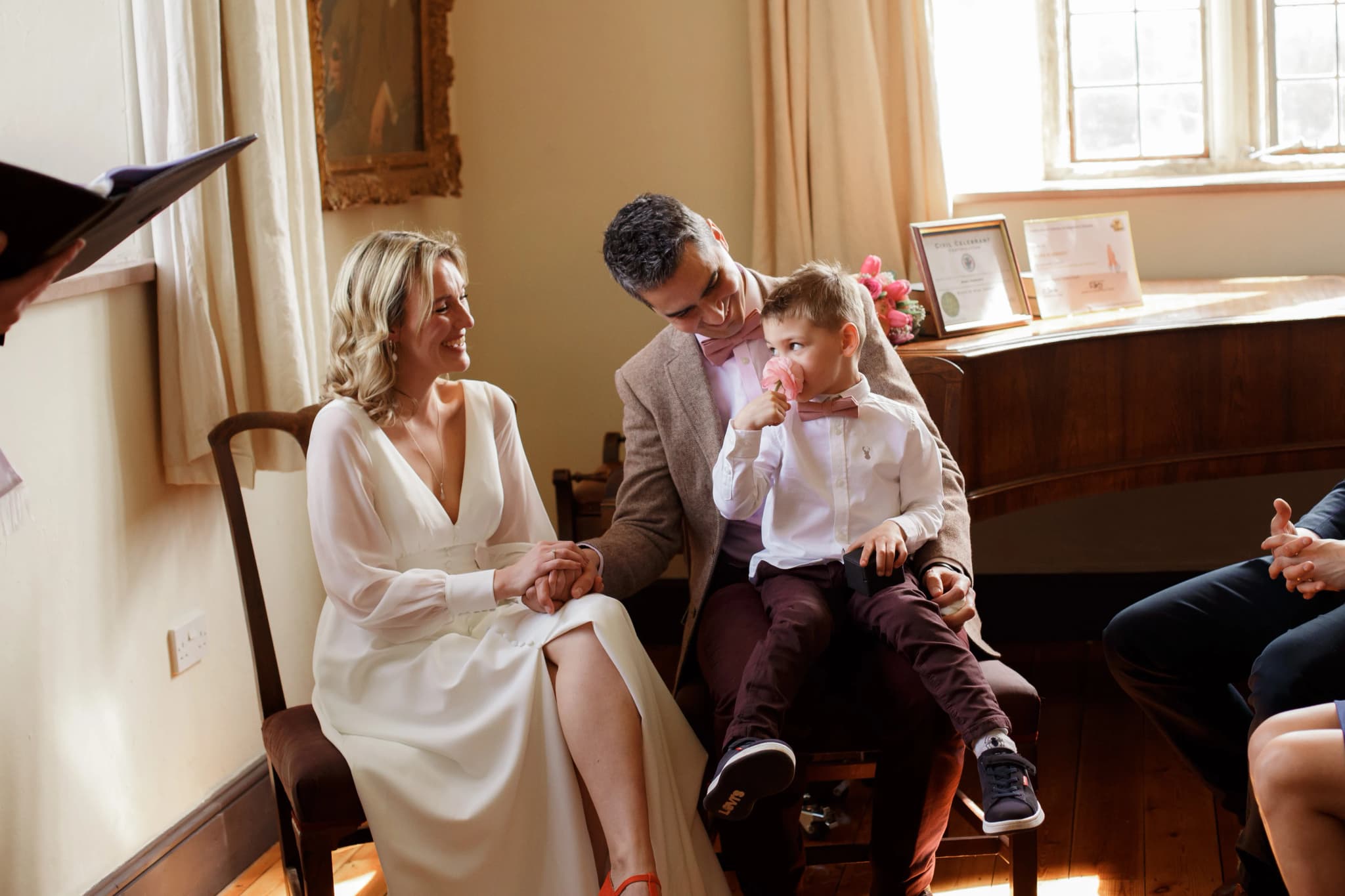
For couples who have had children since their original wedding, being walked down the aisle by those children is one of the most moving choices available, and I would put it just behind walking in together as the option I photograph most often. It reframes the whole moment: this isn't about a parent handing a child over to a spouse, it is about a family that exists now walking into a celebration of the marriage that created it. Small children can be walked hand in hand between both parents. Older children and teenagers can escort one parent each, or take it in turns. Adult children, in cases where a couple is renewing vows after thirty or forty years, sometimes walk both parents in together, which tends to be the moment that undoes an entire congregation.
The practical caveat with young children is pacing. A five-year-old walking down an aisle with a parent will not walk at the same measured pace an usher would coach an adult through, and that is genuinely fine — a child skipping, or stopping to wave at a grandparent, or needing a hand held a bit tighter than planned, produces far better photographs than a forced, adult-paced procession would. I always tell parents not to over-rehearse this one. The charm is in the imperfection.
Recreating the Original Walk
Some couples want the opposite of reinvention — they want to recreate exactly what happened on their wedding day, right down to who walked them in. This is common when a renewal is being held specifically to mark an anniversary milestone and the emotional pull is nostalgia rather than reinvention. If a father walked the bride down the aisle in 1996, plenty of couples want that same father, now thirty years older, to do it again in a way that consciously echoes the original.
These recreations carry real weight when the person who walked them the first time is elderly, or when the original walk happened somewhere the couple can no longer access — a childhood church since deconsecrated, a family garden long since sold. Recreating the walk, even imperfectly, in a new setting becomes a way of honouring both the original day and the passage of time since. If you are planning this, it is worth telling me in advance, because I will often ask to see a photograph from the original wedding so I can echo the framing or angle deliberately, which is a small detail but one that means a great deal in the final gallery.
Not sure yet? That is completely normal
Most couples I talk to at the planning stage have not decided how they want to walk in, and that is absolutely fine — it is often one of the last details settled, sometimes only in the final week. I am happy to talk through what has worked for other renewals I have photographed and help you think about what actually reflects your relationship, rather than what tradition says you should do.
Get in touchBeing Walked By a Friend, a Sibling, or Someone Who Was Not There First Time
This is worth naming because it comes up more often than people expect: sometimes the person who matters most to walk you down the aisle at a vow renewal is not a parent at all. A best friend who has been through everything with you. A sibling who has become far closer in the years since the original wedding. Someone who was not part of your life at all when you first married but has since become central to it. A vow renewal, unlike a wedding, is not bound by the assumption that this role belongs to a parent by default, and I have photographed renewals where the walk was done by a best friend of thirty years, by an adult sibling, and once by a beloved family dog on a lead held by a delighted nine-year-old. All of them were exactly right for the couple involved.
If someone significant has passed away since the original wedding, some couples choose to walk with an empty space beside them, or carry a small item — a photograph, a piece of jewellery, a folded handkerchief — that represents that person's presence. I mention this gently because it is a choice I have seen bring real comfort, not something that needs to be sad or heavy. It simply acknowledges that not everyone who mattered at the first wedding is still here for the renewal, and that is allowed to be part of the day too.
What This Means for How I Photograph the Walk
Whoever is walking you in, the practical photography considerations are broadly similar, but the emotional beats I am watching for shift depending on who is involved. When a couple walks in together, I am watching the space between them — hands, glances, the moment one of them notices the guests and reacts. When children are walking a parent in, I am watching the child's face as much as the parent's, because that unguarded, proud expression on a seven-year-old is often the single best image of the day. When it is a recreation of an original walk, I try to find an angle that echoes the old photograph without being a slavish copy, because the point is connection across time, not a perfect duplicate.
I always ask couples, during planning, to walk me through exactly what they are picturing for this moment, because it changes where I stand, what lens I reach for, and whether I position a second camera to catch guests' reactions as well as the walk itself. This is the kind of detail that gets covered properly during a planning call, alongside timeline and location questions, and it is one of the reasons I encourage every couple booking a renewal to have that conversation with me well ahead of the day rather than leaving it to be worked out on the morning.
A Few Practical Notes for the Day Itself
If more than one person is walking you in — say, two children on either side, or a spouse and a parent for a joint entrance — do one brief practice walk the morning of, purely for logistics rather than performance. Work out who stands where, which side people are on relative to the aisle, and where exactly the walk ends so nobody is unsure at the actual moment. Keep the pace slow. Almost every couple I have ever photographed has walked faster than they intended on the day itself, purely from nerves and adrenaline, so if anything, aim to walk slower than feels natural in rehearsal.
If you are hoping for a particular photograph — the two of you walking in hand in hand with a specific backdrop, or a wide shot that includes the whole aisle and all the guests standing — mention it in advance rather than assuming it will happen automatically. I build a loose shot list for every renewal I photograph based on exactly these conversations, and the walk down the aisle is always near the top of it, because it is one of those moments that cannot be recreated afterwards if it is missed.
There genuinely is no single correct answer to who walks you down the aisle at a vow renewal — the honest answer is whoever reflects the life you have actually built together since the first time you did this. Whether that is a partner walking in beside you, children either side, a parent doing it again three decades later, or a friend who has earned the role in ways a stranger to your story never could, the moment works because it is true to you rather than borrowed from a tradition that was never really written with renewals in mind. If you are planning a vow renewal and want to talk through how the ceremony, and that walk in particular, might come together, I would love to hear from you — you can see more of how I approach these celebrations across my wedding photography work, take a look at pricing for renewal coverage, and browse wedding albums for a sense of how these days are told as a finished story. Get in touch through my contact page and let's talk about your day — I'm Yana Skakun, and I'd be honoured to be there for this one too.

Yana Skakun
Photographer · England
Professional wedding, family and portrait photographer based in England. Passionate about capturing authentic emotions and timeless moments.
About Yana →vow renewal aisle walkwho walks you down the aisle vow renewalvow renewal ceremony ideasUK vow renewal photographerwalking down aisle togethervow renewal traditions
Wedding Tips — Wedding Photography in Cambridge & England
Yana Skakun is a professional wedding photographer based in Cambridge, covering weddings across England — from intimate elopements to full-day ceremonies at country houses, barns, and city venues. Every couple receives a relaxed, documentary approach that captures the day as it truly unfolds. This guide — Who Walks You Down the Aisle at a Vow Renewal? — is part of the photography journal: practical, experience-based advice drawn from real sessions across England. Whether you arrived searching for vow renewal aisle walk or who walks you down the aisle vow renewal, the same care and attention shapes every session Yana photographs.
Wedding Photography sessions are available year-round, with bookings open across Cambridge, Ely, Huntingdon, Peterborough, and further afield — East England, London, the Midlands, and beyond. If you have specific questions about vow renewal ceremony ideas, mention it in your enquiry. Get in touch through the contact form above to check availability and discuss your session. Enquiries are welcomed from anywhere in the UK.
Frequently Asked Questions
How much does a wedding photographer cost in England?+
Wedding photography in England typically ranges from £1,500 to £4,000+ for a full day. Price depends on experience, coverage hours, and whether albums or engagement shoots are included. Most photographers charge between £2,000–£3,000 for 8–10 hours of coverage.
How early should you book a wedding photographer?+
For peak season (May–September), book 12–18 months in advance. For autumn and winter weddings, 9–12 months is usually sufficient. Popular photographers at popular venues fill up fast — as soon as you have a date and venue confirmed, start reaching out.
How many photos do you get from a wedding photographer?+
Most professional wedding photographers deliver 400–800 edited images for a full-day wedding. The exact number depends on coverage hours, how many guests there are, and the photographer's editing style. Quality matters more than quantity — a curated gallery of 500 images tells the story better than 1,500 unedited files.
Do you need a second photographer at your wedding?+
A second photographer is helpful if you want simultaneous coverage of getting-ready moments in different locations, multiple angles during the ceremony, or more candid coverage during the reception. It adds cost but significantly increases the variety and completeness of your gallery.
What is the difference between documentary and editorial wedding photography?+
Documentary (reportage) wedding photography captures moments as they happen — the photographer observes and doesn't intervene. Editorial photography involves deliberate direction: placing you in good light, shaping compositions, creating intentional portraits. Most photographers blend both styles throughout the day.
Continue Reading
Related Articles

Wedding Tips
Sustainable Eco-Friendly Wedding Guide — Planning a Green Celebration
15 min read · Read Article
Wedding Tips
Trash the Dress Session — Complete Planning and Photography Guide
14 min read · Read Article
Wedding Tips
Client Communication for Photographers — From Enquiry to Gallery Delivery
15 min read · Read Article
Get in Touch
Ready to Book Your Session?
Get in touch to discuss your vision — I'll reply within 24 hours.